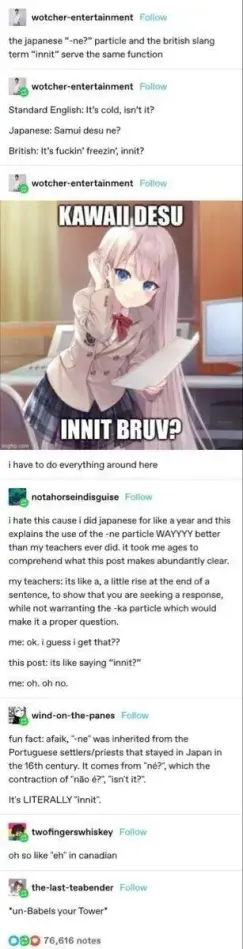
Simple explanation, innit?

https://lemmy.dbzer0.com/post/65848685

In lithuanian we have “ane?” which is a shortening of “ar ne?” which is “or no?” so basically “isn’t it?” as well :3
TIL “isn’t it” is the linguistic equivalent of fried dough
The human need to ask for clarification strikes everyone lol
You mean elephant ears?
Or beaver tails?
And doughnuts, zeppoles, you tiao, beignets, funnel cakes… I would really love it if everybody would dogpile on here with their own fried dough traditions
Just gonna throw in varškės spurgos, and žagarėliai, and skruzdėlynas… and actually I could keep going for a bit with fried dough foods I think lol
Don’t hold back!

In Dutch some people often use “ofnie” which is short for “of niet?” Which means “or not?” so “isn’t it?” as well

I bet many languages have something similar.

Japanese speakers, is this accurate?
Japanese had it before the Portuguese came along, but it probably didn’t help.
Yeah, I was just thinking there’s no way that etymology is true. Ne is part of a whole class of these particles and appears in combinations to form even more specific “response-inviting” markers. A loanword for some traded good I’d believe, but not a grammatical feature like this, especially not because the Portuguese missionaries weren’t all that popular in Japan.

Yes, it’s a part of speech that’s formally in the standard language.

In English it’s slang.

Japan has né??? Wtf was Portugal doing over there? Side quests?