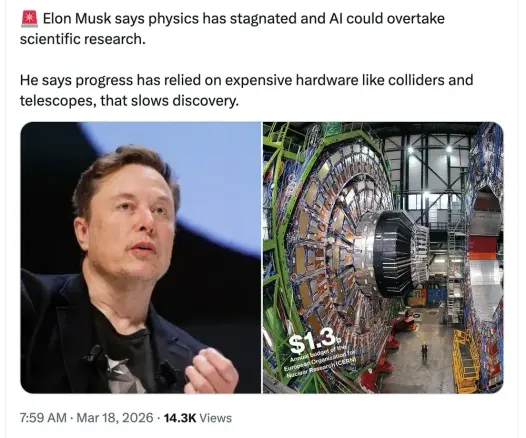
I keep seeing versions of this post, which imply a bizarre misunderstanding of how we know the world.

Do people imagine that if we'd never observed galaxies or neutrinos or exoplanets or the cosmic microwave background, we could have *imagined* these things & that would be just as real?

Or that we've magically reached the point, just now, where we no longer need to observe the world?

#science #nature #technology

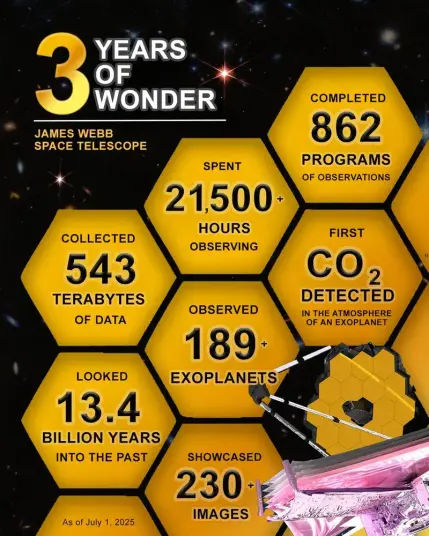
I also have to point out that the most expensive space telescope (JWST) cost about $500 million/year. We spent 1000x that much on AI development in 2025.

Data collection is essential for discovery...and it's remarkably cheap compared to many other things we do routinely.

#science #nature #history #tech

I've also seen smart people tie themselves into knots trying to defend the original claim.

"He just means big science is expensive."
"He just means that AI can help with data analysis."
"He just means that string theory is a dead end."

But that is not the claim, and the efforts to justify it only make the argument even stranger.

@coreyspowell well, for analysis of ever increasing amount of astronomical data, some kind of automation is needed anyway. So maybe it would be better use of AI, than all this chatbot nonsense.

The huge colliders are special case, that now there is AFAIK no special prediction in physics, which can be confirmed or falsified at higher energies. Somehow it is probably not the direction to find any new physics (which would be cool). Also the dark matter detectors are somehow infamous as spending huge amount of money for (predictably) finding nothing.

The situation in astronomy is very different and of course we need new telescopes and new ideas for telescopes. Lot of them would have to be placed in space, probably.

So, somehow the discussion "what next in science" makes sense, and I would not probably bet on particle colliders to be the right answer. Still, over-relying on LLM-líke AIs si ridiculous. Of course, science needs new (not necesarily "more") empirical data and also, for huge amounts of data, some automation to process them.

@xChaos @coreyspowell Astronomers have been using automated data systems for years and these work very well at finding patterns in data. These are not general programs but finally honed analysis software. The issue is, and always has been, to work out what you want to look for. This always needs human intervention and I doubt very much whether any LLM would contribute anything beyond what we put into it.

As you say new telescopes are needed but I would not rule out the wish for a new larger collider. There is still a lot of good science to be done at higher energies even without any new major findings. Although I suspect there are some things lurking out there....

In all cases the cost will be high but relative to the cost of all the weapons expanded in the last few weeks it's not that big.

What's next in science is always a problem when the question tries to pit one side of science against another. You simply have no idea where the next breakthrough comes from. My bet is somewhere in biology and brain science.

If it were me and here we are talking physics I would scrap all manned spaceflight and put that money into science missions and telescopes as well as basic science.

@SamanthaJaneSmith @coreyspowell I am fan of manned spaceflight, but maybe, the funding should be different from science. Manned spaceflight is more or less extrapolation of great voyages, mountain climbing, polar expeditions, and such. I would compare it rather with great sport events... excepts is too ambient (most of the time) and the risks are of different type then risks undertaken in sports, so the funding model of great sport events would not work. It attracts attention of few people and in different way.

The TV show paradigm is definitely more worth replacing, than science.

But when talking about understanding universe, both large and small... you know, I am not scientist, just huge fan of science and history of science, but on amateur basis. It is exciting to invent concepts about how the universe works and be able to do something new, based on these new concepts. Sometimes, save lives.

The intuition, that there may be more to learn when looking at night sky at higher and higher resolutions and more frequency bands, than by smashing particles together at higher and higher frequencies is maybe wrong, who knows.

Definitely, trying to guess things without any input data means doing pure math. You can construct mathematical objects without input data... but why?

There was this strange case of string theory in physics, which thrived even without predicting any observation or suggesting any experiment. No future collider would prove or disprove this. Some theories are too far off....

I feel like there are two major approaches in natural sciences: one is this belief, that if mathematical object is possible, it simply exists somewhere in nature (so we see all this spirals and ornaments in plants, and so on) and the second approach is statistical analysis of gathered data.

Human language is not mathematical object, but LLM AIs somehow treat it as if it was. I seriously doubt, that searching through "all possible conversations" can replace science...

@xChaos @coreyspowell Hi again. The problem with manned spaceflight is that it sucks out the funding from the science program and tbh it is not good value for money. It may be "adventurous" but is that what taxpayer money should be spent on? I think not.

So theories in science are only theories if they are testable otherwise you have beliefs. (this is why the existence of a "god" is a belief - it can't be proved). So progress in science relies on (a) theories that can predict observable data you can observe either now or in the future (b) data to test these theories on or develop new ones from. These go hand-in-hand. Either data or theory may start a new field of research.

So lots of people do construct theories based on mathematical constructs only. Some may become useful some may not. Not all mathematically possible objects can exist or do.

No, you intuition about looking in more detail or different bands is correct which I why I believe they will build more colliders.

Not sure you are right about string theory tbh. It was a candidate for the strong force but it didn't work - however, it did seem to open possibilities for gravity. So it was actually trying to explain a physical phenomena. It is still very much in the - not sure phase of whether this works - but do remember that it is trying to explain the fundamental nature of the world which is observable..... it did however seem to provide some help in some very esoteric ideas that have implications in the real world. But these are way beyond my understanding as I am not a particle physicist or string theorist.

Sammi

@SamanthaJaneSmith @coreyspowell well, I don't generally want to argue. I am not really scientist, partly for dumb reasons, which I regret now, partly simply because the required decisions would be needed at age, when I was not ready for it, may it was about the era our country was going through... I was too much hypnotized by "informatics" taking over everything. It was the mindset, which finally resulted in current LLM bubble, RAMageddon, etc. But I did not have enough concentration and focus anyway. Who knows, what could I focus on, if there was no programming around.

But I am fan of basic research and scientific knowledge. The "manned spaceflight vs. science funding" is mostly artificial political dilemma, and it could be compared to competitive sports vs. availability of some sport activity for public. There can be synergies on many levels.

You could argue, that particle colliders suck funding from other fields of basic research. Sometimes you just bet on certain direction of research and sometimes you spend money finding nothing. Eg. manned spaceflight, while basically just publicity stunt, would be probably better investment, than some attempts on dark matter detection. Maybe better publicity stunt, than "please give us money, so we can find nothing and prove it". I mean, there are worse scams, but sometimes, finding nothing with high level of signifixanxe is not the best message for general public, while cool space selfie may be much better message  

I don't want to join the general speticism about physics, which may be even somehow encouraged by climate change deniers. There are some parts of physics, which can be locally tested and are well known and probably won't be disproved any time soon. But at the same time, I would definitely invest into fine tuning of technologies for storing energy, instead of building larger collider. Sorry. There are real technological needs with political consequences...

@SamanthaJaneSmith @coreyspowell as for the string theory... I really understand just the very basic idea (and maybe not even enough) but it somehow reminds me of the original idea of "asking AI about how the world works and not really needing empirical data".

But of course... eg. atomic bomb was basically pure theory, gone "boom" when implemented. This was also the moment, when science started to be somewhat suspicious activity...

There were many attempts on trying to fugure out "how the things must work". Theory of knots in the 19th century turned out to be dead end... and yet they were quite sure, that they will predict properties of atoms! (The knots theory and string theories seem to be distant cousins).

You know, I am maybe more informed about the history of science ("wikipedia syndrome"), than recent developments  

I am basically very anti-LLM, because we can expect lot of people "educated" by talking with chatbots... and they would believe crazy things. But sometimes, there really may be occasional "nobody told them, that it can't work" effect.

Sometimes, you really need certain (but not too high) level of ignorance, that something is generally considered impossible (but not too much and not as repeated attempts and not when people's life are in danger...).

But also, scientific discoveries and technological inventions are not the same thing... but public likes to confuse them and it is also often misused as reason for funding... which is really oversimplification... like, lack if understanding, how society works...

@xChaos @coreyspowell I don't think that is true what you say about string theory. It may well be wrong but it was an attempt to solve some issues in the strong force. I don't think it's like LLMs at all.

Science works on dead end theories! There are millions of them and always will be. That is the way science works.

Science is not suspicious, its use is. The theories about nuclear reactions were not about bombs to start with.

I also disagree about ignorance, being ignorant doesn't help. What does is asking questions...

Yes, people confuse science and technology but all technology comes from science. The main problem today is the gap between science and technology. Science is generally government funded while technology is generally private so the gap is in the transfer between the two.