 Ek-Hou-Van-Braai
What would you change?
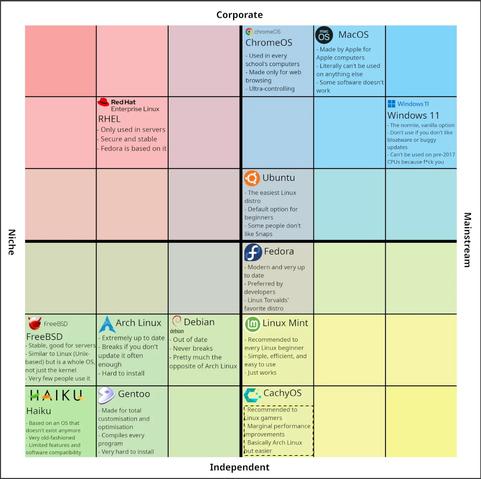
It’s not more hassle than updating other distros after one year, cause they’ll throw a whole new major version at you. Here’s Debian’s upgrade instructions for a comparison:
www.debian.org/releases/…/upgrading.en.html
What I wrote fits in a 6 line bash script, and there are much more sophisticated ready-made updaters available, too.
This is all entirely theoretical.
If you mean the system being screwed over by a dependency on a newer lib version, I’ve had that exact scenario triggered multiple times in Debian testing.
FancyApp depends on libbutt >= 1.1. You have 1.0 installed.
libbutt 1.1 was compiled against glibc 2.43 and lists it as a dependency. You have 2.42.
Upgrading glibc triggers reinstalling half of the system, including low-level components, which in turn pull in updates of other low-level components that don’t themselves depend on glibc. Including the kernel.
Arch only breaks if you don’t read the wiki.
Finally found the ultimate reason why I’m not gonna use Arch.
My Arch install yesterday:
That’s a nice Kernel you have there, it would be a shame if something happened to it.
It somehow deleted the old kernel image from the boot partition but failed to write the new one (and I didn’t notice before rebooting).
I needed to rebuild the kernel via chroot from a live USB.
 Pommes_für_dein_Balg
 QuinnyCoded
 Hazel
Hazel rapchee
 Digit
Digit Klajan