 Dubious Blur
 Tryst 🏴 🇮🇪

Assuming that TGV speed records continue to increase linearly, they'll achieve Mach 1 in 2092.
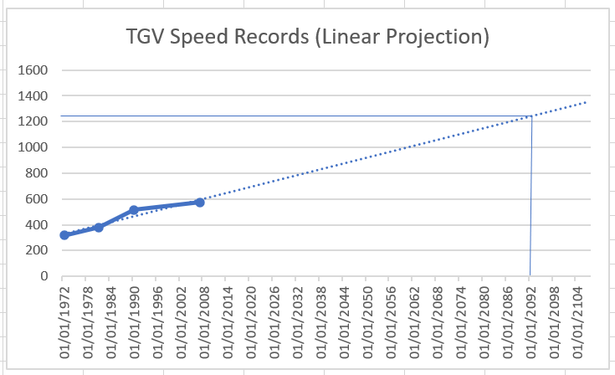
Assuming that TGV speed records continue to increase linearly, they'll achieve Mach 1 in 2092.
@tryst OFC the problem would be to have sufficient lenght test track to safely accelerate and decellerate.
Also ground-level supersonic would be lethal as the sonic boom would create a 165dB shockwave for 1km and 130dB for 2,5km, so not possible.
As of now JR reached >500km on MAGLEV and had two trains pass each other at that speed each...
@tryst pretty shure the problem isn't getting there faster, but that #SNCF runs out of testing track lenght.
586 km/h is propably the fastest on conventional rail due to the exponentially higher demands for accuracy and smoothness of the tracks and if this was a feasible average speed, basically any point in mainland France would be reachable from Paris in less than 2 hours.
@thias @tryst I mean, there's a reason the fastest regular services with dedicaded tracks run ar 320+ km/h top:
It's just neither economical nor feasible to go faster beyond "clout"...
Above 50km/h tracks curves need banking.
Above 100km/h level rail crossing are a no-go.
Above 125km/h concrete bars instead if wood pillars are needed to keep the rails parallell.
Above 130km/h a train is not permitted to pass through a station next to a platform, but needs at least a track if distance (or a wall) to seperate bystanders from it.
Above 150km/h any mixed use won't work due to slower trains causing traffic jams
Above 200km/h the tracks need to be on concrete beds since air turbulence could lift up smaller rocks and turn them lethal for bystandard.
Above 250km/h fencing & wildlife overpasses are necessary to enshure neither deers nor boars get turned into lethal hazards or at least turned into a red smear along several kilometers of track when they face the gront-end.
Above 300km/h Wind noise becomes such a big problem that mandatory distances to homes are needed even with walls to reduce the noise.
Above 350km/h most electrical rail systems can"t supply trains with the necessary power from non-steered pantographs on regular overhead lines and require higher voltages beyond the 15-25kV used in most systems.
Above 400km/h tolerances for tracks and overhead lines make them costly beyond economical.
@thias @tryst Granted, Gotthard Base Tunnel was designed with that in mind including specifically having yards and switching infrastructure at both ends whilst also optimizing use by basically auctioning off capacity to the highest bidder, thus incentivizing constant peak efficiency load.
 Bruno Girin
 Bart de Groot
 Kevin Karhan
 The Micro Channel
 Phil M0OFX
 JamesB
 Kevin Karhan
 🔏 Matthias Wiesmann