#neoliberalism #adulting
@RichBartlett Existential: Authoritarianism has always been the dominant global order since the advent of agrarianism. Even today it is the norm in most of the world and democracy is an anomaly. Standing up to the status quo, the global force of authoritarianism is ludicrous in its own right. Be that chaotic force of joyful lunacy, to put a thumb in the eye of authoritarianism knowing full well what a ridiculously massive task this is, and you may never see it in your lifetime but the long term impact is worth it.
/4
@RichBartlett my current coping strategy for the impotent rage at the current state of our world and the utter failure of our political and social systems to do anything effective or even allow anything effective to be done.
Is to dress up in an inflatable bear costume and dance at protests.
It is effective as street theater, but whether street theater does anything in the current context is a question.
Activism.
I uh... I actually spend a fair bit of time dissociating.
I dunno that it's a _good_ thing but... Yeah, I'm out of it a lot. I have _rage_ cycles. I spit fury into the interwebs ether. Sometimes it helps when folks respond, sometimes not.
Sometimes, I laugh when I don't want to cry.
Sometimes, I cry.
@RichBartlett I cope by trying to get involved with changing things, even if it doesn't always end up working. Being a visible audible, conscious objector.
But yeah, it still gets me down sometimes and it's frustrating. It's hard being the "Debbie Downer" all the time π .
@RichBartlett thank you so much for asking this question. I am gobbling up ppl's replies.
For myself:
1) any kind of movement helps gets that rage buildup out of my body
2) using that anger to fuel momma-bear protectiveness for those more vulnerable than me
3) even small acts of rebellion help me feel I still have power
4) anger is protective, so when rage is off the hook I am probably feeling worn out and vulnerable - rest, reach out, recharge
@RichBartlett @vlrny we are all doing what we can, within our means. In addition, I find it makes a big difference, to me, to have regular zoom checkpoints w. like-minded friends.
βͺ Monday: cowork with C. We use Pomodoro timeboxes for important things we'd otherwise procrastinate on.
βͺ alternate Sundays: sit & quietly art journal & chat with friends near & far.
βͺ alternate Fridays: end of week unwind with a dear colleague.
These keep me anchored, let me vent, keep us all human & softer. πβ€
@RichBartlett It goes in waves for me. Sometimes I can cope hoping things will be better later and try to focus on improvibg myself and otger times I just can't cope and have a meltdown.
I have been lucky enough though recently to find a local business that needs IT help, so I have a way to make money without directly helping billionaires.
@RichBartlett i'm not sure this is a solveable problem. i think everything at the individual or household level can just be mitigated.
what i did learn a long time ago is that rage is an unsustainable energy source.
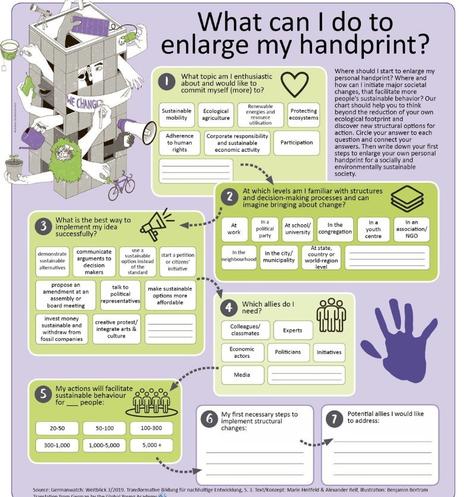
For the rage against the state of the world, I can offer the handprint concept:

Attached: 1 image Many people share your feelings. Our societies are facing environmental collapse. We feel that we have to do something. But we don't know where to start. ... My thoughts on this: We need collective action. We can recycle and save tapwater until our fingers fall off. If the structures don't change, individual actions will mostly keep us busy while the world gets burned because of a mixture of rich people's greed, bureaucrats that "just do their job" and a society that has too little phantasy to see the many desirable alternatives to this apocalyptic late-stage capitalism. There is this amazing concept of the handprint, making you ask yourself the question: "where can I promote societal change?". This is on contrast to the 'carbon footprint' that measures the impact of our individual lifestyle and shifts the guilt to the people. This concept was widely promoted by fossil fuel companies. [1] At the bottom of the web is the link to the poster [2]. It is quite straightforward to use e.g. in a workshop with other people asking themselves the question "what can we do?". 1. What topic am I enthusiastic about? (E.g. sustainable mobility, ecological agriculture, renewable energy, social justice...) 2. At which level am I familiar with decision-making processes ? (At work, university, religious group, neighbourhood...) 3. What is the best way to implement my idea? (Make the sustainable option the default, pressure politicians, make sustainable more known or affordable...) 4. Which allies do I need? (Initiatives, colleagues, experts, politicians, media) And here you go. At the end you have a plan for an attainable objective that will make a difference and bring change on a higher level. All that while showing yourself that you can be part of the change, creating community and mobilizing others. We have a lot to do, so this is something to start with. :anarchoheart3: Interestingy, the handprint was originally launched by the Indian organisation CEE ( https://www.ceeindia.org ) as an open concept of positive action! 1: https://medium.com/greener-together/who-invented-the-carbon-footprint-the-shocking-origins-13d940d05f59 2: https://www.handprint-hub.de/handprint-concept 3: further reading: "The solutions are already here" by the fantastic @[email protected] https://archive.org/details/tfsr20220417-PeterGelderloos @[email protected] @[email protected] #Degrowth #SolarPunk #CarbonFootprint #EcologicalFootprint #Activism #ClimateChange #Organizing #Community #Neighbourhood #Germanwatch