Man With Sign, March 19, 02026

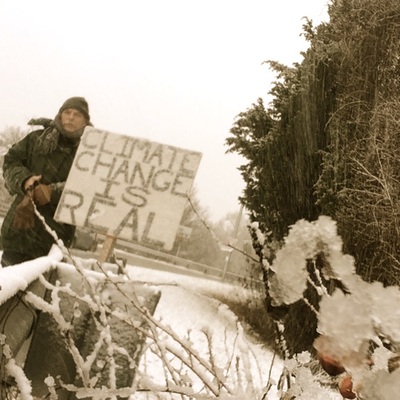
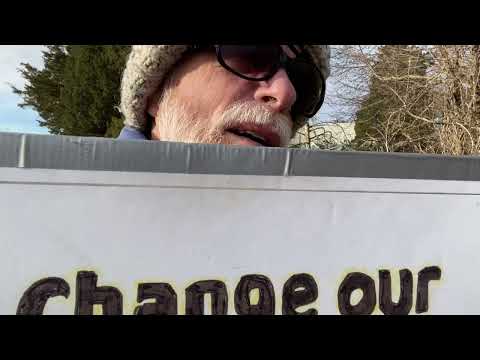
Not as cold as yesterday, but still chilly enough that I'm grateful for my multiple layers. I reach Roosevelt Circle at 7:30, set up my big sign, couple my speaker, and hold up CHANGE OUR CONVERSATION / CHANGE OUR CONSUMPTION / CHANGE OUR GOVERNMENT. I'm not fully awake yet, but the fatigue I feel over most of my body is not unpleasant.

1/
https://www.youtube.com/watch?v=MU9C1UVBrAs
#ClimateChaos #GlobalWarming #HindustaniMusic #CitizenActivism
Man With Sign, March 19, 02026

YouTube

I get a couple of approving honks from various drivers in the morning commute, but there's not a lot of reactions. A dude in a black station wagon calls out a Trump slogan as he passes, and I formulate a quick string of responses which I don't actually voice, because why bother? Instead I just roll my eyes. What a frickin' world.

2/

Today I expand the approach run practice by incorporating new lines and a more general-principles orientation to the practice. Stipulating that no pitches are to be sung twice in a row means that for every starting point, there is a simple yes/no question: will the line arrive at the desired finishing point, or at a note adjacent?

3/

The original bandish starts on Ma, the fourth scale degree. The last note of any approach run must be (according to these temporary rules) one scale tone away, so either Re or Pa in this Megh pentatonic (S R M P Nb s). This means that approach runs with an EVEN number of notes must start on Pa (below Sa), Sa, Ma, or Nib. Runs starting on the other set of pitches will require a doubled note.

4/

The corollary is that approach runs with an ODD number of beats must start on Ni (below Sa), Re, Pa, or the upper Sa. With the added caveat that as the number of notes in the run diminishes, the number of possible starting points likewise dwindles. I have an intellectual grasp on this; now to implement it in practice! With the tabla set at 120, I sing ten or twelve different 8-note runs...

5/

...from the allowed starting points, then sing roughly the same number of 7-note runs from the OTHER group of allowed starting points. Then 6-, 5-, 4-, 3-, 2- and 1-note approaches, shifting the choice of starting notes from one set to the other according to the run's evenness or oddness. This means I'm spending more time at each tempo level, which means that at 8:23 I'm no faster than 160 bpm.

6/

So I accelerate to 180 all at once, sing a few runs at the new tempo without trying for particularly staccato articulation, then make a video in which I sing a variety of 8-, 7-, 6-, and 5-note approach runs from the allowed starting points. I felt pretty good about it; with the exception of one descending run that was ill-focused, I was relaxed and in control at that speed. Nice.

7/

I sing through the hour, then pack up for the walk homeward. Today is relatively easy, with a few students, some video editing, some domestic puttering around, and the usual resistance chores. Periodically I contemplate a world in which resistance was understood differently and in which my country's government was not positioned as the enemy of decency, kindness, and sustainability.

8/

And then I square my shoulders and settle back into the reality of where and when we are. This is not the world I imagined when I was growing up; I vastly underestimated the charisma of racism, misogyny, and bullying. I would like to see improvement in my lifetime, and unless I find better ways to work for it, I guess that means I'll

See you tomorrow.

Man With Sign

end/