This paper provides a bi-annual assessment of efficient fossil fuel prices and subsidies for 170 countries, based on a comprehensive analysis of environmental and other externalities from fuel consumption. Globally, explicit (or fiscal) subsidies were $725 billion (0.6 percent of GDP) in 2024. Implicit subsidies, primarily underpricing of environmental costs, were $6.7 trillion (5.8 percent of GDP), with three quarters from underpriced air pollution and climate change.* Relative to GDP, explicit subsidies have stablized at pre-COVID levels while implicit subidies have increased somewhat and are expected to rise gradually until 2035. Explicit subsidy removal would reduce CO2 emissions by six percent below baseline levels in 2035, avoid 70,000 premature air pollution deaths annually, raise 0.6 percent of GDP in government revenue, and generate net economic benefits worth 0.5 percent of GDP. Removal of both explicit and implicit subsidies (through corrective taxes) generates substantially larger benefits, such as 1.1 million fewer premature air pollution deaths and a 46 percent reduction in CO2 emissions, but would be politically difficult. Subsidizing fuels is an inefficient way to support low-income households: for every dollar spent on explicit fuel subsidies, the poorest 20 percent of households receive just 8 cents.

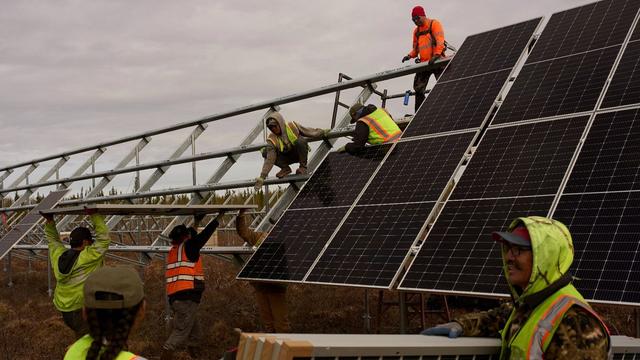
G20 governments provided at least USD 168 billion in public financial support for renewable power in 2023, less than one third of G20 fossil fuel subsidies that year.
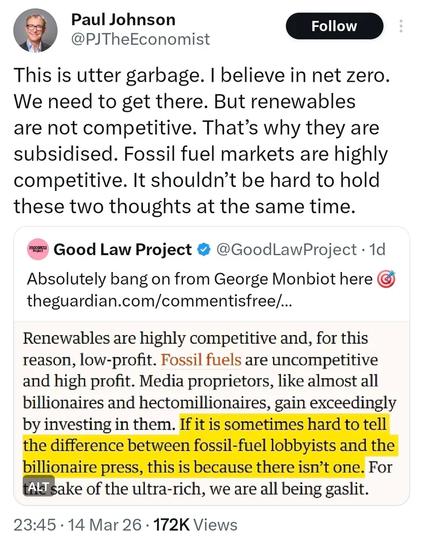
You might have formed the impression that Paul Johnson, former director of the Institute for Fiscal Studies, knows what he's talking about. The media treats him like the voice of God. But here he is - and not for the first time - talking out of his hat. Let's break it down in a short thread. đź§µ...
@Freedman is cheese the only burger?
Dude, seriously, do some effort.
Preaching about competition and markets in the 21st century is the direct equivalent of preaching about hellfire, heresy and sin in the 14th.
Neoliberalism has become a religious cult.
"Not Competitive" is code for lower ROI. With all the fat govt. handouts to fossil corps, externalized costs to communities and the world, and cartel pricing, oil is still likely a higher ROI to make the rich richer.
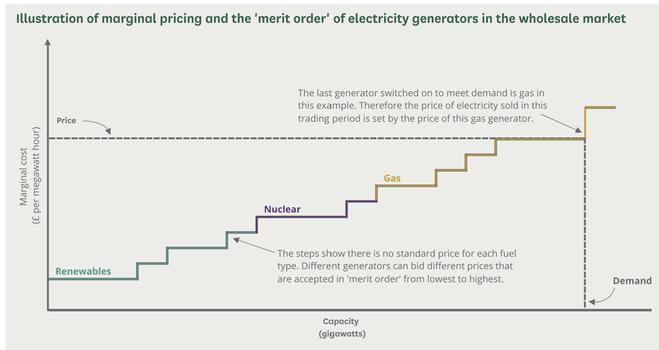
Renewables compete with everyone, including families with solar roofs, and largely insensitive to external factors.
Fossil fuels are natural monopolies with war influenced profit usury baked in, wrapped in the myth of necessity. F them.
@georgemonbiot.bsky.social
Someone needs to explain “capital expenditure” and “operational expenditure” to Paul.
With fossil fuels, you’ve gotta keep digging shit out of the ground.
That doesn’t feel like a good model, unless your whole business is built around digging shit out of the ground.