You might have formed the impression that Paul Johnson, former director of the Institute for Fiscal Studies, knows what he's talking about. The media treats him like the voice of God. But here he is - and not for the first time - talking out of his hat. Let's break it down in a short thread. 🧵
Claim 1: “Renewables are not competitive”. Oh yeah? As the UN reports, over 90 per cent of new renewables worldwide produced electricity for less than the cost of the cheapest fossil fuel alternative.
www.euronews.com/2025/07/22/m...Solar is now 41% cheaper than ...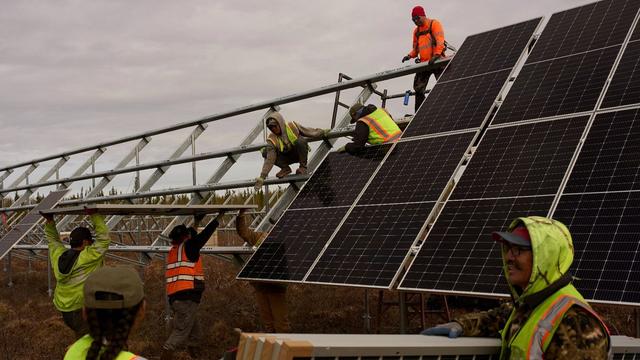
Solar is now 41% cheaper than fossil fuels, UN report shows
The global switch to renewable energy has passed a “positive tipping point”, according to two United Nations reports released on Tuesday.
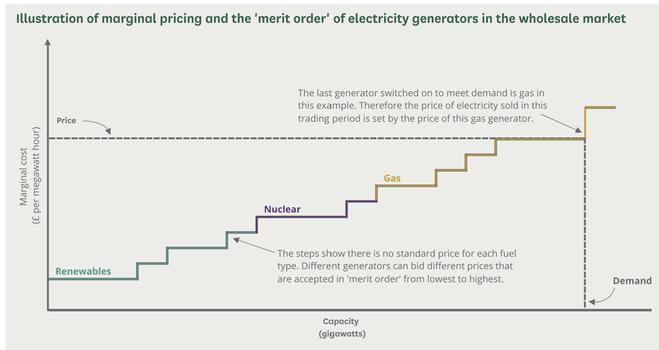
Claim 2: “That’s why they are subsidised”. Generally subsidies are used to kickstart these new technologies, after which they take off, becoming MUCH CHEAPER than the fossil alternatives. As in the UK. Illustrative diagram from House Commons library.
Claim 3: “Fossil fuel markets are highly competitive”. If, as it appears, his yardstick is subsidies, he really needs to do some research. Globally, the IMF states, explicit subsidies for fossil fuels were $725 billion in 2024. Implicit subsidies were $6.7 trillion.
www.imf.org/en/publicati...Underpriced and Overused: Foss...
Underpriced and Overused: Fossil Fuel Subsidies Data 2025 Update
This paper provides a bi-annual assessment of efficient fossil fuel prices and subsidies for 170 countries, based on a comprehensive analysis of environmental and other externalities from fuel consumption. Globally, explicit (or fiscal) subsidies were $725 billion (0.6 percent of GDP) in 2024. Implicit subsidies, primarily underpricing of environmental costs, were $6.7 trillion (5.8 percent of GDP), with three quarters from underpriced air pollution and climate change.* Relative to GDP, explicit subsidies have stablized at pre-COVID levels while implicit subidies have increased somewhat and are expected to rise gradually until 2035. Explicit subsidy removal would reduce CO2 emissions by six percent below baseline levels in 2035, avoid 70,000 premature air pollution deaths annually, raise 0.6 percent of GDP in government revenue, and generate net economic benefits worth 0.5 percent of GDP. Removal of both explicit and implicit subsidies (through corrective taxes) generates substantially larger benefits, such as 1.1 million fewer premature air pollution deaths and a 46 percent reduction in CO2 emissions, but would be politically difficult. Subsidizing fuels is an inefficient way to support low-income households: for every dollar spent on explicit fuel subsidies, the poorest 20 percent of households receive just 8 cents.
While available figures aren’t directly comparable, fossil fuel subsidies appear to be far greater than those for renewables, both explicit and implicit.
www.iisd.org/publications...Public Financial Support for R...
Public Financial Support for Renewable Power Generation and Integration in the G20 Countries
G20 governments provided at least USD 168 billion in public financial support for renewable power in 2023, less than one third of G20 fossil fuel subsidies that year.
What we see here is something very common: that people treated by the media - inc the BBC - as neutral, dispassionate and reliable are actually deeply embedded in capitalism and all its myths. They are as partisan as anyone else. They sound neutral because what they say aligns with "common sense".
RE: https://bsky.app/profile/did:plc:npq5s3nmnuyxv7qc6ux4lnqj/post/3mh4vf2xlw22x George Monbiot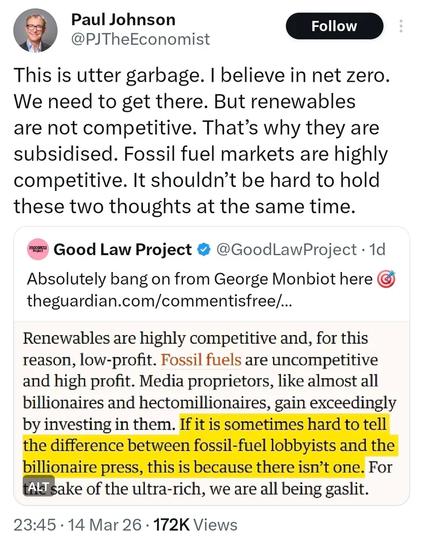
 Dave Freedman
 Joris Meys