 myrmepropagandist
Please be advised that the use of the term “war” to describe “human group conflict” is highly myrmeocentric. Obviously, there are many similarities between the conflicts of human groups and wars but humans do not (as far as we know) form colonies. Hence, “human group conflict” is preferred by this journal.
sometimes journals contain warnings like the one that I was lampooning in the previous post. I find it funny that in their great care to avoid anthropocentrism these journals make implicitly human centered assumptions. For example: that war is a concept invented by human beings and *not* by ants who have been practicing war, for millions of years longer than people have even existed.
 Solar🌄Garden
@futurebird not much hope of myrmecology coming up with ways of dealing with human war-mongering then, if the ants are still at it :(
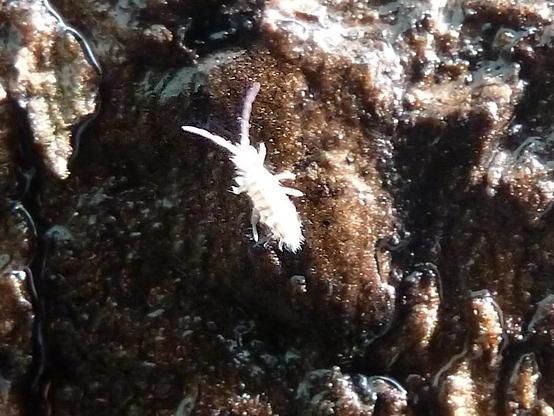
@futurebird _totally coincidentally_ before the following-on ant conversation popped up, I was about to send this photo of a tiny, <2mm arthropod frequently seen on wood here, to a friend.
Tiny and fast moving, it was only photographable using a general-purpose camera bcs it was caught in bright tangential sunlight scuttling around on smooth, wet cork-oak bark. It's [NOT!*] a woodlouse - Isopod - poss of suborder Oniscidea.
I'm bringing it in here bcs I just learned that similar species are closely associated with ants, who they "tidy-up" after. This tree has a seasonal ant city in it, but not since I've had the decent camera that took this photo.
* see reply
@frankashwood Frank... do you know this one? Seems like someone you might know?
 Frank Ashwood
Hi all, this isn't an isopod, it is a springtail (Collembola) of the order Entomobryomorpha, probably an Entomobrya species. Some springtails are found in close association with ant colonies, just like some woodlice are, often pale ones which lack eyes.
@frankashwood @futurebird "springtail"
TIL! Thank you! I never knew about the "slender" ones. The thicker larger ones I know, that ping themselves around when disturbed. Never seen these do that. I do see these around often, just difficult to photograph well.
The way-off ID was google's image search. It came up with lots of wrong comparisons, no correct ones, surprising bcs when I searched Collembola there were several instantly better matching ones. So it seems it was being lazy and just choosing "more common" rather than "more accurate".