 myrmepropagandist
Please be advised that the use of the term “war” to describe “human group conflict” is highly myrmeocentric. Obviously, there are many similarities between the conflicts of human groups and wars but humans do not (as far as we know) form colonies. Hence, “human group conflict” is preferred by this journal.
sometimes journals contain warnings like the one that I was lampooning in the previous post. I find it funny that in their great care to avoid anthropocentrism these journals make implicitly human centered assumptions. For example: that war is a concept invented by human beings and *not* by ants who have been practicing war, for millions of years longer than people have even existed.
 Solar🌄Garden
@futurebird not much hope of myrmecology coming up with ways of dealing with human war-mongering then, if the ants are still at it :(
Dinomyrmex gigas are very big ants. You can tell from their name. Imagine a carpenter ant, but three times as big. They live in Borneo in the forests and anyplace with trees and the tree-hoppers they love to farm.
Since they are big powerful ants all out war between colonies is very wasteful. They have a kind of "dance" majors from rival colonies will do to see which ant is "taller."
They stand with their legs as tall as possible and tap each other with antennae.
 Dave Dawkins (D. Harrigon)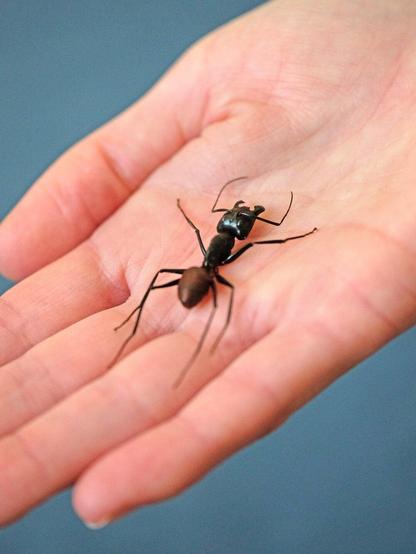
My biggest dream is to meet these ants. They don't sting and are apparently rather gentle and will explore your hand without a problem. Though, that is a dried specimen I think.
 Michael Gemar
@michaelgemar @golgaloth @wavesculptor
I wonder if a nice museum would let me do that... or I could move there. They are kind of hard to keep for a hobby at home, you'd need to give them a whole room of your house to do it correctly IMO. They live in huge hollow trees and forage over long distances.
But you could have hamster tubes all over a zoo or museum with ants in them, huge exciting ants it'd be wonderful!
we do have an ant here that is almost that size - maybe 25mm?
they are quite ponderous when seen out and about on a warm day - doing a lot of tasting the ground with their palps and staying in groups in one area.
Next time I see some, I'll try to get a decent photo. they seem to pretty much ignore observers, dont behave aggressively .. just a bit in awe of the size of their mandibles
 Medea Vanamonde 🏳️⚧️
@golgaloth @futurebird @wavesculptor
An Ant in the Hand is worth 20 in the pants
It seems clear this evolved as a way of measuring if each big major from one colony could be matched by a similar major from the other. If they don't match one group falls back and lets the more powerful ants have the branch. If not they have a peaceful border.
Of course... then there are the sidewalk ants... Tetramorium immigrans who die in huge numbers in their wars... but this is at the end of the summer when many ants die anyway for winter.
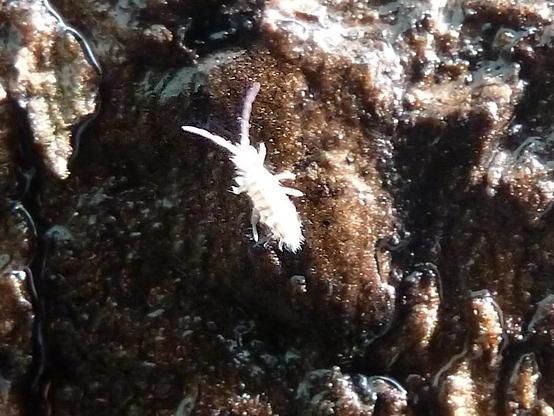
@futurebird _totally coincidentally_ before the following-on ant conversation popped up, I was about to send this photo of a tiny, <2mm arthropod frequently seen on wood here, to a friend.
Tiny and fast moving, it was only photographable using a general-purpose camera bcs it was caught in bright tangential sunlight scuttling around on smooth, wet cork-oak bark. It's [NOT!*] a woodlouse - Isopod - poss of suborder Oniscidea.
I'm bringing it in here bcs I just learned that similar species are closely associated with ants, who they "tidy-up" after. This tree has a seasonal ant city in it, but not since I've had the decent camera that took this photo.
* see reply
@frankashwood Frank... do you know this one? Seems like someone you might know?
 Frank Ashwood
Hi all, this isn't an isopod, it is a springtail (Collembola) of the order Entomobryomorpha, probably an Entomobrya species. Some springtails are found in close association with ant colonies, just like some woodlice are, often pale ones which lack eyes.
 3Jane Tessier Ashpool
@frankashwood @futurebird @wavesculptor I will always think people calling them woodlice are being super mean to Roly Polys and Doodlebugs (all three are the same animal to me)
Spring tails are kind of like ants for ants.
@frankashwood @futurebird "springtail"
TIL! Thank you! I never knew about the "slender" ones. The thicker larger ones I know, that ping themselves around when disturbed. Never seen these do that. I do see these around often, just difficult to photograph well.
The way-off ID was google's image search. It came up with lots of wrong comparisons, no correct ones, surprising bcs when I searched Collembola there were several instantly better matching ones. So it seems it was being lazy and just choosing "more common" rather than "more accurate".