
This post from Logos Publishing claims that we've mistaken sarcasm for irony with a clean dichotomy between the Socratic Irony and Modern Sarcasm.

However, this confusion, in the light of cynical reason looks less like a mistake & more like a symptom.
#sarcasm #irony #Socrates #cynicalreason #Sloterdijk
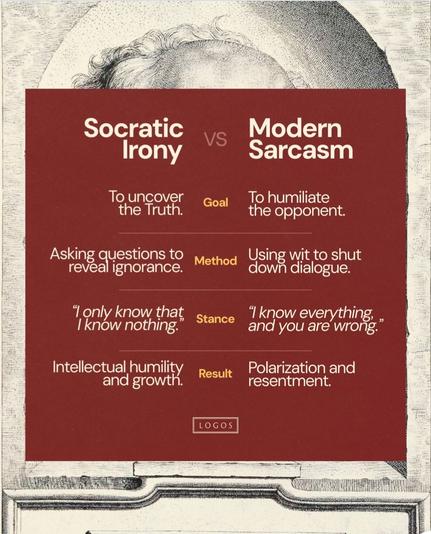
Socratic Irony requires faith, however faint, that truth is worth uncovering, that dialogue can refine us, that ignorance exposed is a step towards wisdom. It is in a quiet way, optimistic. Even Socrates with all his feigned ignorance believed the soul could be improved by inquiry.

The modern cynical subject however has already lost that faith. He knows the game is rigged, the arguments are rehearsed, the participants are posturing.

Why bother uncovering truth when truth itself has become just another rhetorical prop? Thus sarcasm emerges, not as a fall from irony, but as its degenerate descendant.

Where Socratic irony says "let us peel away illusion," cynical reason signs, "everything is illusion so let me at least be entertaining while suffocating in it."

Sarcasm, then is irony that has given up on redemption. It keeps the form of intelligence (wit, inversion, distance) but abandons the purpose.

It no longer seeks to reveal ignorance. It presumes it everywhere & treats it as an occasion for sport. We're all enlightened enough to see the absurdity, but too weary or complicit to transcend it.

So we perform knowingness instead of pursuing knowledge. And here lies the final cruelty: cynical reason flatters us. It allows us to feel superior w/o requiring us to change. Sarcasm becomes its dialect --quick, sharp, socially rewarded, & utterly sterile.

In short: yes, the confusion is not accidental. It is what happens when a culture inherits the tools of philosophy but loses the will to use them seriously.

We keep the irony but we drain it of hope, & call the residue intelligence.