 Susan Potter
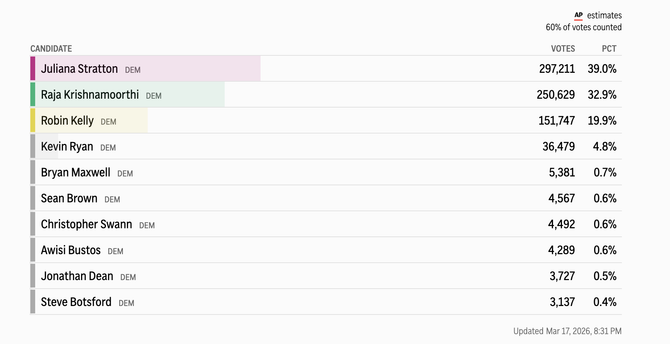
For Illinois US Senate primary results tonight: https://apnews.com/projects/elections-2026/illinois-primary-results-us-senate/
Team Stratton here.
For Illinois US Senate primary results tonight: https://apnews.com/projects/elections-2026/illinois-primary-results-us-senate/
Team Stratton here.
@aphyr @SusanPotter Ranked-Choice Voting suffers from a lot of very non-obvious problems. I would recommend approval voting or score voting for their relative simplicity and predictability.
@SusanPotter @aphyr I agree that the voting model is simplistic, but the basic technique is one of the best we've got, and has resulted in real insight into the differences and tradeoffs in single-winner social choice functions. Ka-Ping Yee is far from the only person to perform these types of simulations.
The interesting thing though is that the exact choice of voter model doesn't seem to matter too much: approval and score voting usually does quite well relative to many other systems, and in my experience it's only the increasingly implausible models that tend to show otherwise.
There does seem to be an overarching probabilistic result that approval and score voting tend to elect a Condorcet winner whenever one exists, making some (unclear but almost certainly shockingly mild) assumptions about voter behavior. As Yee's diagrams indicate, this is _not_ true of ranked-choice voting, where it's not uncommon for ranked-choice voting to fail to elect a Condorcet winner, and real-world voting paradoxes have been repeatedly observed with Ranked-Choice Voting in Burlington, which gave it up.
@leon_p_smith @SusanPotter @aphyr There are several RCVs methods that are proven to also be Condorcet methods. I advocate for one of those because I want to have a Condorcet method (and E2E Verified Voting).
But, this is the US. I'll certainly support Approval Voting because it's a huge improvement over Plurality. Plus, as you say, it's nearly always a Condorcet method in practice anyway.

 École des Bro-Arts
 Leon P Smith
 Boyd Stephen Smith Jr.