 Susan Potter
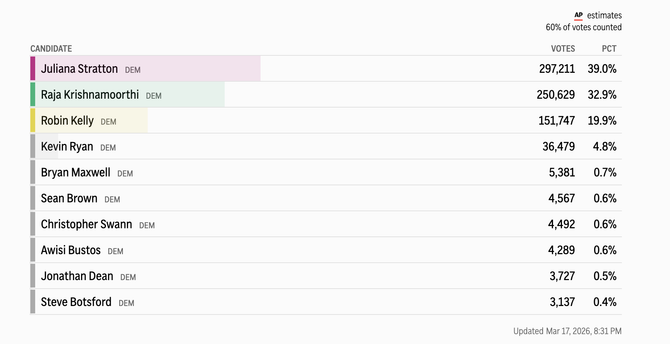
For Illinois US Senate primary results tonight: https://apnews.com/projects/elections-2026/illinois-primary-results-us-senate/
Team Stratton here.
For Illinois US Senate primary results tonight: https://apnews.com/projects/elections-2026/illinois-primary-results-us-senate/
Team Stratton here.
@aphyr @SusanPotter Ranked-Choice Voting suffers from a lot of very non-obvious problems. I would recommend approval voting or score voting for their relative simplicity and predictability.
@SusanPotter @aphyr I agree that the voting model is simplistic, but the basic technique is one of the best we've got, and has resulted in real insight into the differences and tradeoffs in single-winner social choice functions. Ka-Ping Yee is far from the only person to perform these types of simulations.
The interesting thing though is that the exact choice of voter model doesn't seem to matter too much: approval and score voting usually does quite well relative to many other systems, and in my experience it's only the increasingly implausible models that tend to show otherwise.
There does seem to be an overarching probabilistic result that approval and score voting tend to elect a Condorcet winner whenever one exists, making some (unclear but almost certainly shockingly mild) assumptions about voter behavior. As Yee's diagrams indicate, this is _not_ true of ranked-choice voting, where it's not uncommon for ranked-choice voting to fail to elect a Condorcet winner, and real-world voting paradoxes have been repeatedly observed with Ranked-Choice Voting in Burlington, which gave it up.
Any system that eliminates candidates from consideration before the winner is chosen will be sensitive to the sequence of comparisons that lead to the winner. Those that control this sequence can pick any winner from the Smith Set, as in the case of a pairwise tournament, or some similar kind of set depending on the social choice function.
(And, IIRC, all such systems are guaranteed to be non-monotonic)
Ranked choice voting determines the sequence of comparisons from the ballots, which does give well-funded political activists more surface area that they can manipulate and work with.
And that is really what attracts me to Approval Voting: it's important that voters correctly understand how their vote impacts the winner of the election. This is very hard to do in general with ranked choice voting.
Whereas understanding how Approval Voting turns ballots into winners, and understanding what effect votes like yours will have on the outcome, is comparably very easy.
Moreover, under Approval Voting, there never any reason to give less the maximum support for your honest favorite(s), and never any reason to give more than the minimum support for your honest least favorite(s). Plurality fails the first, and ranked-choice fails both.
Under Approval Voting, it may very well be in your best interest to vote for a lesser evil, but that doesn't prevent you from voting for your honest favorite.
@leon_p_smith to me, multiple changes including switching to open cross-party (party-irrelevant) primaries, denying state corporate/business political speech[1], and allowing voters to have varying non-objective evaluation criteria when voting for candidates, improve representational democracy as a package. The fact that we haven't been able to iterate on any of these changes yet is the bigger issue IMO.
@leon_p_smith @SusanPotter @aphyr There are several RCVs methods that are proven to also be Condorcet methods. I advocate for one of those because I want to have a Condorcet method (and E2E Verified Voting).
But, this is the US. I'll certainly support Approval Voting because it's a huge improvement over Plurality. Plus, as you say, it's nearly always a Condorcet method in practice anyway.
 École des Bro-Arts
 Leon P Smith
 Boyd Stephen Smith Jr.