 Aaron Vegh
 Human Brain Enthusiast
Is there single/multicore benchmark for CPUs that makes current-generation CPUs comparable with stuff from say the mid-90s onwards?
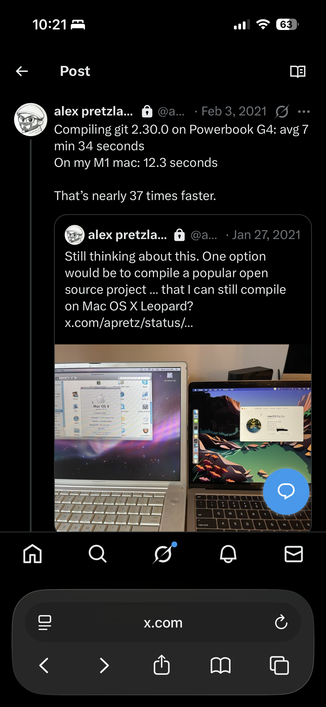
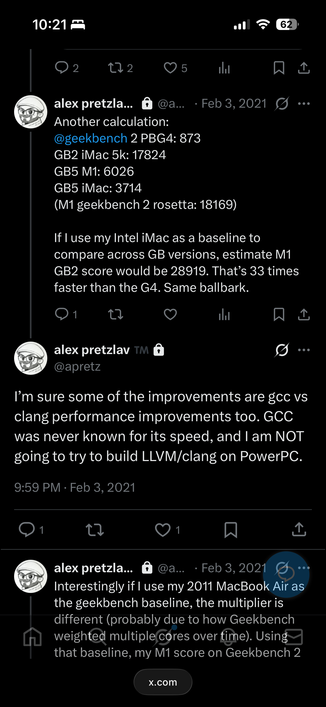
I'd like to specifically compare how fast a G4 (e.g. PowerPC 7455) is versus current Apple M5.
Is there single/multicore benchmark for CPUs that makes current-generation CPUs comparable with stuff from say the mid-90s onwards?
I'd like to specifically compare how fast a G4 (e.g. PowerPC 7455) is versus current Apple M5.
@MrDOS @thomasfuchs i dont have numbers but what is your expectation of single thread performance difference over 20y? I think all the improvements have been in adding cores, and splitting work, afaik single-core perf is only incrementally better, maybe 5-10% per major generation bump, or less, so 3x faster doesnt sound entirely crazy to me.
Edit, i see some better estimates downthread that suggest 10-15x is probably a better ballpark for M-series vs G3/G4
@raven667 @thomasfuchs My gut feel was also 10-15x.
Trying to make an apples-to-apples comparison over the same timeline, an AMD Athlon X2 4200+ from August 2005 gets a single-threaded PassMark CPU rating of 803. Just shy of twenty years on, a Ryzen 9 9950X3D from early 2025 gets 4742 – nearly 6x faster. Not sure how you'd count the generations between those two parts, but if we say there's a generation every ~two years, that's more like a 15% generation-on-generation improvement, which is pretty incredible.
@raven667 @thomasfuchs Back to the original point, I still suspect in a fair fight, an M5 is still about 10x a G4, but probably not much more than that: I was definitely overestimating the scale factor.
If anyone has an empirical test to try, I have a 1.25 GHz G4 Mac mini close to hand that I'd be happy to run benchmarks on.
@thomasfuchs I found 7zip* to be a reasonably time-stable benchmark as it runs on almost any architecture and almost any CPU.
Of course, it doesn't really check anything besides (un)zipping things...
* e.g. 7z b -mmt1
@thomasfuchs someone ran a custom single threaded Dhrystone benchmark against various computers he used since 1976 - not sure if this is of interest? It isn't optimised and so gains from this and multi threading would be much better these days.
(Updated with a better source which includes a list of results and link to the GitHub repo for the benchmark)
https://hothardware.com/news/dhrystone-benchmarks-1976-today
@thomasfuchs @joe really janky way of estimating, but: the Cell PPE/Xenon cores (same uarch) were “essentially” dual G4s at half the clock frequency, since they were in-order and alternated two threads.
So if you can find a usable single threaded comparison between a modern system and the Xbox 360 or PS3, that’ll get you a hypothetical “1.6GHz G4 with less anemic frontside bus”.
Then you could try to estimate the remaining scaling by comparing G4s and extrapolating.
 Empterdose
 Raven667
 Fabian Transchel
 Markus Osterhoff
 Arakin
 ☮ ♥ ♬ 🧑💻
 David Smith
 Alex Pretzlav 🥨