William Gibson is one of history's most quotable sf writers: "The future is here, it's not evenly distributed"; "Don't let the little fuckers generation-gap you"; "Cyberspace is everting"; and the immortal: "The street finds its own uses for things":

https://en.wikiquote.org/wiki/William_Gibson

--

If you'd like an essay-formatted version of this thread to read or share, here's a link to it on pluralistic.net, my surveillance-free, ad-free, tracker-free blog:

https://pluralistic.net/2026/03/17/technopolitics/#original-sin

1/

"The street finds its own uses" is a surprisingly subtle and liberatory battle-cry. It stakes a claim by technology's *users* that is separate from the claims asserted by corporations that make technology (often under grotesque and cruel conditions) and market it (often for grotesque and cruel purposes).

2/

"The street finds its own uses" is a statement about technopolitics. It acknowledges that yes, there *are* politics embedded in our technology, the blood in the machine, but these politics are neither simple, *nor are they immutable*. The fact that a technology was born in sin does not preclude it from being put to virtuous ends. A technology's politics are up for grabs.

3/

In other words, it's the opposite of Audre Lorde's "The master's tools will never dismantle the master's house." It's an assertion that, in fact, the master's tools have all the driver-bits, hex-keys, and socket sets needed to completely dismantle the master's house, and, moreover, to build something better with the resulting pile of materials.

4/

And of *course* the street finds its own uses for things. Things - technology - don't appear out of nowhere. Everything is in a lineage, made from the things that came before it, destined to be transformed by the things that come later. Things can't come into existence until other things already exist.

5/

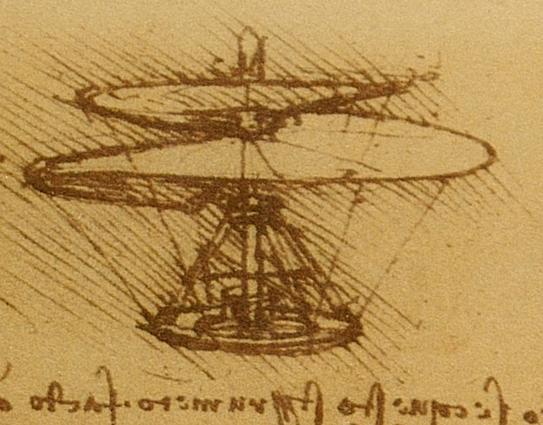
Take the helicopter. Lots of people have observed the action of a screw and the twirling of a maple key as it falls from a tree and thought, *perhaps that could be made to fly*. Da Vinci was drawing helicopters in the 15th century:

https://en.wikipedia.org/wiki/Leonardo%27s_aerial_screw

6/

Leonardo's aerial screw - Wikipedia

But Da Vinci couldn't build a helicopter. No one could, until they did. To make the first helicopter, you need to observe the action of the screw and the twirling of a maple key, *and* you need to have lightweight, strong alloys and powerful internal combustion engines.

7/

Those other things had to be invented by other people first. Once they were, the next person who thought hard about screws and maple keys was bound to get a helicopter off the ground. That's why things tend to be invented simultaneously, by unrelated parties.

8/

TV, radio and the telephone all have multiple inventors, because these people were the cohort that happened to alight upon the insights needed to build these technologies *after* the adjacent technologies had been made and disseminated.

9/

If technopolitics were immutable - if the original sin of a technology could never be washed away - then *everything* is beyond redemption. Somewhere in the history of the lever, the pulley and the wheel are some absolute *monsters*. Your bicycle's bloodline includes some truly horrible ancestors. The computer is practically a crime against humanity:

https://pluralistic.net/2021/10/24/the-traitorous-eight-and-the-battle-of-germanium-valley/

10/

The Traitorous Eight and the Battle of Germanium Valley – Pluralistic: Daily links from Cory Doctorow

A defining characteristic of purity culture is the belief that things are defined by their origins. An artist who was personally terrible must make terrible art - even if that art succeeds *artistically*, even if it moves, comforts and inspires you, it can't ever be separated from the politics of its maker. It is terrible because of its origins, not its merits. If you hate the sinner, you must also hate the sin.

11/

"The street finds its own uses" counsels us to hate the sinner and *love* the sin. The indisputable fact that HP Lovecraft was a racist creep is no reason to write off Cthulhoid mythos - it's reason to claim and refashion them:

https://pluralistic.net/2021/01/09/the-old-crow-is-getting-slow/#i-love-ny

The claim that sin is a forever-chemical contaminant that can't ever be rinsed away is the ideology of Mr Gotcha:

> We should improve society somewhat.

> Yet you participate in society. Curious!

https://thenib.com/mister-gotcha/

12/

Pluralistic: 09 Jan 2021 – Pluralistic: Daily links from Cory Doctorow

In its right-wing form, it is Margaret Thatcher's "There is no alternative":

https://pluralistic.net/2024/10/15/piketty-pilled/#tax-justice

Thatcher demanded that you accept all the injustices and oppressions of capitalism if you enjoyed its fruits. If capitalism put a roof over your head and groceries in your fridge, you can't complain about the people it hurts. There is no version of society that has the machines and practices that produced those things that does not also produce the injustice.

13/

Pluralistic: Of course we can tax billionaires (15 Oct 2024) – Pluralistic: Daily links from Cory Doctorow

The technological version of this is the one that tech bosses peddle: If you enjoy talking to your friends on Facebook, you can't complain about Mark Zuckerberg listening in on the conversation. There is no alternative. Wanting to talk to your friends out of Zuck's earshot is like wanting water that's not wet. It's unreasonable.

14/

But there's a left version of this, its doppelganger: the belief that a technology born in sin can never be redeemed.

15/

If you use an LLM running on your computer to find a typo, using an unmeasurably small amount of electricity in the process, you still sin - not because of anything that happens when you use that LLM, but because of LLMs' "structural properties," "the way they make it harder to learn and grow," "the way they make products worse," the "emissions, water use and e-waste":

https://tante.cc/2026/02/20/acting-ethical-in-an-imperfect-world/

16/

Acting ethically in an imperfect world

Life is complicated. Regardless of what your beliefs or politics or ethics are, the way that we set up our society and economy will often force you to act against them: You might not want to fly somewhere but your employer will not accept another mode of transportation, you want to eat vegan but are […]

Smashing Frames

The facts that finding punctuation errors in your own work using your own computer doesn't make it "harder to learn and grow," doesn't "make products worse," and doesn't add to "emissions, water use and e-waste" are irrelevant. The part that matters isn't the use of a technology, it's the *origin*.

17/

The fact that this technology is steeped in indisputable sin means that every use of it is sinful. The street can find as many uses as it likes for things, but it won't matter, because there is no alternative.

When radical technologists scheme to liberate technology, they're not hoping to redeem *the gadget*, they're trying to liberate *people*.

18/

Information doesn't want to be free. Information doesn't and can't want anything. *People* want to be free, and liberated access to information tech is a precondition for human liberation itself.

Promethean leftists don't reject the master's tools: we *seize* them. The fact that Unix was born of a convicted monopolist who turned the screws on users at every turn is no reason to abandon Unix - it demands that we reverse-engineer, open, and *free* Unix:

https://pluralistic.net/2025/01/20/capitalist-unrealism/#praxis

19/

Pluralistic: Enshittification isn’t caused by venture capital (20 Jan 2025) – Pluralistic: Daily links from Cory Doctorow

We don't do this out of moral consideration for Unix. Unix is inert, it warrants no moral consideration. But billions of users of free operating systems that are resistant to surveillance and control *are* worthy of moral consideration and we set them free by seizing the means of computation.

20/

If a technology can do something to further human thriving, then we can love the sin, even as we hate the sinners in its lineage. We seize the means of computation, not because we care about computers, but because we care about *people*.

Artifacts do have politics, but those politics are not immutable. Those politics are ours to seize and refashion:

https://faculty.cc.gatech.edu/~beki/cs4001/Winner.pdf

21/

@pluralistic the phrase echoing in my brain from some lawsuit in the file-sharing wars is "substantial non-infringing uses", presumably uttered a judge in response to someone hoping to make the very idea of bit torrent illegal.
@bencurthoys It's from the Betamax case, a bid to make all recording devices illegal, and it comes from the SCOTUS majority.

@pluralistic
I suspect that some of the motivation to see things that way comes from the books of *one particular* big-name author having contained some questionable elements that would have slid by an uncritical audience, but stuck out like a sore thumb once her politics turned against those of a lot of her original readership.

Since it happened once and caused a generational trauma in the process, younger types are paranoid about it happening again.

@pluralistic
To anyone who doubts that the person who wrote about fighting wizard Nazis being a horrible person herself would qualify as a generational trauma... well, imagine what it would have been like if in the early 90s. Mr. Rogers turned out to have been a serial rapist, and you'd have some idea of the level of horror and incongruity involved here.
@pluralistic Lorde wasn't talking about screwdrivers and widgets, though. She was talking about the intellectual tools of patriarchy. Much of that essay was about how academic feminist theory centred white feminism and in doing so was self-defeating—centering whiteness was the master's tool in that case.

@pluralistic you've used this analogy before. it was stupid then and it's stupid now. the excretions of the #software industry are not hard and concrete things like nuts and bolts; in fact they are deliberately made to be as unlike those things as possible, as unlike REAL ACTUAL TOOLS as possible.

I know who William Gibson is. I respect him. Who the fuck are you

@pluralistic
"the sky above the port was the color of television, tuned to a dead channel"

{*looked it up just now}

@trrektor @pluralistic

And, for an instant, she stared directly into those soft blue eyes and knew, with an instinctive mammalian certainty, that the exceedingly rich were no longer even remotely human.

William Gibson, Count Zero

@ajh @trrektor @pluralistic
this one is my default internal Alt text for images of Mark Zuckerberg particularly, though the rest of them also fit...
@bigblen @ajh @trrektor @pluralistic
I reread that recently, and that's EXACTLY who I thought of.
@trrektor @pluralistic
is this one going to need a footnote in future explaining that not just black, or the words "No Signal" on a black background.
@bigblen @trrektor @pluralistic First we'll have to answer "What's a television?"
@bigblen @trrektor @pluralistic Neromancer: The Annotated Edition
@bigblen have newer models switched to black already? You can get a pretty good idea about someone's age if they are thinking of an intense blue screen
@trrektor @pluralistic Except that since at least the late 90s that might mean ‘solid blue’…
@pluralistic “And, for an instant, she stared directly into those soft blue eyes and knew, with an instinctive mammalian certainty, that the exceedingly rich were no longer even remotely human.”

@pluralistic

“The important fact about a technology is what it does, not how it came about.”

So the ends *do* justify the means 🤔