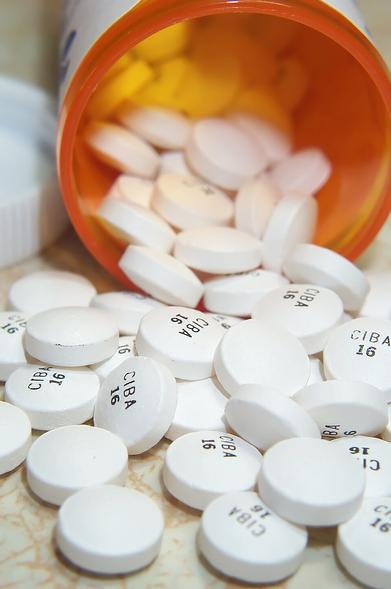
 🍹Early to RISA 🧉
Anon has anxiety
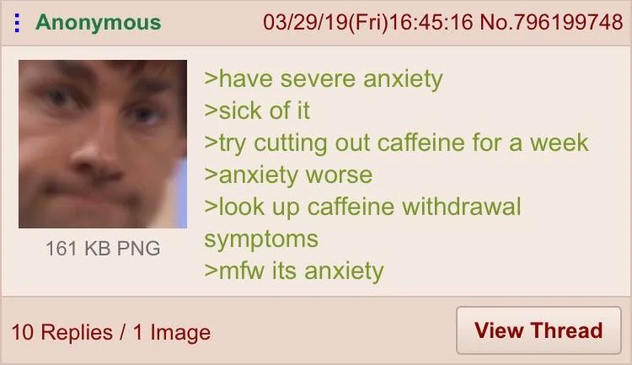
The whole ‘giving you energy’ thing is a myth, all it does it make you tired without it.
Absolute nonsense. I don’t drink coffee or tea, and if I drink a couple cups of coffee I end up with a hundred more tabs in the browser, two programming projects started and abandoned, a hundred notes tagged and reorganized, and a bunch of unnecessary and vaguely mean comments on Reddit and Lemmy. Possibly also a sore leg or shoulder from impromptu exercise.
You need to take control of your caffeine addiction.
Absolute nonsense
No, science. (first result) mindbodygreen.com/…/does-caffeine-actually-give-u…
The other one, sounds like caffeine effect on ADHD.
Thanks for your speculation as to what it might be, but I don’t need it. Unless you totally abstain from coffee, tea and fizzy drinks, you have no idea what caffeine is like after not consuming it.
Especially, seeing as another guy here speculates that taking a nap after drinking coffee is a caffeine effect on ADHD, perhaps you two might want to speculate against each other whose speculation is more correct, speculatively speaking.
rom worsening their symptoms over having no effect at all to making them sleepy.
Thanks for admitting that your guesswork doesn’t amount to jackshit since it contradicts itself.
With the info, that a “Syndrom” means a range of causes, displaying similiar effects you can roughly group together.
Now calm down.
By Josey Murray
Josey Murray is a freelance writer focused on inclusive wellness, joyful movement, mental health, and the like.
:-/
Indeed, “the cognitive and physical energy is a temporary gift that instant-release caffeine gives,”* shares Ashley Jordan Ferira, Ph.D., RDN
tc.netlify.mindbodygreen.com/about
Ashley Jordan Ferira, Ph.D., RDN, mbg Vice President of Scientific Affairs
:-|
Citation Ouroboros
Let’s also consult Wikipedia:
Stimulants (also known as central nervous system stimulants, or psychostimulants, or colloquially as uppers) are a class of psychoactive drugs that increase alertness. They are used for various purposes, such as enhancing attention, motivation, cognition, mood, and physical performance. Some stimulants occur naturally, while others are exclusively synthetic. Common stimulants include caffeine, nicotine, cocaine (including crack cocaine), amphetamine/methamphetamine, methylphenidate, and modafinil. Most stimulants are highly addictive and damage health when addicted.
 davetortoise
 UnderpantsWeevil