 Virgile Andreani ⏚ 🇵🇸
Do you know of any software licenses that would allow everything for academics and the general public, and would require companies to pay to use the software?
 Malin
Malin@malin You mean that would not be GNU's definition of "Free Software", right? I think open source is a little bit more tolerant on this?
 🏳️⚧️ Chloé: IA Vegan
@Armavica
CC-By-NC-SA?
CC-By-NC-SA?
@jenesuispersonne Hmm that is smart, thanks. I rarely see code under CC though
 Graham Lee, D.Phil
@Armavica the open source definition doesn’t solute for discrimination by field of endeavour, and that condition you have is discriminatory.
@leeg What about the non-commercial clause of CC licenses?
@Armavica they don't satisfy the open source definition and they aren't open source licenses (see this page, where the definition of a "free cultural work" is very similar to the "four freedoms" of free software that inform the OSD: https://creativecommons.org/public-domain/freeworks/). NC clauses are also problematic, because there isn't a generally-agreed definition of the scope of "commercial behavior".
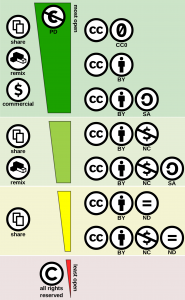
Understanding Free Cultural Works - Creative Commons
Creative Commons provides a range of licenses, each of which grants different rights to use the materials licensed under them. All of these licenses offer more permissions than “all rights reserved.” To help show more clearly what the different CC licenses let people do, CC marks the most permissive of its licenses as “Approved for…
@Armavica also note the broader problem that you asked about software licenses, and no CC license is a good software license https://creativecommons.org/faq/#can-i-apply-a-creative-commons-license-to-software
@leeg Thank you for the references, I will read them with attention
 Rohit Farmer, Ph.D.
@Armavica CC-BY-SA-NC. You can also declare your own license with the terms and conditions you want. There is nothing wrong with it. Most academic software used to be like that, unless funding required you to release it into the public domain.
I remember PyMol was like that before Schrodinger overtook it. And Amber or CHARMM had restrictions on specific countries.
 Marcel Stimberg
@Armavica AFAICT, the usual solution is to dual-license: everyone is free to use it under a strict copyleft licence, but at the same time companies can pay to get a licence to use it without the copyleft restrictions.
 fossham
@Armavica Of course not. The term "open source" is formally and legally defined to be inclusive and non-discriminatory, so your desire to be exclusionary and discriminatory is the opposite of "open source."
The same is true of the term "free software" too, so don't try to mis-apply that term either.