 Brian Gordon
RE: https://mamot.fr/@Khrys/116226030767910474
As predicted, humans are being turned into accountability sinks for #AI. AI code doesn’t work? You're fired!
"After outages, Amazon to make senior engineers sign off on AI-assisted changes"
RE: https://mamot.fr/@Khrys/116226030767910474
As predicted, humans are being turned into accountability sinks for #AI. AI code doesn’t work? You're fired!
"After outages, Amazon to make senior engineers sign off on AI-assisted changes"
@tknarr Because this *isn't* a structural construct (like if/for/etc) I indent up to the level of indentation of that block, then if I *really* need to make things align I fill in the remaining space with spaces. (tabs, if I don't)
This ensures that the block as a whole still indents/unindents correctly with tabs. I am never, ever going to adjust the level of indent of *part* of an expression in this way, so the use of spaces for intra-block expression alignment padding doesn't matter.
@tknarr if this expression by the unholy machinations of mathematics DOES become so gnarly that heavy use of brackets becomes mandatory...
...then I've just invented a new code block surrounded by a different kind of bracket, put the complete expression on a new line inside them, indent with tabs like it's a regular code block, and continue to apply the rules recursively as normal.
@tknarr @pdcawley This is pretty irrelevant.
If I'm writing code for myself, then it's a complete non issue. If I really had to deal with someone adding in spaces randomly, I'd just write a simple linter that turns spaces into tabs. If the rest of the office mandated spaces as a condition of my employment I'd tack on a reverse linter that converts tabs to spaces before I check code in.
 Todd Knarr
 RealGene ☣️
 ShutterBugged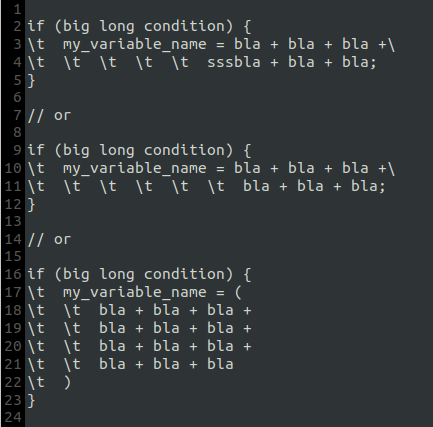
 Piers Cawley