Antimatter Trucker is finally a job title! But don’t worry, this isn’t going to be “The Wages of Fear, 2026”:

“The device on Cern’s truck will carry about 1,000 antimatter particles, weighing about a billionth of a trillionth of a gram. Should the containment fail, and the antimatter make contact with normal matter, the resulting pulse of energy would be so feeble, the load doesn’t even warrant a radioactive label.”
https://www.theguardian.com/science/2026/mar/14/please-drive-carefully-scientists-plan-to-transport-volatile-antimatter-for-first-time

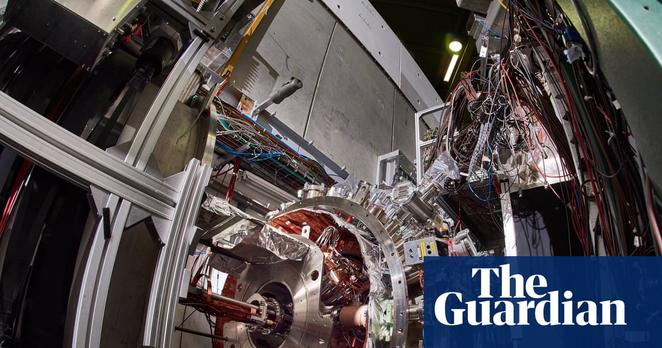
Please drive carefully: scientists plan to transport volatile antimatter for first time

Cern researchers are testing traps capable of moving antimatter, which explodes into energy as soon as it comes into contact with regular matter

The Guardian

They actually did it!

“On 24 March, a team at CERN transported 92 antiprotons in a specially designed bottle that traps the particles using magnetic fields. The bottle travelled on the back of a truck, for a 30-minute journey ... ”

https://www.nature.com/articles/d41586-026-00950-w

Antimatter has been transported for the first time ever — in the back of CERN's truck

Physicists have succeeded for the first time in transporting the most expensive and most volatile substance on Earth — antimatter.

If you’re wondering how they knew they had 92 antiprotons in their trap, and didn’t lose any along the way, the answer is “image current detection”.

When a charged particle moves past a metal plate, its electric field induces a current in it, with no need for the particle to actual touch anything. That current was monitored to keep track of the contents of the trap.

“Monitoring the antiprotons in real-time: a standard non-destructive image current detection technique is used – this technique is routinely available in precision Penning-trap experiments – so the team gets a continuous signal showing the amount of particles in the trap.”

https://home.cern/science/cern/antimatter-transportation-media-kit

Antimatter Transportation Media Kit

CERN
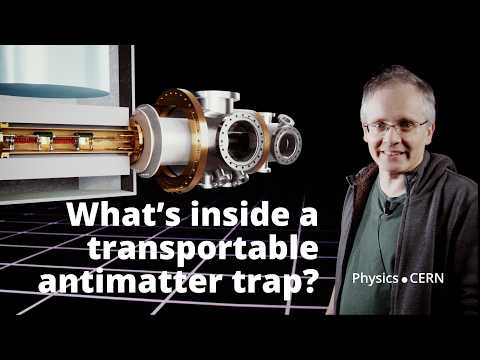
@gregeganSF CERN put out a video on the trap. It calms down after the ACTION MOVIE INTRO that every org that hardly ever makes video does https://youtu.be/KdPm6t-jNsw
What's inside the BASE-STEP antiproton trap?

YouTube
@ChateauErin @gregeganSF Wow! Though presenting from the ST TNG holodeck does raise some questions
@ChateauErin @gregeganSF … presumably antimatter? or else it's badly named
@gregeganSF We were one traffic accident away from a supervillain origin story…
@gregeganSF there is an interesting essay to be written about being sure that there are 92 protons in there. How come its exactly 92? How did they count them?
@prof_T @gregeganSF easy, they used antimatter tweezers, duh
@fmobus @gregeganSF only if they had antimatter fingers and hands :)
@prof_T @gregeganSF safety first, must wear antimatter gloves
@gregeganSF They better be careful or Trump will send in Seal Team 6 to to steal the bottle so he can make make a SUPER OBLITERATOR!
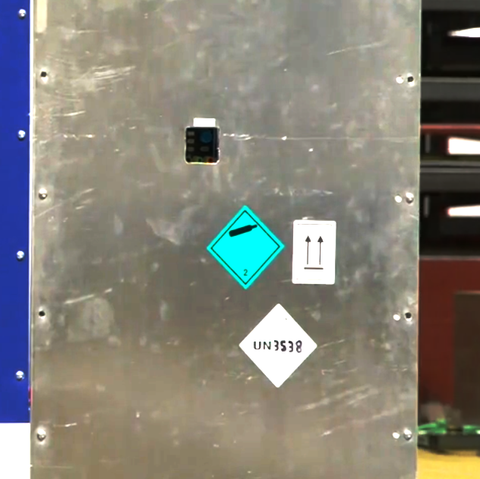
@gregeganSF Which hazard diamond is antimatter?
@yngmar @gregeganSF in this case (at least if it were on US roads), I'd guess it needs the unofficial CRYO marker that goes in the white quadrant for the superconducting magnet system (which is of course a vastly greater hazard than the antimatter at these quantities.) (Which is probably still safer than the truck's own fuel, which doesn't need an NFPA tag...)

@eichin @gregeganSF UN 3538 apparently!

"ARTICLES CONTAINING NON-FLAMMABLE, NON TOXIC GAS, N.O.S."

Probably refers to the cooling system though :)

@gregeganSF @lana not far off from the Tenet highway scene now …

https://youtu.be/EoarG7_pSNw

But seriously, incredible sci-fi stuff.

The Reverse Car Chase (TENET) ● 4K HDR IMAX ● DTS HD 5.1

YouTube
@gregeganSF We're gonna need a bigger antimatter containment vessel.
@gregeganSF very cool, I hope their experiment goes well. Interestingly there actually are a workforce of antimatter truckers who transport positron-emitting radiopharmaceuticals from cyclotron facilities to hospitals who use these products for PET scans. Since the products are quite short-lived, they must deliver multiple times a day to the meet the needs of the hospital. Of course the material is emitting positrons (and those are annihilating) the whole time, unlike what CERN are trying here
Physicists Plan Antimatter's First Outing--in a Van

Researchers intend to transport the elusive material between labs and use it to study the strange behavior of rare radioactive nuclei

Scientific American

@ChateauErin

It’s puzzling comparing those two accounts, The 2018 Scientific American article talks about a portable trap containing a billion antiprotons, being transported a few hundred metres, though they hadn’t actually done this yet:

“Developing and testing technology for the portable trap will take around four years, with the first measurements scheduled for 2022.”

The 2026 Guardian article talks about 1,000 particles, which they later say are antiprotons. (So apparently not neutral antihydrogen, which would be harder to make and store.) It sounds like the planned drive is quite a bit longer than a few hundred metres in this case: 20 minutes around the CERN campus initially.

So I wonder what happened to the plan to trap and transport a billion antiprotons.

@gregeganSF yeah. It'd be fascinating to track down some of the folks and ask. Maybe a bit awkward, if the initial plan turned out to be over-reach

@gregeganSF I tried googling, ended up at CERN's site and this quote made me ugly laugh

> Yesterday, the team of scientists and engineers took an important step towards this goal by transporting a cloud of 70 protons in a truck across CERN’s main site. “If you can do it with protons, it will also work with antiprotons,” said Christian Smorra, the leader of BASE-STEP. “The only difference is that you need a much better vacuum chamber for the antiprotons.

https://home.cern/news/news/experiments/base-experiment-takes-big-step-towards-portable-antimatter

BASE experiment takes a big step towards portable antimatter

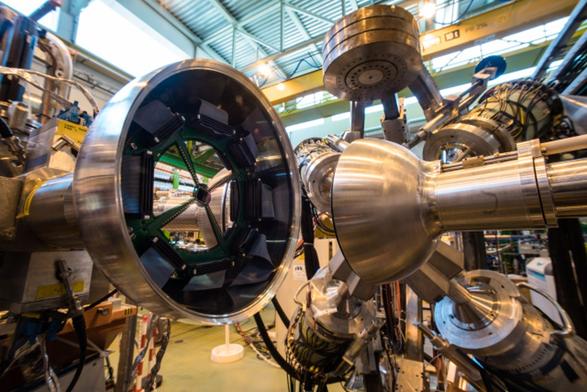
Antimatter might sound like something out of science fiction, but at the CERN Antiproton Decelerator (AD), scientists produce and trap antiprotons every day. The BASE experiment can even contain them for more than a year—an impressive feat considering that antimatter and matter annihilate upon contact. The CERN AD hall is the only place in the world where scientists are able to store and study antiprotons. But this is something that scientist working on the BASE experiment hope to change one day with their subproject BASE-STEP: an apparatus designed to store and transport antimatter. Yesterday, the team of scientists and engineers took an important step towards this goal by transporting a cloud of 70 protons in a truck across CERN’s main site. “If you can do it with protons, it will also work with antiprotons,” said Christian Smorra, the leader of BASE-STEP. “The only difference is that you need a much better vacuum chamber for the antiprotons.” This is the first time that loose particles have been transported in a reusable trap that scientists can then open in a new location and then transfer the contents into another experiment. The end goal is to create an antiproton-delivery service from CERN to experiments located at other laboratories. Antimatter is a naturally occurring class of particles that is almost identical to ordinary matter except that the charges and magnetic properties are reversed. This has baffled scientists for decades because according to the laws of physics, the Big Bang should have produced equal amounts of matter and antimatter. These equal-but-opposite particles would have quickly annihilated with each other; leaving a simmering but empty Universe. Physicists suspect that there are hidden differences that can explain why matter survived and antimatter all but disappeared. The BASE experiment aims to answer this question by precisely measuring the properties of antiprotons, such as their intrinsic magnetic moment, and then comparing these measurements with those taken with protons. However, the precision the experiment can achieve is limited by its location.  “The accelerator equipment in the AD hall generates magnetic field fluctuations that limit how far we can push our precision measurements,” said BASE spokesperson Stefan Ulmer. “If we want to get an even deeper understanding of the fundamental properties of antiprotons, we need to move out.” The transportable trap being carefully loaded in the truck before going for a road trip across CERN's main site. (Image: CERN) This is where BASE-STEP comes in. The goal is to trap antiprotons and then transfer them to a facility where scientists can study them with a greater precision. To be able to do this, they need a device that is small enough to be loaded onto a truck and can resist to the bumps and vibrations that are inevitable during ground transport. The current apparatus — which includes a superconducting magnet, cryogenic cooling, power reserves, and a vacuum chamber that traps the particles using magnetic and electric fields — weighs 1000 kilograms and needs two cranes to be lifted out of the experimental hall and onto the truck. Even though it weighs a tonne, BASE-STEP is much more compact than any existing system used to study antimatter. For example, it has a footprint that is five times smaller than the original BASE experiment as it has to be narrow enough to fit through ordinary laboratory doors. During the rehearsal, the scientists used trapped protons as a stand-in for antiprotons. Protons are a key ingredient of every atom, the simplest of which is hydrogen (one proton and one electron.) But storing protons as loose particles and then moving them onto a truck is a challenge because any tiny disturbance will draw the unbonded protons back into an atomic nucleus. “When it’s transported by road, our trap system is exposed to acceleration and vibrations, and laboratory experiments are usually not designed for this”, Smorra said. “We needed to build a trap system that is robust enough to withstand these forces, and we have now put this to a real test for the first time.” However, Smorra noted that the biggest potential hurdle isn’t currently the bumpiness of the road but traffic jams.“If the transport takes too long, we will run out of helium at some point,” he said. Liquid helium keeps the trap’s superconducting magnet at a temperature below 8.2 Kelvin: its maximum operating temperature. If the drive takes too long, the magnetic field will be lost and the trapped particles will be released and vanish as soon as they touch ordinary matter. “Eventually we want to be able to transport antimatter to our dedicated precision laboratories at the Heinrich Heine University in Düsseldorf, which will allow us to study antimatter with at least 100-fold improved precision,” Smorra said. “In the longer term, we want to transport it to any laboratory in Europe. This means that we need to have a power generator on the truck. We are currently investigating this possibility.” After this successful test, which included ample monitoring and data taking, the team plans to refine its procedure with the goal of transporting antimatter next year. “This is a totally new technology that will open the door for new possibilities of study, not only with antiprotons but also with other exotic particles, such as ultra-highly-charged ions,” Ulmer said. Another experiment, PUMA, is preparing a transportable trap. Next year, it plans to transport antiprotons 600 metres from the AD hall to CERN’s ISOLDE facility in order to use it to study the properties and structure of exotic atomic nuclei. The BASE-STEP team celebrating the successful transport at the end of the operation. The green signal on the computer screen shows that the 70 loose protons are still "alive", maintained by the magnetic field in the trap. (Image: CERN)   

CERN
@gregeganSF love the Wages of Fear reference!
@gregeganSF Rare usage of this variant of the sign

@gregeganSF

This job could be a dream come true for Shaxs.

@gregeganSF

What about in the nacells?

@gregeganSF Inspired me to watch my DVD of “Sorcerer” again. If nothing else the “Tangerine Dream” soundtrack is worth it.
@gregeganSF Even if the radiation exposure is low if containment is lost, think of an incident as a "points on your ability to have children" or "I'm gonna die of cancer in 10 years" policy.
@gregeganSF Interesting as a plot device (I hope all goes well).