 Alexander J. Stein
Guest editorial: Alternative p...
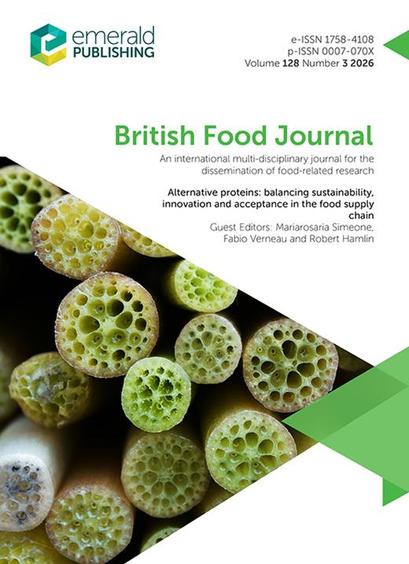
Guest editorial: Alternative proteins: balancing sustainability, innovation and acceptance in the food supply chain
Rapid population growth in certain areas of the globe and environmental degradation across all of it represent the main challenge for global food security. According to United Nations estimates [1] the world population is expected to reach 9.7 billion by 2050, intensifying pressure on food systems and increasing the responsibility of governments and the food industry to ensure sufficient, safe and sustainable food supplies. Within this changing scenario, achieving a sustainable food system has become a central objective, principally in relation to the environmental goals of the European Green Deal and the Farm to Fork Strategy [2], which explicitly connect human health, societal well-being and planetary sustainability.This Special Issue was conceived with the aim of understanding the current state of knowledge, practices and challenges surrounding alternative proteins for direct human consumption. Beyond environmental necessities, the transition toward sustainable protein presents significant economic chances, including potential first-mover advantages for actors within the European Union (EU) food chain who adopt innovative and sustainable alternative protein solutions ahead of global competitors (Suvanto et al., 2020).The Farm to Fork Strategy is also a basis of the European Commission's agenda to achieve the United Nations Sustainable Development Goals (SDGs), encouraging systemic change through both production and consumption. Dietary change will play a central role in any progress regarding sustainability (Hallström et al., 2015). Shifts in consumer beliefs and values are reshaping food markets, creating space for new products and consumption models (Dagevos and van Ophem, 2013; Russo et al., 2020).Alternative protein sources, including insect protein, fungal protein, seaweed/algal protein, seed-based proteins and legume-derived proteins, such as lentils and beans, offer the possibility of producing nutritionally adequate protein using fewer natural resources than conventional animal-based systems (Moura et al., 2023). For consumers seeking to reduce their intake of meat and other animal products, these alternatives represent both a sustainable and health-conscious choice (Hartmann et al., 2018). However, their successful diffusion depends on a complex interplay of technological possibility, disgust response with regard to some alternatives and consumer acceptance. Barriers relating to market structures and regulatory frameworks also stand between the neo-protein solution and the consumer.This Special Issue reflects the growing attention devoted to alternative proteins by both European and international institutions, an interest that is confirmed by substantial investments in research programs and private initiatives. Numerous projects are currently investigating how to promote sustainable foods, encourage sustainable food choices and improve information and communication about alternative proteins across different contexts (Abrahamse, 2020). The contributions collected in this issue reflect these ongoing international research efforts and provide a comprehensive picture of the current state of the field.The articles included in this Special Issue address alternative proteins from multiple perspectives, with a strong focus on consumer and supply chain acceptance, alongside supply-side analyses that examine environmental efficiency, innovation-related risks and organizational adaptation. Particular attention is also paid to governance and policy challenges, highlighting the role of policymakers in shaping production standards, information provision and labeling regulations necessary to support a transparent and reliable market environment.At the same time, the transformation of food systems cannot be understood without considering the cultural dimensions of food consumption. Food identities, traditions and symbolic meanings may generate resistance to change among certain population groups, making it essential to identify which segments are more likely to resist or embrace dietary innovation (Simeone and Verneau, 2024). Moreover, changes in supply structures are already reshaping markets and driving significant organizational transformations within the food industry, reinforcing the need for market-oriented and consumer-centered approaches in the development of new products.By bringing together different empirical and theoretical contributions, this Special Issue aims to capture the current state of alternative proteins within a rapidly evolving global scenario, offering insights into how food systems are adapting and where future research, policy and industry efforts may be directed.The 16 contributions selected for this Special Issue indicate that the central challenge has shifted from whether alternative proteins can contribute to sustainability to how they can be effectively embedded into food systems, markets and everyday practices. The content includes five major categories of study:The first group of studies analyses consumer acceptance, motivations and psychological drivers of alternative proteins. These studies investigate consumer acceptance, psychological motivations, cultural and emotional barriers and the factors influencing the intention to adopt alternative proteins (cultured meat, insects, bacterial protein and plant-based).Simeone and Verneau's (2026) study, “Lab-grown bites: What drives or stops the world from eating cultured meat? A global perspective on developed and developing countries”, reviews consumer acceptance of cultured meat, comparing developed and developing countries. In developed nations, cultural factors, especially familiarity and food neophobia, are the main barriers to adoption. In developing countries, interest is driven by environmental concerns and food security, as cultured meat is seen as a potential solution to global food supply challenges.The study highlights key drivers and obstacles to guide future market adoption and communication strategies. In their contribution, Fantechi et al. (2026), “Exploring alternative proteins: psychological drivers behind consumer engagement,” investigate the psychological factors shaping consumers' intention to adopt alternative proteins using an extended norm activation model. Based on a survey of Italian consumers, the results show that awareness of the environmental impacts of meat and involvement in sustainable eating support personal norms, which in turn increase intentions to try alternative proteins. In contrast, food and food-technology neophobia significantly reduce acceptance, especially of insect-based foods and cultured meat, while sociodemographic characteristics and prior experience further influence consumption behavior.Chang and Liang (2026), in their work titled “Attitude as a determinant of sustainable milk consumption in Taiwan,” provide evidence on sustainable milk consumption in Taiwan. They show that milk products are primarily utilitarian and that motivation is a relevant driver in emerging sustainable food markets, and it identifies key psychological factors shaping consumer decisions and future consumption trends.Contributing to this macro thematic area is the study of Benmeridja et al. (2026). Their research, “Feeding the future: consumer willingness to try bacterial protein, a comparative study with fungi, algae and cultured meat,” studies consumers' willingness to try bacterial protein and compares it with other third-generation proteins such as fungi, algae and cultured meat. Based on an online survey, results show modest acceptance of bacterial protein, similar to cultured meat but lower than fungi and algae. Willingness to try is mainly driven by consumer awareness and low food neophobia, with perceived sustainability and healthiness also playing an important role.The research paper titled “The role of hedonic liking of new food on emotions: a laboratory study on insect snacks with young Italian participants”, presented by Proi et al. (2026), examines how hedonic enjoyment of trying new foods influences emotional responses to insect-based bakery products. A tasting experiment with Italian high school students shows that individuals who appreciate novel foods experience fewer negative emotions and more positive ones, while women report stronger negative reactions than men. These findings offer insights for marketing insect-based foods by targeting specific emotional responses.The second group of studies addresses consumer segmentation, attitudes and behavior with regard to alternative proteins.The research paper presented by Garaus et al. (2026), “Avoiding, experimenting, adopting: a segment-based analysis of Austrian meat alternative consumers,” examines perceived barriers and benefits of meat alternatives among Austrian consumers, identifying three consumption segments, avoiders, experimenters and adopters, with distinct demographic and food-related attitudes. An investigation of free word associations reveals sub-profiles that inform targeted policy and marketing strategies to reduce adoption barriers and encourage a more plant-based diet.The study “Do Consumers Repurchase and Recommend Plant-Based Meat? Integrating the Theories of Product Evaluation, Protection Motivation, and Brand Equity” by Zhang and Luan (2026) investigates the factors driving consumers' repurchase and word-of-mouth intentions for plant-based meat in the UK. Using survey data, the research shows that utilitarian value, hedonic value, protection motivation and brand preference significantly influence post-purchase behaviors, with utilitarian value being the most important driver. Psychological discomfort weakens the effects of hedonic value, protection motivation and brand preference, highlighting the need for strategies that enhance product value, motivation, and brand loyalty. Finally, Gallen et al. (2026) in their work titled “How to SHIFT adolescents' behavior toward alternative proteins? The case of entomophagy” identify actionable pathways and innovation opportunities to narrow the green gap between attitudes and behaviors in sustainable food consumption.The third group of studies addresses the area of information, communication and knowledge effects in facilitating the adoption of innovative and sustainable foods.The research paper prepared by Arru et al. (2026), “The influence of external and internal information sources on consumers' willingness to pay for fish fed with insects,” examines how different internal and external information sources influence consumers' willingness to pay (WTP) for an innovative food product involving indirect human consumption of insect protein. The findings show that subjective knowledge is the strongest cause of WTP, followed by dietary guideline recommendations and information provided on packaging. The study contributes to interesting perspectives in the literature on the sustainability transition of the aquaculture sector by identifying the most effective information levers to support the diffusion of this innovation.In the research presented by Santini et al. (2026) titled “The role of participatory movements and organizations in plant-based food diffusion,” the authors examine how initiatives function and engage with individuals to raise awareness of the protein transition and to inform potential policy directions. The study by Jiménez-Islas et al. (2026) titled “Bibliometric insights into the science of lab-grown meat as alternative protein” reveals a growth in the number of publications in this area after 2019, with the United States and the UK as the most influential sources of contributions on the topic. Alternative protein is an option that researchers visualize for the food crisis in a sustainable context.The fourth group of articles addresses producer and stakeholder views, and it includes studies that analyze the perspectives of the agri-food supply chain with regard to alternative proteins.King et al. (2026) present an article, “The Moon is made of green cheese: a case study of producer perspectives of plant-based cheese in Tasmania, Australia”, that explores why artisanal cheesemakers choose to adopt or reject plant-based cheeses (PBC) via a case study. Based on ethnographic and qualitative research, the findings show that producers' positions depend on whether they hold an essentialist or an interpretive view of what cheese is. This distinction shapes their attitudes toward PBC in terms of definitions of cheese, perceptions of PBC's form and function and views on the balance between art and science in cheesemaking. The study contributes original insights by highlighting how traditional food producers navigate cultural, symbolic and political dimensions of change in the face of alternative food innovations.The study by Degieter et al. (2026), “Risks, resilience and sustainability of plant-based protein chains in Europe: a stakeholder analysis,” involves a survey that identifies two alternative protein consumer groups: optimistic advocates and cautious conventionalists, whose membership is shaped by familiarity with alternative proteins, attitudinal certainty and stakeholder type. The findings provide novel insights into stakeholder segmentation and highlight the importance of knowledge and experience in shaping acceptance of plant-based protein systems.Dolfi et al. (2026) present an article titled “Beyond the plate: exploring next generation professionals' views on cell-based meat”. Their findings give further insights into the debate on this topic and provide valuable information for policymakers, particularly in relation to novel foods such as cell-based meat for which a comprehensive regulatory framework at the European Union level is still lacking.The fifth group of articles explores retail strategies and market dynamics and analyses the role of retail and marketing strategies in promoting alternative protein consumption.Pagnanelli et al. (2026) use their study – “Alternative proteins: How do retailers drive the transition towards new sustainable consumption?” – to explore how retailers can promote alternative protein consumption in the grocery market. Based on in-depth interviews with Italian retailers, the findings highlight key strategies such as product differentiation, targeted promotions, consumer communication and education and sensitivity to innovation and customer requirements. The research emphasizes the crucial role of retailers in supporting the transition toward more sustainable food systems.In the second research article of this group, “How retail marketing levers influence demand for plant-based products: a revealed preference analysis across food categories and urbanization levels”, Caccialanza et al. (2026) analyze how retail marketing strategies affect the market share of plant-based alternatives compared to conventional products across different levels of urbanization in Italy. Using sales data from 2020 to 2023, the findings show that product assortment is the most consistent driver of plant-based market share, especially in rural areas, while price-based promotions are more effective in urban settings. The results highlight the need for retailers to tailor marketing strategies to urban–rural contexts to promote plant-based alternatives effectively.This special issue provides a comprehensive and timely overview of the multifaceted role that alternative proteins can play in addressing global food security challenges, environmental sustainability and the transformation of food systems. The collected contributions clearly demonstrate that the transition toward alternative proteins is no longer a niche phenomenon but rather a systemic and multi-actor process involving consumers, producers, retailers, policymakers and civil society.Across the five groups of articles, a consistent message emerges: while alternative proteins hold significant potential to contribute to ecological transition and food security, their successful diffusion depends on social acceptance, effective governance, market coordination and cultural embeddedness. Consumer-focused studies highlight the central role of psychological drivers, emotions, knowledge and perceived risks in shaping acceptance and consumption intentions, emphasizing that technological feasibility alone is insufficient to ensure adoption. Segmentation analyses further underline the heterogeneity of consumer responses, calling for targeted communication and differentiated strategies rather than one-size-fits-all approaches.From the supply side, contributions addressing producers, stakeholders and retailers reveal that alternative proteins challenge established identities, routines and value chains. Producer perceptions, stakeholder familiarity and retail marketing levers all play a crucial role in shaping market outcomes, indicating that the protein transition requires not only innovation in products but also organizational, cultural and strategic adaptation along the entire agri-food chain. Retailers, in particular, emerge as key intermediaries capable of influencing consumer choices through assortment decisions, communication and pricing strategies tailored to different market contexts.At the macro level, studies on policy frameworks, participatory movements and research trends stress the importance of institutional support, regulatory clarity and collective action. Public policies, social initiatives and shared governance mechanisms are essential to reduce uncertainty, enhance trust and ensure that alternative proteins contribute effectively to sustainability goals without exacerbating social or economic inequalities.Overall, this special issue confirms that the core challenge has moved from questioning whether alternative proteins can support sustainable food systems to understanding how they can be meaningfully integrated into everyday diets, markets and policy frameworks. Future research should continue to adopt interdisciplinary and multi-level perspectives, exploring interactions between consumer behavior, supply chain dynamics and institutional settings. Such an approach is essential to guide the protein transition in a way that is not only technologically viable but also socially acceptable, economically resilient and environmentally sustainable.The authors would like to take this opportunity to thank the Editor and the Editorial Assistant for their support and help during the entire process of creating this special issue.