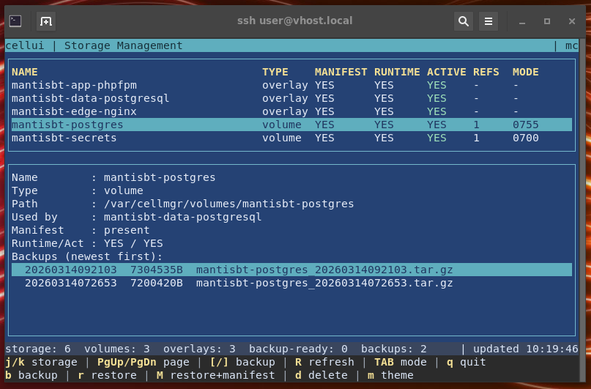
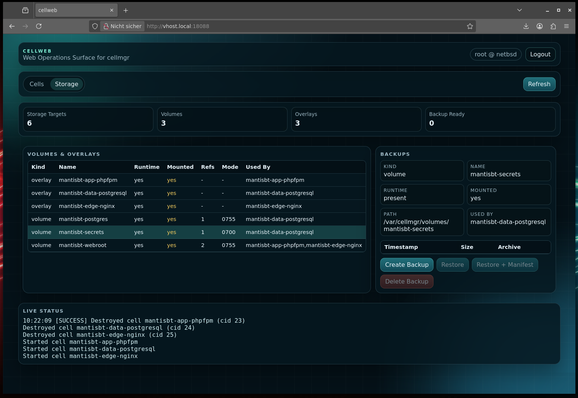
…and for those who wondered about the recurring MantisBT example in the screenshots - that is one of my end-to-end scenarios I use to test the practical viability of the Reconcile Engine, including things like volume management.
The scope is deliberately host-centric. It is not a cluster-wide deployment model like Kubernetes, but always framed around something like a sovereign home server, where I simply want to manage and operate my services in a clean and structured way.
For example, running a bug tracker with its database and reverse proxy - or something entirely different, like a Luanti game server for my son.
Some documentation has also started to emerge, because at this point it can no longer really be explained in a one-pager:
https://netbsd-cells.petermann-digital.de/docs/end-to-end-recipes/mantisbt-end-to-end-example/index.html
https://netbsd-cells.petermann-digital.de/docs/end-to-end-recipes/luanti-gameserver-end-to-end-example/index.html
#netbsd #devops #modernretrocomputing #luanti #mantisbt #selfhosted #clt2026
 Matthias Petermann