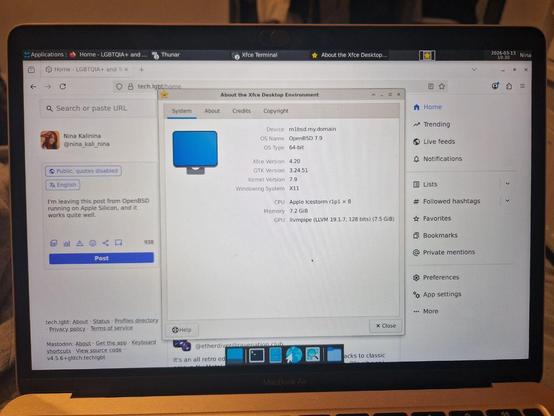
I'm tooting this from OpenBSD running XFCE on Apple Silicon. It was a bit of a learning curve, but it works better than my first Linux did. Display, keyboard, touchpad, Wi-Fi, even sound - they all work. Firefox is quite usable even without the video acceleration, but I'm not sure if I can daily-drive it if I'm not able to play videos on this machine.

This, of course, is only possible thanks to incredible work of volunteers from Asahi Linux and OpenBSD.

The installation is relatively straightforward:
1. Resize your MacOS drive to have enough space for a new OS,
2. Get Asahi Linux installer,
3. Install UEFI-only,
4. Get OpenBSD install79.img and record it on a USB stick (with dd or whatever)
5. Boot Asahi UEFI, it will pick up the stick
6. Install with default settings (skip configuring the network)
7. Mount /dev/sd0i as /boot, find FIRMWARE.TAR on the disk, unpack WiFi firmware to /etc/firmware/apple-bwfm
8. Configure network as usual, install whatever stuff you want, be it xenodm, xfce4, firefox-esr, chrome, etc etc
9. Bonus: configure GDK_SCALE=2
10. Bonus: configure touchpad through /etc/wsconsctl.conf
11. Bonus: configure firefox unveil through /etc/firefox
One scary part in this step is getting the disk partitioning right. Asahi manual and OpenBSD manual say that it is safe to use "Whole disk" setting, as it won't damage the MacOS partition required for the computer to function. The manual does not lie here.

Fdisk tool will show the full size of the SSD on the computer, but OpenBSD installer will still only use the part of the disk that is available for Asahi when "whole disk" setting is chosen.

@nina_kali_nina
this is a wild path to get openbsd on it! how's power management? what generation apple silicon? I knew Asahi was working on apple silicon (of course), but didn't realise any of the bsds were too.
@ejstacey it's MacBook Air M1. I don't think there is any power management beyond adjusting screen brightness, but maybe I have not figured it out yet :)
@nina_kali_nina
Cool thanks for the info. I was wondering how battery life would be, but didn't know if they (the Asahi/openbsd gods) had decoded that firmware yet. Have fun!

@ejstacey it looks like the full charge should last ~3 hours, which is not impressive at all. But I haven't fully measured it yet.

It won't be super cool because closing the lid won't make the laptop sleep, probably...

@ejstacey actually, I stand corrected, apparently there's _some_ apm even since 2023: https://openbsdmailbox.blogspot.com/2023/04/lidaction-on-m1-macbook.html
lidaction on an M1 macbook

openbsd openmail openmailbox

@nina_kali_nina that does looks nice. I really have to take my time to learn some BSD one day.
@nina_kali_nina Very cool
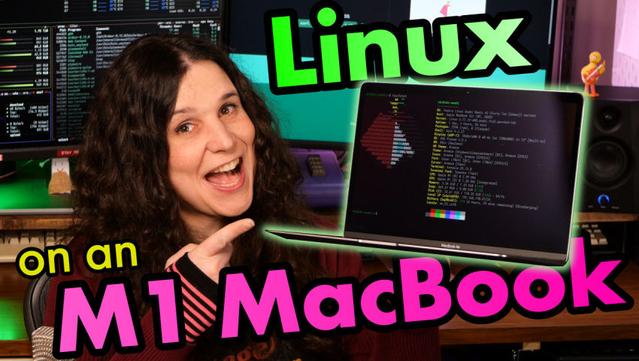
Linux on a Mac (it's not going back)

PeerTube
@ericdere yep, but Linux is on its way to sloppification, I don't want to :<
@nina_kali_nina @ericdere is there something specific why you think that‘s the case?
@Nico @ericdere well, they now explicitly allow LLM code contributions. There is an ongoing pattern of projects allowing LLM contributions, and then having more of them, to the point that some parts of the project have no one who know how they are supposed to work.
@nina_kali_nina man, i get the impression that if someone figures out how to crack putting ubuntu on apple silicon, people are going to absolutely lose their shit
@Viss I mean, there's ubuntu-asahi flavour already, but Linux is going to be dead to me soon :D
@nina_kali_nina is that because of the claude.md now found in the systemd repo?
AI Coding Assistants — The Linux Kernel documentation

@nina_kali_nina @Viss

> AI agents MUST NOT add Signed-off-by tags. Only humans can legally certify the Developer Certificate of Origin (DCO). The human submitter is responsible for:
>
> - Reviewing all AI-generated code
> - Ensuring compliance with licensing requirements
> - Adding their own Signed-off-by tag to certify the DCO
> - Taking full responsibility for the contribution

This is absurd as plagiaristically generated code cannot be certified by a DCO by design, as the origin is not the developer's own work. Do you have a lettuce around to see how it lasts more than this nonsense policy?

@taxorubio @Viss consider: AI generated code is in the main tree for almost a year now :(

@nina_kali_nina iirc M1 ought to be more than fine for 1080p software rendering of videos. My RK3399 SBCs are okey for 720p software rendering.

Is there something else missing on BSD?

@pak0st the CPU is not the bottleneck, framebuffer is: full-screen is 2560x1660 at 30bpp, running this at 60 fps through CPU willpower is tough (1 GB per second of throughput is needed)
@nina_kali_nina
Reminds me that my first unix was NetBSD. I should see about setting it up again.
@nina_kali_nina
My main problem is likely to be old NVidia GPUs though. 
@kirtai it should be supported through nouveau, I believe
@nina_kali_nina
Probably, but one of them is recent enough to play the two games that I like
@nina_kali_nina Hey, a fellow BSD person :D
@Longplay_Games Not yet, but I'm aspiring to. Thanks!

@nina_kali_nina

/narrator And yet the burst of productivity, uninterrupted by videos, became strangely irresistible.

@nina_kali_nina Do you know if OpenBSD Apple Silicon supports external displays connected to a USB-C port? Asahi Linux doesn't (only the real HDMI ports on Macbook Pros are supported), so I don't expect it to work in OpenBSD, but it would be nice to know...
@me_ it doesn't seem to support external displays, which is sad, because I have a Huion Kamvas...
@nina_kali_nina Thanks for the confirmation, what a pity. That makes it a bit difficult to use for teaching... I could use an AMD-based Thinkpad, but where's the fun in that? 🙂
@me_ I wonder how difficult it is going to be to add such a driver...
@nina_kali_nina I think this is one of the harder nuts to crack, the USB controller is already quite complex without the alternative DisplayPort functionality. Most of this will probably have to be reverse engineered, too.
how low is fps for 720p videos?
@hi I can watch 1080p without going full-screen with very little screen tearing, but full-screen is too slow :(