

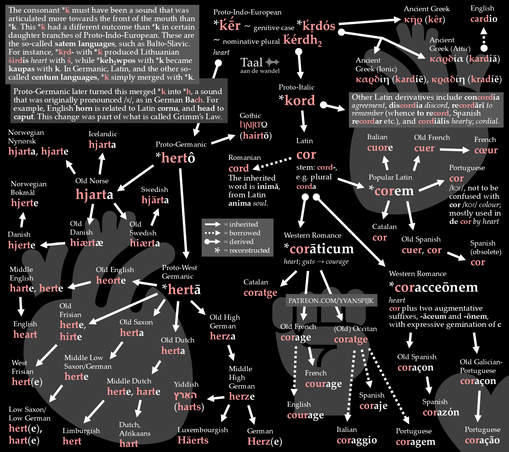
Despite its looks, the English word ‘heart’ is etymologically related to ‘cardio’, ‘cordial’, ‘to record’, ‘courage’, and even Spanish ‘corazón’.

Through Germanic, Greek, and Latin, these words all derive from a Proto-Indo-European root meaning “heart”.

In Germanic, sound changes that are called Grimm’s Law radically changed its consonants.

Click my new infographic to learn how:
@yvanspijk wow. which means sanskrit "hrday" also comes from the same PIE root!
@yvanspijk the ancient Greek (ionic) shows two words, where the second has the rho and alpha swapped, yet the two latinized words in parentheses are the same, is that correct?
@DerPumu That's a stupid mistake of mine. The second latinisation should be 'kradíē'. I'll correct it soon!
@yvanspijk so it takes courage to set the clock to summertime. heart-warming insights
@yvanspijk Would you know a good introduction about how to read those stars, subscripts and various diacritics for reconstructed languages?

@nojhan
This Wikipedia page explains a lot, but it's quite technical:
https://en.wikipedia.org/wiki/Proto-Indo-European_phonology

In short:
- The star indicates that the word isn't attested but is reconstructed: it's hypothetical.
- The *h's with the three numbers represent three consonants that we know were different from each other, but we have a very hard time reconstructing their exact nature.
- The circle under the r is used when this r occupies the position of a vowel, in between two consonants. It must have ... 1/

Proto-Indo-European phonology - Wikipedia

@nojhan 2/ ... sounded like the r in the geographical name 'Krk'. There's also an l with a circle, which must have sounded a bit like the English l in 'bottle' pronounced as 'botl'.
- Small flying h's indicate aspirated consonants. For instance, *dʰ must have sounded a bit like in 'roaDHouse', while *tʰ represented what you hear in 'boaTHouse'.
- The accent on the k is explained in the graphic.