
A really fun dataset for this week's #TidyTuesday, looking at how people interpret different probabilistic statements 📊

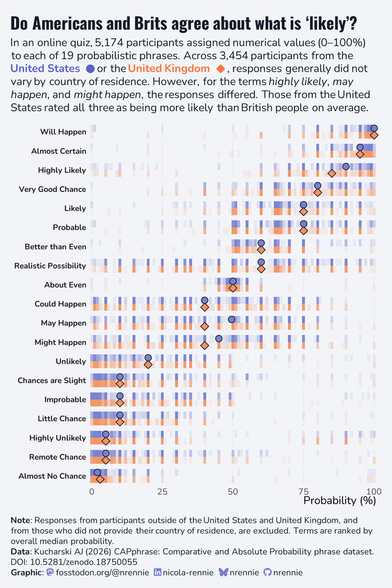
There's so many aspects of this to visualise, but I decided make some barcode plots comparing how people from the UK and US responded. It seems we're much the same with the exception of may/might happen and highly likely - where our American friends are more optimistic!

Code: https://github.com/nrennie/tidytuesday/tree/main/2026/2026-03-10
#DataViz #RStats #ggplot2

@nrennie Very intersting, thank you! One wonders, with answers in the 80-100 percent range for "highly unlikely", if people misread and read "highly likely" instead. (The effect is less pronounced for "highly likely" but still there.)
@geeeero Yes, I wondered that too! The other explanation I considered was that people might be more likely to use those terms sarcastically to mean the opposite?
@nrennie In American English, "may" denotes a greater possibility of something happening than "might" does. I wonder if it's the same in British English?
@DataAngler That's interesting! I'm not sure, I've never really heard that distinction before. In everyday language, I think "may" is often used as a more formal version of "might" in the UK