Forum - LRE Foundation

09-12 March 2026, Arnhem & Nijmegen (The Netherlands) Each year, the annual LRE Forum, organised by the LRE Foundation, brings together members, partners, and tourism professionals for expert insights, networking opportunities, and dedicated travel trade events. Following the success of the 2025 edition in Kraków – and earlier events in Aachen, Florence, Normandy, and Brussels […]

LRE Foundation

The keynote speech by James D. Bindenagel (a former ambassador of the USA) opened strong enough.

His question was: Has "Never Again" failed? Despite avoiding mentioning the conflict in Iran, he also avoided hypocrisy by contrasting the powerful attempts at reestablishing a nationalistic world order, now very prominent in the USA and Russia, with the European project, which is vulnerable despite some of its members openly reaching for the same playbook.

His key thesis was that we are experiencing a severe lack of #empathy on a societal level. #HumanRights and fighting for making empathy a core human ethic again is the solution.

I missed a question not being asked: what social forces lead to the events that ended in freed Buchenwald survivors chanting "never again"? Because these forces are present again today, in one form or the other.

All in all, glad to hear the right framing given to what is to follow by someone who clearly cares.

2/5

The first panel discussion is very rich. I will paraphrase some key points by the speakers.

Jurmet: We need to go to tell our stories to where people who need to be reached most are, like football stadiums. Policymakers need to support democracy with narratives that promote "never again". Politicians need to discuss the support of the common good with institutions and the public directly. Especially the youth. We need not only to teach them, but work together with them on our shared future.

Rafal: It's useful to give young people a chance to use artistic expression in learning emotionally difficult topics. We need to invest into research and finally supporting education transnationally.

Marieke: The main trend that hinders our work is the blatantly open political interference, even in the #Netherlands. Thus us - the audience, - the people within democracies, matter more than ever to make ourselves heard over the voices of malignant minorities.
She also mentions this exhibition:
https://www.vfonds.nl/projecten/women-life-freedom

James: He urges us to use social media to bring relevance to topics that are being trivialised by demagogues and force what matters into discussion. But how to make historical topics emotionally relevant to people of today? To understand, we need to answer another crucial question: we need to understand why we are doing this, why we are commemorating past tragedies, and why we are teaching democratic competencies?

Question from the audience: Is using more digital tools (like social media) really the best way to engage young people?

Jurmet: We need more information, research and knowledge to answer that.

Rafal: We need more innovative ways to make history interesting to young people.

Blandine: Teaching history is indeed more complex than just reaching for digital tools.

Question from the audience: "Never again" is a phrase not relevant to young people. They prefer something like "we need to remember to avoid it happening again". Is the old phrase still useful?

James: It's indeed losing its effect. The debate, however, is what matters, not the specific phrasing. Like how immigrants became neighbours and are, even now, threatened by cruelty. The precaution begins at home. It's about the sentiment and dialogue - catchphrases are just words to convey a meaning.

Marieke: The important thing is how much energy we are investing into preventative work? Who can say that they are part of that effort?

Rafal: There are serious conflicts today. Trauma is fresh. Knowing how to speak about #WW2 helps mediate contemporary parallels.

Question from the audience: Reflecting on the lack of empathy and the divide and conquer tactic, how can we use the former to combat the latter?

James: It is also the responsibility of governments to unify through dialogue and education.

Jurmet: A useful way of increasing empathy through education is multiperspectivity. She quotes Otto Frank:
"We cannot change what happened anymore. The only thing we can do is to learn from the past and to realise what discrimination and persecution of innocent people means. I believe that it's everyone's responsibility to fight prejudice."

This discussion was a practical synthesis of modern educational trends in the non-formal space. I would add cultivating curiosity next to empathy, and would not forget teaching critical analysis, even though it's less trendy to promote nowadays.

3/5

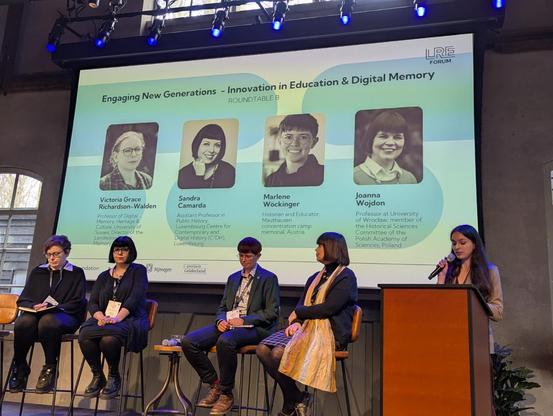
I joined one of the parallel discussions. It's following up on one of the questions from the previous panel by asking: "how to engage new generations via innovation in education and digital memory"?

Marlene: A lot of adolescents, adults and elderly come to visit the former campsite (Mauthausen). A recurring question they ask is: "what does this have to do with me?" The memorial site educators work with this question, and besides building on what preexisting knowledge visitors bring, they developed new methods to flow with the times, such as using short-form videos (like #Loops) with accompanying teachers' guides. These videos work by answering that very same question, even though this format is very challenging for the use of building remembrance. The positive side is that this way education can reach outside of the classroom. However, this approach requires significant resources. It is ineffective against people who have been radicalised by destabilising disinformative campaigns.

Joanna: Teachers and museums (and, more broadly tourist attractions) should always work closely together. Museums have the specific subject matter knowledge, while the teachers are equipped with the adequate pedagogical knowledge. Ultimately, both groups should work with students - to teach human history to human beings. The pupils should not be taken as naive young people.

Sandra: Constructing historical knowledge requires fragmentation, dissonant sources and contextualisation. Usual educational narratives miss this tension-filled process in the name of streamlining learning. Digital tools, like serious games, can help introduce nuanced learning in pre-tertiary learning.

Victoria: Research shows that there is an immense amount of innovative creativity in #EduTech but most of it gets muffled due to lack of funding and/or adequate research. There is a strong tendency by solution providers to jump on the #VR or AI bandwagon, striving for interactivity and immersion, while users don't always want interactivity. Instead, they are looking for innovative data representation approaches (e.g. five digital collections of testimony videos versus a 3 hours long tape of one testimony). Museum visitors often don't want to use QR codes and their phones - they want to be immersed in the analogue space.

Marlene: As a professional, begin with using methods and tools you already know to work well. They do work for a good reason. You can build from that and explore innovation.

Victoria: Nowadays, there is also a switch through media exposure to how memorialisation is done: immediately and without historicalisation (collecting testimonies for teaching from victims while the conflict is still ongoing). That significantly changes how historical pedagogy needs to approach these sources.

Sandra: Correcting the "proper" application of new formats and tools (like #AI) is not the point, but understanding how they are different and how that difference can serve as an asset to expand the established frameworks is.

Question from the audience: How can the depth of historical learning be effectively translated into short attention span grabbing media?

Marlene: History simply cannot be translated into a 90 second video. The format doesn't allow for the real, implicit depth. There are ways to work with this, but this approach is not complete.

Sandra: The point of these approaches is different. The goal is getting the foot in the door of interest through captivating storytelling.

Question from the audience: How has the fact that many of popular social media platforms are owned by corporations and within countries that are unaligned with teaching inclusive and multiperspective history affected your work?

Marlene: The algorithms in fact don't react well to something like female victims of sexual abuse. When platforms become too saturated with destructive agendas and become useless in terms of teaching, we need to leave them behind. We abandoned X, for example. However, we still feel the need to reach young people, and many of them are on these platforms.

Victoria: To be frank, it is unavoidable to talk about some owners of these platforms being openly fascist and chauvinistic. But abandoning these platforms currently means withdrawing from the discourse and disappearing from the view of our target audiences.

I was happy to see young members of the audience ask the questions the more experienced speakers should have elaborated on. I favour adaptive pragmatism when looking for solutions (in education especially), so this balanced and self-reflective conversation played well into my biases.

4/5

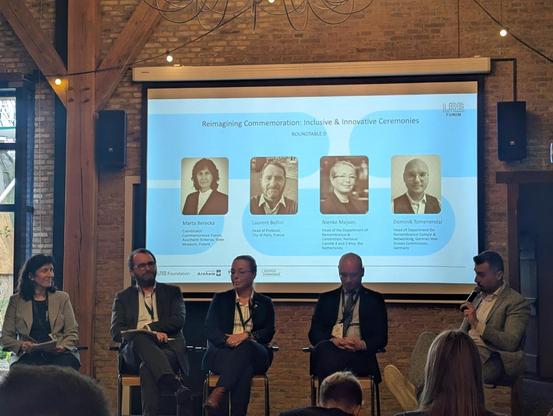
The final discussion is about reimagining #commemoration (of WW2) by making #ceremonies more inclusive and innovative.

Laurent: He details the 5 ceremonies on the 80th anniversary of the liberation of Paris on August 25, and calls on the importance of including young people and facilitating their learning during such events. Modern technology allows new elements to be added, like recorded music that evokes a certain atmosphere (he recalls the time when they used the theme song of The X-Files during commemoration for its eerie sound). It is necessary to invent new ways of reaching younger audiences, since older generations and primary eyewitnesses who consider coming to these ceremonies a duty, will one day soon pass away. Yet, the commemorations need to stay alive. For that to happen, physical places need to be visited. Digital substitutes simply do not have the same power: visiting Auschwitz-Birkenau and experiencing its memorial power is not possible without being physically present. #XR and AI can well support learning if used responsibly, but cannot substitute commemoration in situ. Places cannot be replaced.

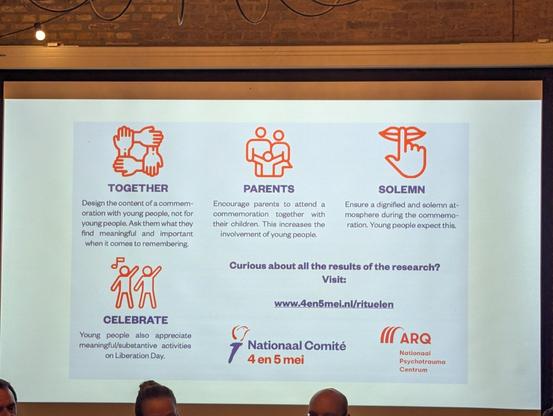
Nienke: In the Netherlands, there is quite a unique way of commemoration: on the 4th of May we commemorate, while on the 5th we celebrate (#Denmark being the only other country with such a tradition). As of this year, there are 15 festivals for the celebration of liberation (the 15th being organised in Curacao). There was a discussion how to bring people closer together during these events, especially in the modern times when many tend to isolate within their personal slice of cyberspace. They realised that the answer is sharing food, and thus they offer "freedom meals" during which people talk to each other. What it comes down to ultimately is building respect. For that to happen, it is necessary to be transparent and strict about what is and what is not talked about during the ceremony. Thus, reflecting on contemporary conflicts is welcome, but this is done with the respect to the main reason of gathering: commemorating the past.

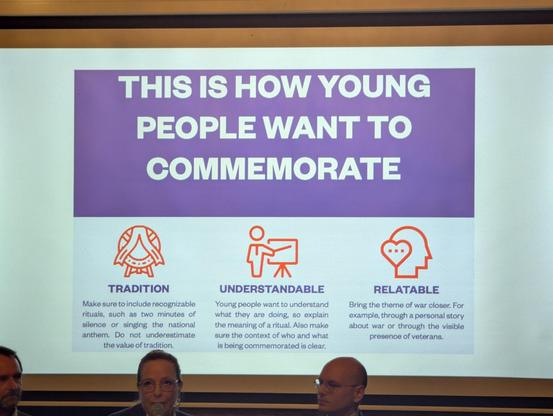
If we make things understandable and relatable, she continues, young people will participate, understand the associated rituals, and learn respect and responsibility. Especially the power of rituals (such as the 2-minute silence at 20h on May 4) we must not underestimate. They must be continued, but they also need to evolve. For example, young people don't just want to stand on the side and recite a poem, but want more involved, active roles in these events. It is important to note that there is an age period when organisers can lose the interest of young people, during their most turbulent adolescent years (16-23), but they often come back, especially if they participated when they were younger.

Dominik: In Germany, for obvious reasons, commemoration ceremonies don't have a celebratory nature. There are those organised with international partners, with a lower profile, either for the general public, or focused on youth with cultural approaches relevant to them (such as approachable live music like Bach that is not necessarily evoking sadness). They also have a ceremony in the parliament, inviting international political figures as guests. It is important for politicians to publicly address important past events. The international dimension is crucial in Germany. Some sites are in need of renovation, which requires funds. Failing to restore such sites where ceremonies are held poses a risk of diplomatic tension. It is also important to avoid all censorship during ceremonies. Representation is crucial (such as commemorating the homosexual victims of the Holocaust).

Marta: There are several ceremonies at Auschwitz-Birkenau, but she focuses now on the one held on January 27 (camp liberation day). This ceremony was strongly shaped by the survivors' own initiatives. It evolved from the ceremony of laying flowers to incorporating a very strong educational dimension. Continuity is an important factor that ties the yearly events together, while respect is the principle that guides them. Combining education with the commemorative and respect-paying nature of these events is the main pedagogical challenge. For that, we need to preserve as many testimonies of survivors as we can, while still possible. How commemoration without survivors will look like in the future remains an open question.

This closing session was encouraging to me in the sense that I see professionals from adjacent sectors being forward-thinking and careful in some of their assessments, but adamant in some of the established values of modern, science-led education.

If you don't yet know the Liberation Route Europe, which is one of the flagship initiatives of the LRE Foundation (who organised this event), check it out here:
https://www.liberationroute.com/en

5/5