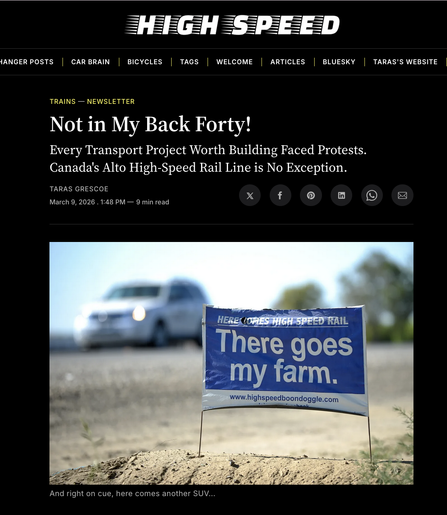
...but the media is foregrounding farmers, and Conservative politicians, who want to derail the project.
The same has happened in #California, where litigious landowners have stalled high-speed rail, causing costs to skyrocket.
...but the media is foregrounding farmers, and Conservative politicians, who want to derail the project.
The same has happened in #California, where litigious landowners have stalled high-speed rail, causing costs to skyrocket.
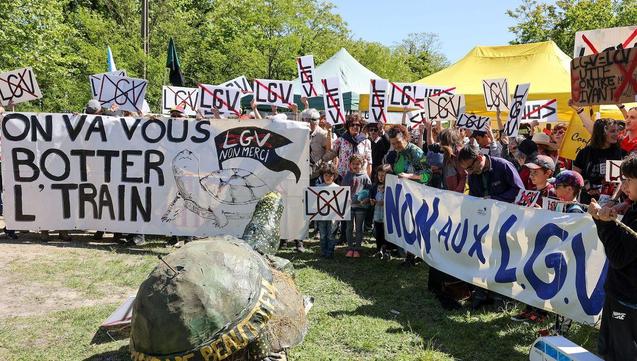
If you look back, every high-speed project, from Japan's original bullet train to #France's TGV, faced NIMBY protesters. (Winemakers claimed railway vibrations would wreck their grands crus!)
It's all part of the process of building ambitious infrastructure.
The alternative to fast railways is more runways and highwaysβthe most polluting forms of inter-city transport.
I take a look at the history of opposition to railways, going back to England in the 1830s, in this HIGH SPEED newsletter:
One of the reasons NIMBY opposition can get a foothold is failure to use existing Rail-Right-of-Way.
For Alto, the plan is an entirely new route. The reason is the existing #RRoW is owned, aiui, by CNR due what I would describe as an exceptional subsidy to industry.
This is why the #Cascadia #HSR plan began by first acquiring RRoW from #Oregon through #Washington to #BritishColumbia. It is shovel-ready, once the plan is completed.
@straphanger After first line built between Paris and Lyon, SNCF learned and has standards on crossings for farmers. So whenever they want to build new line, the farmers know in advance what they can expect.
The problem in Canada is Alto won't even release its route (or possible routes) and certaintly hasn't don any standard on crossings for farmers and small roads so there is much uncertainty and people just see a 200km long fence blocking any crossing.
@straphanger When NIMBY farmers want to stop a rail line, they're celebrated.
When NIMBY farmers want to stop a pipeline, highway, or power line, they're demonized.