Chris Edsall
 Lars Brinkhoff
Happy birthday, PDP-10!
@mral Nice! When was this?
Do you remember any serial number?
@mgarraha @karlauerbach @larsbrinkhoff
DEC Fortran was still like that when I was working in it in 1980, as Fortran77 hadn't been accepted as FIPS yet.
(I recall being annoyed that the unused bit wasn't the sign bit, which would have been convenient to mark last word or not last word, but rather the units bit.)
and DecSystem 10 COBOL packed more, iirc, i forget if it was 6×6-bit characters?
(In theory could fit 7×5-bit old TTY chars, ugh!)

@karlauerbach It's very much true; the PDP-6 and 10 instruction sets are about 99% compatible.
Do you remember if the Berkeley PDP-6 was installed in the basement of Cory Hall?

@larsbrinkhoff An image description would be really nice to have for this post. Here is the main text:
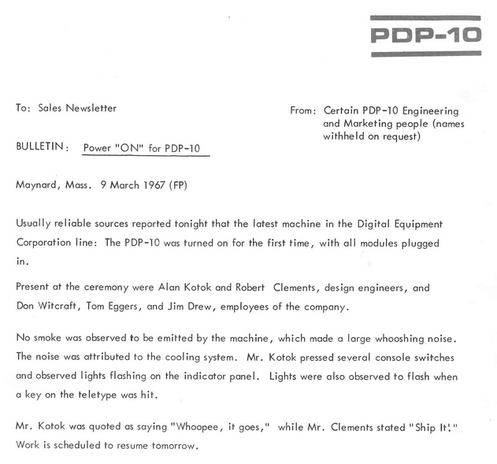
BULLETIN: Power "ON" for PDP-10
Maynard, Mass. 9 March 1967 (FP)
Usually reliable sources reported tonight that the latest machine in the Digital Equipment Corporation line: The PDP-10 was turned on for the first time, with all modules plugged in.
Present at the ceremony were Alan Kotok and Robert Clements, design engineers, and Don Witcraft, and Jim Drew, employees of the company.
No smoke was observed to be emitted by the machine, which made a large whooshing noise. The noise was attributed to the cooling system. Mr. Kotok pressed several console switches and observed lights flashing on the indicator panel. Lights were also observed to flash when a key on the teletype was hit.
Mr. Kotok was quoted as saying "Whoopee, it goes" while Mr. Clements states "Ship It!". Work is scheduled to resume tomorrow.
@larsbrinkhoff @larsbrinkhoff I always thought DEC 10 Day was October 12th. Turns out it's March 9th.
Kotok used to come around TMRC when I was there in the late 1970s. He always had stories.
@dws Thanks, I didn't know about that stop code.
Another similar thing is RPG "rapid program generation", and also Richard P. Gruen.
"No smoke was observed to be emitted by the machine" 😍
I test my power tool fixes the same way.
Do you know what the relative speeds of the PDP-6, KA-10, and KL-10 were?
The MIT AI Lab's PDP-6 was quite stable at about 1/3 of a MIPS. Maclisp was fine on a KA-10 and really sweet on a KL-10 ('73-'76 period).
Later ('82-'86) I was using Yale's Scheme implementation ("T") on 68010 and 68020 workstations. On the 68010 workstations it was horrifically slow, but quite fine on the 68020. The internet claims the 68010 was a "1 MIPS machine", but my actual experience differs...
@larsbrinkhoff @djl
The KL-10 is roughly a 1MIPS machine; the microcode engine is about 5MIPS.
The KI-10 is about half as fast, and is of course a hardware implementation with no microcode.
I think, but am not certain, that the KA-10 is about 300KIPS, again in hardware.
I have no figures for the PDP-6 other than the clock speed, which was 2 microseconds per cycle (quoted from the magazine advertisement at
https://www.panix.com/~alderson/PDP-6_advert.jpg
).
Thanks. I guess the MIT AI Lab PDP-6 may have been hacked up to run faster, or maybe the 1/3 MIPS I remember is wrong. Or was the microcode speed.
Another problem here is that for running Lisp, the PDP-6/10 instruction set is seriously optimal. That the 68010 is claimed to be a 1 MIPS thingy, but in real life was horrific for Lisp, was that it was "1 MIPS" for 16-bit arithmetic and a tiny fraction of that for slinging around pairs of 32-bit pointers...
Unrelated 36-bit computer trivia.
Today I learned that the IBM 701 was a 36-bit, 16,000 addition operations per second, vacuum-tube computer, and was released the year I was born.
The all-relay Harvard Mark II (5 years earlier) could do about (drum roll) 24 operations per second.
Thus supporting my point that vacuum tube computers were about 1000 times faster than relay computers. We had to wait a long time after the 701 (1952) to get another factor of 1000.
@larsbrinkhoff @cstross : today, I learned that I share my birthday with the PDP-10!
(already knew about Youri Gagarine and about my son but that one is new)
 AL
AL Karl Auerbach
 Bill Ricker
 Mike Garrahan
 M Horstmeier
 retroprom
 🇺🇦 haxadecimal 🚫👑
 Kernel Bob
 Dave W Smith
 Mikko
Mikko Fusselwurm
 Jyrgen N
 David, a Bostonian in Tokyo.
 ploum
ploum Mason Loring Bliss
 Gemma ⭐️🔰🇺🇸 🇵🇭 🎐