 Lars Brinkhoff
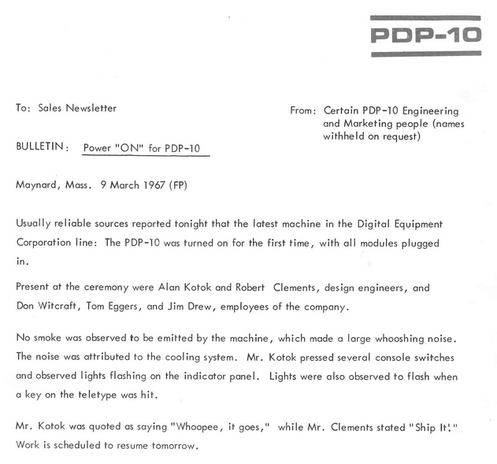
Happy birthday, PDP-10!
Do you know what the relative speeds of the PDP-6, KA-10, and KL-10 were?
The MIT AI Lab's PDP-6 was quite stable at about 1/3 of a MIPS. Maclisp was fine on a KA-10 and really sweet on a KL-10 ('73-'76 period).
Later ('82-'86) I was using Yale's Scheme implementation ("T") on 68010 and 68020 workstations. On the 68010 workstations it was horrifically slow, but quite fine on the 68020. The internet claims the 68010 was a "1 MIPS machine", but my actual experience differs...
@larsbrinkhoff @djl
The KL-10 is roughly a 1MIPS machine; the microcode engine is about 5MIPS.
The KI-10 is about half as fast, and is of course a hardware implementation with no microcode.
I think, but am not certain, that the KA-10 is about 300KIPS, again in hardware.
I have no figures for the PDP-6 other than the clock speed, which was 2 microseconds per cycle (quoted from the magazine advertisement at
https://www.panix.com/~alderson/PDP-6_advert.jpg
).
Thanks. I guess the MIT AI Lab PDP-6 may have been hacked up to run faster, or maybe the 1/3 MIPS I remember is wrong. Or was the microcode speed.
Another problem here is that for running Lisp, the PDP-6/10 instruction set is seriously optimal. That the 68010 is claimed to be a 1 MIPS thingy, but in real life was horrific for Lisp, was that it was "1 MIPS" for 16-bit arithmetic and a tiny fraction of that for slinging around pairs of 32-bit pointers...
 David, a Bostonian in Tokyo.
 Rich Alderson