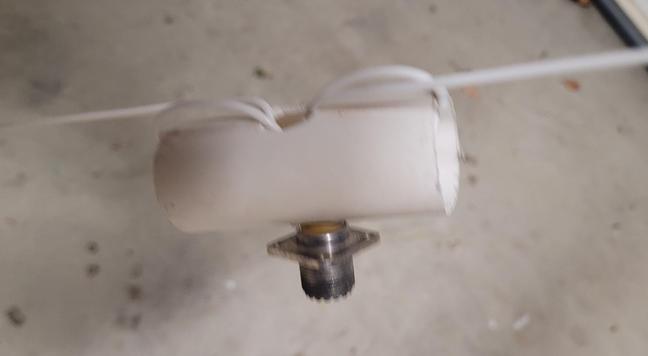
Someone asked me about ham radio antennas today, built one out of scrap parts to give them. Radio antennas are easier in metric. ðŸĪ”

Fancy 3D printed parts are not necessary.

This is from the "practically free" school of antenna builders. (Random spool of wire acquired somewhere for $1, scrap pieces of PVC from out in the yard, and the antenna connector off an old broken CB radio that would have otherwise e-wasted).

#hamradio #antenna

The cheapest version of these you see for sale are around $50. The "tactical version" will cost you $460 (in camo and with fancy carrying case and fancy 3D printed antenna wire holders). 🙄

(I make more contacts on my el-cheapo free antennas than people who buy any "tactical antenna" ever will).

#antennas #hamradio

They teach you the "English system" on antenna calculations in the US.

468 / Frequency = half wave dipole in feet
Then multiple by 12 for inches, divide by two for each side blah blah blah

In meters, 142.5 / Frequency = half wave dipole... but it corresponds to the band names.

In meters, for a 10 meter dipole at 28.500... you need an antenna that is 5.000 meters (half wave of 10 meters). 🙄 That's WAY EASIER.

20 meters at 14.250Mhz? 14.250/142.5 = 10 meter half wave dipole.

#math #antennas #hamradio

@ai6yr I know people (Ben knows the same people) who get totally bent out of shape when I tell students to ignore all of those idiotic formulae. (Is Stu on Mastodon? I don't know...)

I don't care what system of measurement people use-they are ALL arbitrary, period. But MIXING systems is the very picture if stupidity.

We name Ham bands in meters. So do the calculations in meters, in your head, or on your fingers. Yes, Home Depot sells metric tape measures.

@W6KME @ai6yr I find mental arithmetic hard. Just a quirk of my working memory. And I can never remember "468" without seeing it. I look away and remember some other number. (Probably 486 because Intel...) 300, on the other hand I can remember.

So for the ham tests, even the questions in imperial measurements I did in metric. 40 inches is close enough to a meter to give me the right answer on the multiple-choice questions. Heck, for most of them, 3 feet is close enough to a meter to get the right answer! Once I passed the tests, I could just work in metric without the side trips through imperial.

Also, I have a machine shop in my basement. I do all of my design in metric, and I use metric hardware unless I'm interfacing with something that already exists. My mill has a DRO that is natively metric (though you can configure it to display imperial units). My lathe does not have a DRO and has only imperial. So... a common workflow for me is to set my calipers to a desired dimension in metric, zero them, change them to imperial, then measure the part in the lathe, and the display tells me how much I still have to remove in decimal inches so that I can use the handwheel that is marked in decimal inches. Because it's a large lathe, buying a DRO for it will be a substantial financial investment.

So, anyway, I guess I'm the very picture of stupidity...

@mcdanlj @ai6yr Your tools force you to switch from one system to another. That's logical. The ARRL instruction manuals force people to use multiple systems in the same calculations, with arbitrary and unintuitive numbers like 468. THAT is what I am calling stupid.

Side note: the way all three US license exams are written, and the multiple choice answers available, make me believe they intended for people to use the easy head math, not the goofball mixed formulae in the instruction manuals.

@W6KME @ai6yr I wish that both the ARRL and the test questions would just get off imperial measurements entirely.

Then when it comes to lengths and frequencies, in practice all you need is "Whatever you want, 300 divided by what you have is the answer" 😁

@mcdanlj @ai6yr I can't tell you how frustrating it is an an instructor. it could be so easy.

Since I am That Guy, I have to say this or my head will explode...I'm sorry in advance! The USA has never used Imperial measurements. US Customary Measurements have the same origins as Imperial but there are some significant incompatibilities. The Imperial system dates to the early 19th century, a time when the US would certainly not been interested in adopting anything decreed by the British crown. ðŸĪŠ

@W6KME @ai6yr Ooooh look, a shiny soapbox! Mind if I borrow it for a moment? I promise I'll give it back when I'm done! ðŸĪĢ

I do in fact know about US Customary, including some of the history of changes to its definitions, but most people don't. In technically precise usage, yes "US Customary" is correct. However, in informal usage meant to actually communicate in a public context where the majority of people have never heard of it but do know "Imperial", in my opinion it's a kindness to the majority to use the colloquial term rather than the technical term. No one who knows the difference will be confused by my imprecise colloquialism.

It's like the famous court case about the tax on "fruit" where the court said more or less "yes, we know that a tomato is botanically a fruit, but it is culinarily a vegetable, the point of the tax was a luxury tax, and tomatoes were not what the legislators had in mind."

(These days, sometimes I think that the most die-hard royalists are in the US... 😎)

Anyway, you can tell what side of the prescriptivist/descriptivist divide I'm on! And fully aware of the irony of being opinionated about it...

During the next three weekends, I'll be helping teach new ham classes. Fortunately for me, and possibly fortunately for the students, the sections for which I'm responsible are not those in which mixed measurement systems come up. (What's the US Customary unit for Electromotive Force? ðŸĪĄ)

@mcdanlj @ai6yr I want to add...I didn't mean to say I thought you didn't understand US vs Imperial, I just didn't have many characters to work with. Anyone with a mill and lathe in their basement will definitely be one of the Illuminated Wise. 👍
@W6KME @ai6yr To be clear, I wasn't taking offense, I was just responding in the spirit of the original for amusement. Hopefully amusement for you as well as for me!