I've been thinking I need to try out and switch to #Linux when I replace my current Win 10 laptop.

But I was just reading about how to set up dual boot and it occurred to me: Why don't I start now, running the flavours of Linux I want to try off of external storage? πŸ€”

If I did that, would I be able to transfer the existing Linux install off of the external USB/SSD to a bootable partition in the future?

Anyone know?

(Approaching it this way would actually be better, if it works, because if the hardware in the aging laptop fails, my OS would be on the external drive.

The challenge would be how to back up the external drive in the meantime.

Now fast, higher capacity drives are available, maybe I should always just do this πŸ€” Aside from access speed, is there any downside?)

@tokyo_0 I have always been very happy doing this. One pickle is that what as time claimed my computers became my main one only had two usb drives, and that meant the os took one of them.

An sbc is, I guess, within a factor of ten of the drive you would want, if you don't need a lot of space. So why not just use an sbc?

@screwlisp You mean like a Raspberry Pi or something? I kinda want to use the laptop πŸ˜… Did I misunderstand? (That is a good point about the USB ports. I have a big powered USB hub hanging under my desk, but it does need replacing and it seems harder to get them right now.)
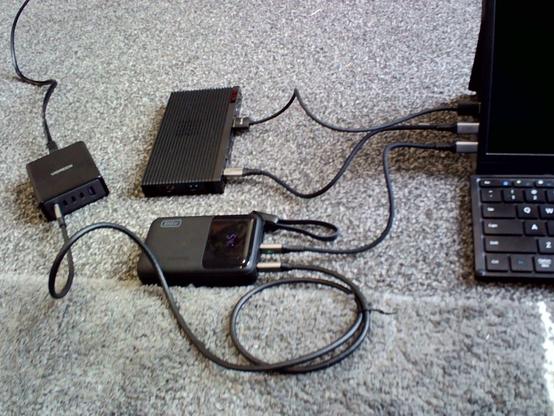
@tokyo_0 one of my computers runs off usb drives / external harddrives, my recent replacement one is a fancy sbc rig (palmshell rather than raspberry pi) :
@screwlisp That is an interesting option, for sure. What do you use for a monitor (for the palmshell one)?
@tokyo_0 someone gave this to me, I guess it is an NNW 16".
@screwlisp I don't know what that is - Google doesn't turn up anything either πŸ€”
@tokyo_0 I read the brand name upsidedown, it was MNN
@screwlisp Aha! I found it - thank you ☺️ That's a really interesting idea. I'll definitely give it some thought before splurging on a whole new laptop πŸ‘
@tokyo_0 why not, i used #rsync to transfer my older installation on a ssd, then you need to modify /etc/fstab accordly to new UUIDs
@lcruggeri Right now that's something I wouldn't know how to do (rsync is probably ok, but modifying fstab sounds a bit intimidating). I'd definitely give it a go, though. Thank you for the info and the encouragement! ☺️

@tokyo_0 yep, you can 100% do this.

Once you find the one you like, you can clone it to an internal drive with a tool like clonezilla

@rogueren Thank you! That sounds perfect πŸ‘

@tokyo_0 well, this is a coincidence. I posted about that just yesterday.

https://fosstodon.org/@geraldew/116180557035949092

p.s. edit: while it does get covered in my articles, the trap-for-new-players is that EFI booting introduces some risks about how updates get handled.

I took took two years to resolve that aspect - and that was the core reason for writing the articles.

The earlier (MBR) booting methods didn't have that problem but by now that's moot as modern hardware doesn't usually boot that way.

@geraldew Fabulous! Thank you so much for sharing this - it's so helpful that you've gone into this level of detail as well πŸ™πŸ§‘

@tokyo_0 I use Gparted live for this running off of a usb stick. That way neither the source nor destination disc is in use at the time of copying.

You can use the Gparted GUI to copy/paste partitions from the source drive to the destination.

Other tools I have used to copy disc images are dd under Linux (cli) and the Raspberry Pi "SD card copier". The latter is misnamed as it can copy to and from any type of media SSD/SD card etc.

#gpartedlive #gparted #dd #raspberrypi #linux

@tokyo_0 I did this the last time I installed Linux on my remaining elderly parent's (REP) laptop.

They inherited a usable laptop from the deceased parent so I decided to set that up as a back up machine.

I installed the image the way I wanted it on the back up laptop, then booted into Gparted live.

I copied the whole drive image over to the new SSD for the REPs main laptop and when finished I installed the SSD in the main laptop.

@tokyo_0 The back up laptop is one with an Intel CPU and chipset while the REP's main laptop has an AMD CPU and chipset.

I didn't have to do anything to get the AMD laptop to boot into the image from the Intel back up laptop.

I have done this before booting a Linux image installed on an old Intel macbook on a much newer AMD NUC machine.

@the_wub Very neat, and great to know too - thank you for sharing, especially with the different software you've found helpful as well!! πŸ‘
@tokyo_0 I have always used debian based Linuxen but I assume that other flavours are equally accomodating. YMMV.
@the_wub That's a good point - thanks for mentioning it. Right now I'm looking at regular Linux Mint. I'm going to try out a couple of different distros, though, before I decide on one, and I'll check out how accommodating they will be with this, too. Appreciate the pointer!

@tokyo_0 LinuxMint is based on Ubuntu which means both are based on debian.

I am a long term LM XFCE user and tend to use debian XFCE on my Raspberry Pis.

I still have one PC with Xubuntu on it which is Ubuntu with the XFCE desktop. LinuxMint XFCE is still more polished than Xubuntu in some small and subtle ways.

@the_wub Interesting! I haven't even started digging into the variations of Mint itself, although I knew there were a couple. I used to use standard Ubuntu. Am tempted to use something as standard as possible as I had an experience with Ubuntu before where its audio drivers got messed up for my hardware and I was without a working mic for about six months at a time when I really needed it. But I'll definitely look into the Mint flavours - thank you for the recommendation for XFCE!
@tokyo_0
I can recommend Clonezilla for this task.
A live #Linux with a guided tool to clone your external disk to your internal.
@burki Thank you, this sounds good - it's great to know these tools are out there and that others have had success with using them!
@tokyo_0 yes you can do that, just do a LVM setup then you can migrate it live easily