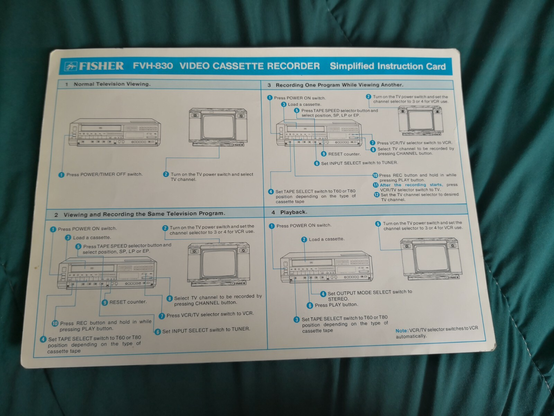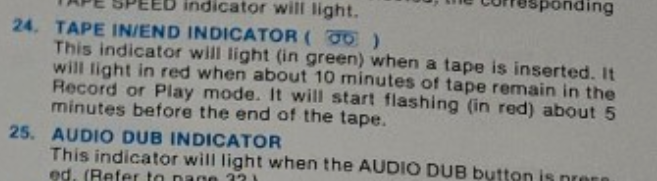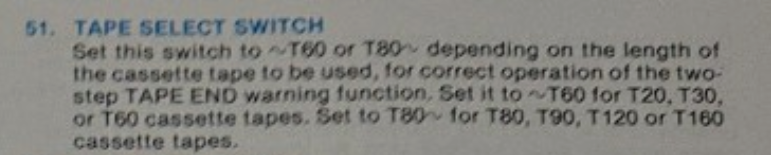
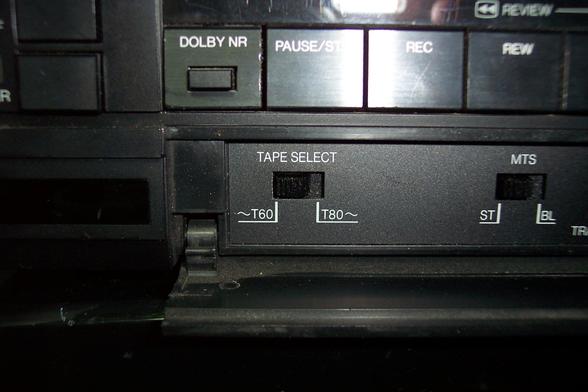
One odd thing about the 1985 Fisher FVH830 VCR I used in my Macrovision video: it has a "tape select" switch with positions marked "~T60" and "T80~". The manual just says to set it to the length of tape you're using, and gives no further explanation. I guess the squigglies are supposed to mean "T60 or shorter" and "T80 or longer", but who was using tapes that short, anyway? I thought T120 tape was already the norm long before then. And why would it matter?

@vwestlife Is there a "time remaining" counter?

I had a VCR that would calculate this after a minute or two, presumably based on the speed of the two reels. Shorter tapes (with the fat spools) might confuse this?

@vwestlife Does this model have a tape position counter?
@riley It does not have a real-time counter. (I don't think any VCR had that yet in 1985.) It is just a numerical counter. And there is no variable-speed rewind or fast-forward; it runs at the same speed until it hits the clear leader at the end of the tape.
@vwestlife @riley there were models with a standard counter, but that had a time remain feature. It worked by comparing the speeds of the two reel tables, but it needed to know the length of tape used. T60 and T80 are extremely odd values though
@probnot @vwestlife @riley Same reason my Aiwa AD-F770 cassette deck has a tape length selection - so it can accurately estimate the tape remaining.
@vwestlife Mechanical counters were definitely a thing for audio tapes before that.
@vwestlife I think they were paving the way of low cost, mailable, 10-15 VHS tapes 😀
@vwestlife Maybe it somehow adjusts the torque depending on the length of tape?

@jenny753 @vwestlife It looks like the switch is also on the FVH-839, and there's an ebay ad for the manual with more photos. https://www.ebay.com/itm/358090306173

It's used for the "Tape end indicator" light. So it's like a very basic version of a time remaining counter, but probably uses a similar method of comparing reel table speeds.

@vwestlife Could it have been that the early short tapes were thicker, and needed some sort of careful spooling lest the looseness of the tape cause the tape not fit onto its uptake spool, and later tapes were thicker and could be safely spooled in potentially-faster-but-less-steady ways? I suspect if this was the case, ordinary playback would necessaarily have used the carefully controlled steady spooling both ways, but fast forward/rewind might run faster if the switch is in the "T80~" position.
@vwestlife Sorry, I now saw your post in the other subthread. If it didn't do variable speed FF/RW, this doesn't apply.