 Andrew Zonenberg
Wrote up the blog-format version of the TCXO failure analysis including a bit more backstory and commentary all in one place
 witch hat hacker


@haskal thanks fixed
 Attie Grande
@haskal @azonenberg Another at:
> Aftee a bit of poking, I found what looked to be a textbook quartz crystal resonant curve
 Laíns ⚡🌈🇵🇸
@azonenberg oh, nice! you managed to get it open
@MissingClara And identified the failure point, and a strong suspicion of the two contributing causes
 vxo
vxo@azonenberg
So I guess I'm going to avoid screaming at my TCXOs then
So I guess I'm going to avoid screaming at my TCXOs then
 Stewart Russell
@vxo @azonenberg yeah, don't shake the singing rocks
@scruss @azonenberg Seems legit. At work we had these Lectrosonics IFB receivers that would often break crystals when dropped hard. What's weird is I've seen Sennheiser stuff survive getting basically used as hockey pucks and surviving multiple HARD impacts that never skipped a beat, but something about the way the Lectros are constructed would murder the crystal.
@vxo it always amazes me that they work at all. Though I do have a 10.000000 MHz OCXO that I think I've managed to fritz entirely by dropping it
@scruss ow!
I have a 10 mhz OCXO as my transfer frequency standard at home, it's a well aged unit. My frequency counter's internal reference is absolute poppycock so I use that with it. My cat appreciates the warmth after it's been powered up about an hour prior to use.
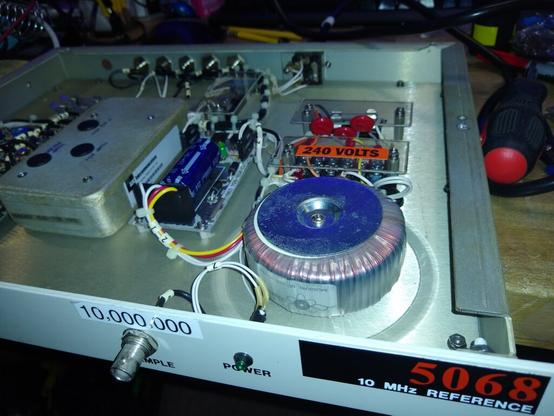
@scruss Load-bearing masking tape used during calibration is a phrase I think should be more common because it's hilarious.
But yeah, you can see the OCXO unit itself in the preview pic here - it looks like a distinctly in-house designed thing in a Bud box full of what might actually be fancy ceramic fiber insulation.
@vxo that's quite a nice OCXO. Still annoyed that I missed out on a Rubidium standard when a local ham got a bunch for very cheap years back. Ah well ... I'll never be as cool as the guy I met who had a Shortt Synchronome set up in his office.
@scruss HECK that looks neat
I have a weird thing I bought a few weeks back that might contain some kind of OCXO driven 60 hz reference (!) and has an adorable mechanical clock on the face of it, I've gotta see what's inside it. It even has a receptacle on the back rated for 120V 7 watts. Only use I can imagine that low power output having would be like, driving a strip chart recorder motor
@vxo very neat, is a Synchronome. He was somewhat eccentric: when his work required that everyone senior must have carphones, his phone was worth considerably more than the beat-up Saab 96 it was installed in.
@scruss I swear every time I hear about someone having a Saab they're an eccentric engineer and the car is probably missing about 30 screws
@vxo as long as that one vital screw (most likely a wood screw) is still there, the Saab will hold together. It'll flex a bit, but nothing that Erik "On The Roof" Carlsson couldn't handle
Said engineer was the chief wind turbine designer for many companies. He is why wind turbines spin the direction they do. If he's not fully retired, he's doing something with a carbon capture startup.
 Lee Holmes
@azonenberg Super cool analysis! Thanks!
@azonenberg
> It took a bit of experimenting with external GPU enclosures and such to figure out how to get the ThunderScope to sit out on my lab bench so I wouldn’t need to crawl under the bench and run cables up from the workstation on the floor up to probes on my DUT, but I figured that out easily enough.
I'm looking forward to reading the rest, but I'm also very interested to hear more about this if you're able! I opted for the Thunderbolt variant precisely because I didn't want to dig for connections. Might be reconsidering my choice now... 🤔
@attie The keyword to search for is "OCuLink" which is basically just PCIe over cables.
On the PC side the adapter card is just a passive PCB taking the differential pairs from a PCIe card edge connector and shoving them over a SFF-xxxx (forget the number) cable.
On the enclosure side, typically you have a board with a SFF connector and a 12V DC power inlet that converts it back to a PCIe connector you can slide a card into.
@attie note that many oculink carriers are just the card edge connector and provide no side support so i 3d printed a card guide to go around the pcb and keep the TS from wobbling side to side
@azonenberg Good info, thanks! I was aware of the PCIe 1x stuff from mining, but didn't know about this. (4x)
Did you manage to find an "enclosure", or just one of the open-air adapters? (from your wording, I presume it's just an open-air variant?)
@attie i took the pcb from an open air adapter and 3d printed an enclosure around it
 TommyTorty10
@azonenberg Just wanted to pop in and say I read your article in my RSS reader, and I really liked it! Thanks for writing and sharing!