 Andrew Zonenberg
OK, oscillator failure analysis step one: Cleaning residual solder off the underside so it sits flat on the mill table. Then a final cleaning with acetone to get any flux residue off.
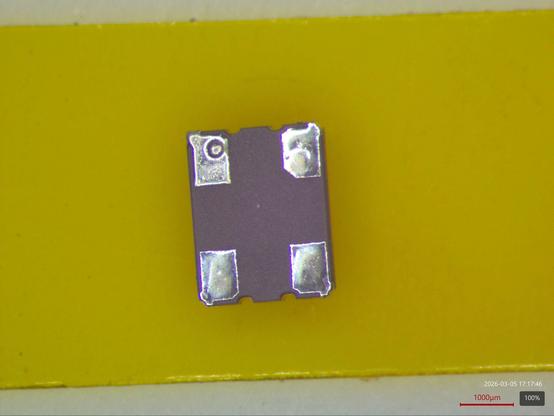

I wasn't sure if I could mount it to the mill table without it flying off because it was so small, so I mounted it to a ~1cm copper disk with some crystalbond wax.
This will make it much easier to find if I drop it, and give more area for me to attach to the chuck with double-sided tape.
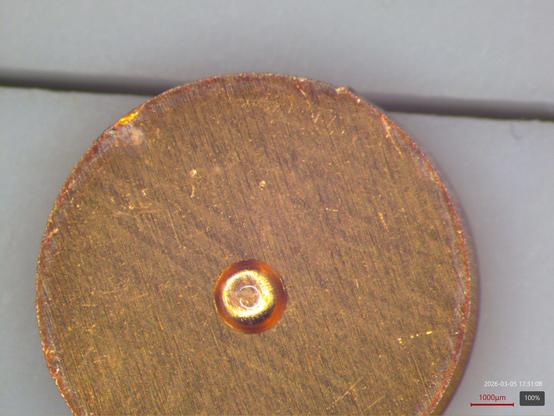
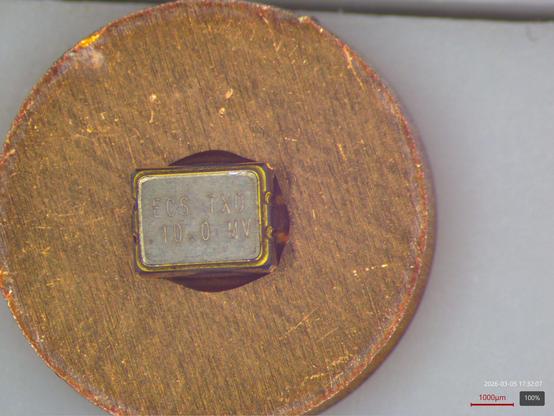
Pretty happy with the results for a surgical decap.
It looks like the quartz crystal sits on top and the oscillator driver is under it. Unfortunately we can't see the oscillator die without destroying the crystal.
Nothing looks obviously damaged, I'll do some higher mag images next.
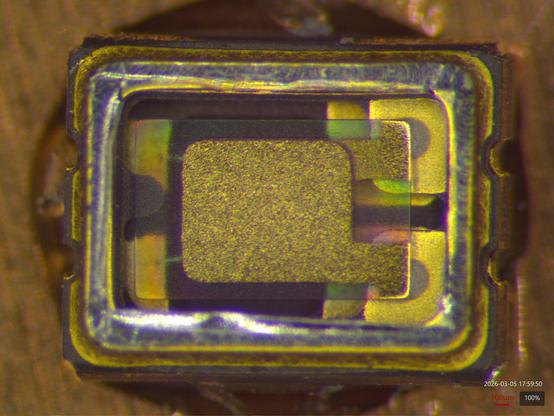
That's a good microscope!
It better be given how much it cost, lol.
The difference between no name AliExpress optics and good German or Japanese glass is staggering but you get what you pay for.

Wishing I could afford a Leica! But worth it!
@dianea Oh absolutely. We have amscopes at work, they're enough most of the time.
But for professional use in my own lab when I don't need to jump through management to get budgetary approval and can just pull out my credit card? I will absolutely pay what it takes to get good glass.

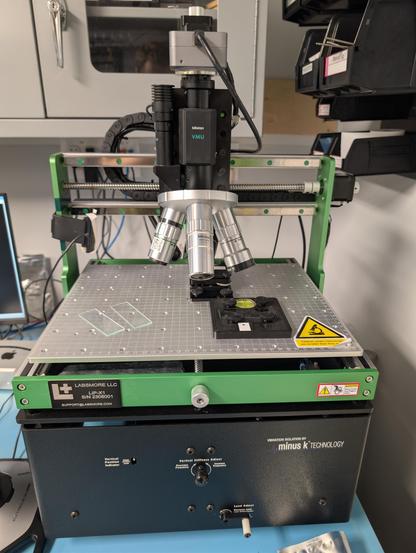
@azonenberg @dianea the "custom CNC platform" looks exactly like one of those cheap chinese CNC routers. That feels so wrong, the nice japanese optics on a motion stage without real axial bearings on the spindles 😵💫
But I suppose without load (beyond the weight of the optics), and backlash avoidant toolpaths that caaaaan be pretty precise... still feels wrong to me.
@la @dianea The custom bit is the integration, I got the router frame + motion controller + optics assembly as a turnkey solution rather than having to DIY it (which some people do but I didn't want to jump through the hoops).
The motion planner has some backlash compensation but for the most part you don't need ultra tight repeatability for step-and-repeat imaging, you just need enough precision that the stitching software can align one tile to the next. If you're a few microns out of a perfect 30% overlap it's fine.
The main things I care about are good optics, not vibrating, and taking many images per hour without me having to manually move the stage between images. It does that just fine.
@la @dianea honestly if they had gone overboard on the stage axes for this application I would have complained a bit, I want to put my money into glass not metal :P
It's also a huge upgrade from my last stage in smoothness (it had large, visible steps each time you moved, plus the axes would sometimes stick and jerk). This is butter smooth. There is a tiny bit of backlash (noticeable in a system with 300nm depth of focus) in the Z axis if you're doing manual jogging on the focus but not much, and when it's doing plane-fit interpolation it does backlash compensation on the toolpaths.
@azonenberg @dianea Fair enough
I think of automated measuring equipment and images of hundreds of kilos of granite pop into my head, but that's not optical... I am a bit surprised that at those recorded feature sizes the woble in MGN rails and 2020 alu extrusion doesn't wobble too much, but I guess if you wait a moment before taking the picture it's fine 🤷♀️
@la @dianea Yeah the movement is small (a few tens of μm from one tile to the next at high magnification, a few hundred at low mag) then it waits a little while for vibration within the system to damp out before snapping the image.
It averages around 2-2.5K photos an hour so a bit under 1 Hz repetition rate, I forget how many ms the settling time after the movement is. There's an adjustment control for it, the factory default worked well with the 20x objective but there was still a little motion blur with the 100 from not being fully damped out so I slowed it down.
The bigger problem I had was actually vibration from the HVAC coupling through the walls/floor and into the table, which made 100x nearly unusable until I got the vibration isolation system to put under it.


 diana 🏳️⚧️🦋🌱
 Laura
Laura