 Andrew Zonenberg
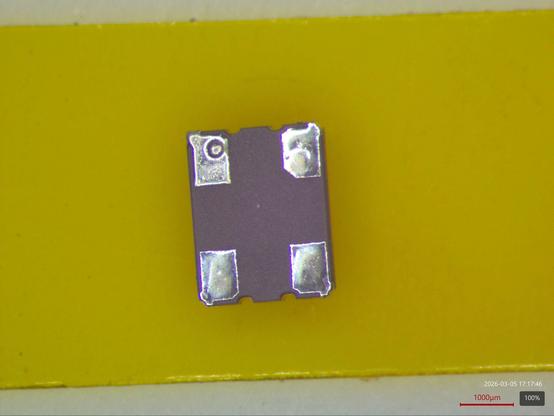
OK, oscillator failure analysis step one: Cleaning residual solder off the underside so it sits flat on the mill table. Then a final cleaning with acetone to get any flux residue off.

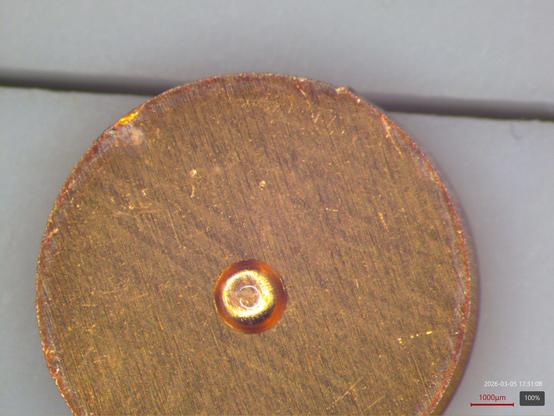
I wasn't sure if I could mount it to the mill table without it flying off because it was so small, so I mounted it to a ~1cm copper disk with some crystalbond wax.
This will make it much easier to find if I drop it, and give more area for me to attach to the chuck with double-sided tape.
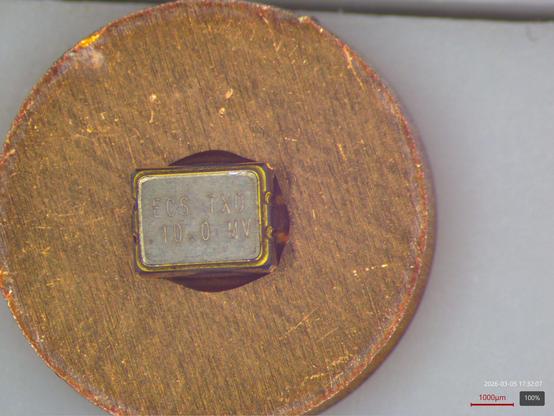
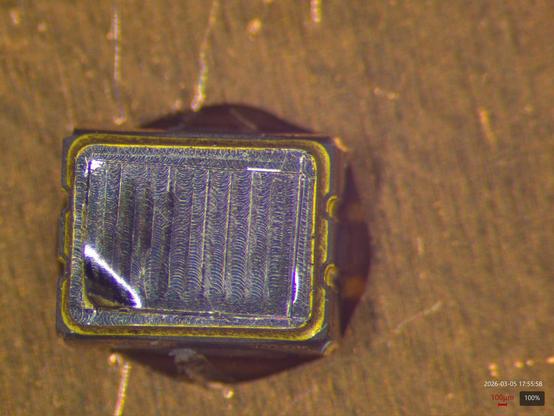
Pretty happy with the results for a surgical decap.
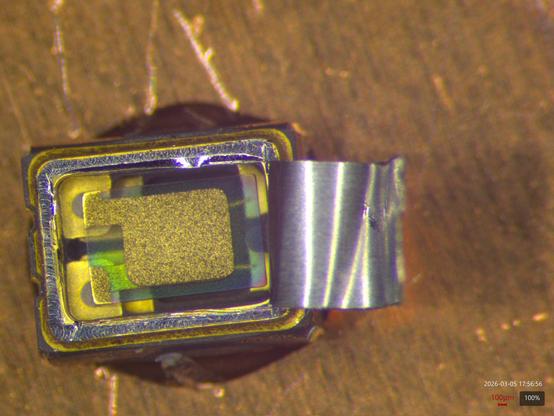
It looks like the quartz crystal sits on top and the oscillator driver is under it. Unfortunately we can't see the oscillator die without destroying the crystal.
Nothing looks obviously damaged, I'll do some higher mag images next.
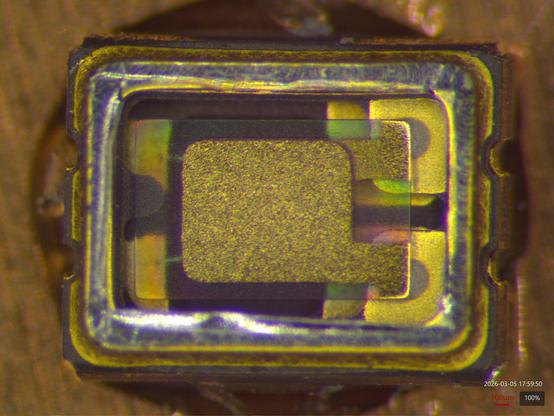
Composite of three focal planes (upper bond pads/crystal surface, lower bond pads, top of package) on the Labsmore/Mitutoyo system.
The left two pads clearly have connections to the driver IC but aren't very visible with the DOF of this system at the chosen focal planes.
It's interesting that the quartz is a somewhat textured surface, I expected a mirror polish.

@azonenberg never seen a mirror polish on any xyal I disassembled. There are several hypotheses for that:
* electrode adhesion
* result of the frequency tuning process, blanks are ground and thinned until desired frequency is obtained. The mirror finish would be partially destroyed during this process, or it would be too slow to thin the blanks while maintaining the polish.


 F4GRX Sébastien