 alessandro
800 gamers tried to beat an '80s adventure without a walkthrough—only 2 did - Only .25% of players completed the AGAT, the Adventure Game Aptitude Test, designed by fiendish developer Woe Industries.
 F/15/
F/15/Idiots should have known to use the honey on the skeleton, causing ants to carry away the bones but leave behind the clearly visible key that I was clicking on for 15 fuckingijfiejbfitkbeofniwkwhofh
Oh seriously???
The way I suspect some of them were made: get 10 random people, present the problem to them and ask each person what they think the solution is. Say no to the first 9, then say yes to whatever the 10th person guesses. If they guess something previously guessed, then keep prompting for more information until the solution is so specific even people on the right track will be confused by it.
Also add endless segments where several specific squares of the grid have mandatory items, something prevents you from systematically searching the entire grid, and if you go too far, you die.
 caseyweederman
Hey! Spoilers!
4 hours is pretty cruel.
I mean I beat that game for the first time, in the first way, when I was ten. But it took me a lot more than 4 hours. Now I could probably do it in two. But only for the Bernard involved endings, and where you can make use of the glitches, like the switch character-pause-freeze Edna in her bedroom.
 Wildmimic
Lol only 4 hours given? Sounds like the study runners also didn’t have enough patience to really study this. Or designed the study for the conclusion.
The SAT, MCAT and most forklift operator certifications lie prostrate at our feet.
Idk what kind of forklift certifications they’ve been going through, those things are impossible to fail
 MelodiousFunk
Challenge accepted
 rbos
rbosGoing into it cold without knowing the tropes of the genre and the visual design language would be a massive disadvantage. Gamers in the 80s would have a set of expectations and strategies that we wouldn’t lean on today. Giving someone from 1985 Factorio might lead to some similar confusion until they got the hang of it.
Factorio spends a lot of time optimizing the first 30 minutes of game play for this exact reason. Check out these blogs on it:
factorio.com/blog/post/fff-241 www.factorio.com/blog/post/fff-327

Friday Facts #241 - New player experience | Factorio
New player experience (V453000 & Abregado) In the last several weeks/months we have been working on deciding the fate of the campaign and the demo/tutorial missions. Hi, I'm Ben (Abregado). My experience as an educator using Factorio in the classroom means I have thoroughly examined new players (young and old), and have played the first 30 minutes of Factorio for as many hours as some players spend on a single megabase. The systems in Factorio are deep and interconnected, so creating an onboarding experience for a single concept poses many exciting challenges. We find that the Freeplay portion of the game is already enjoyable to its target audience, but those who prefer a more guided experience only get a short campaign which doesn’t even utilize all of the features we’ve added to the game. On top of that brand new players need to dig through a tutorial which takes about 30-45 minutes to get to automation, which is what the game is about. We want to keep the demo so that anybody who wants to try the game can do it for free, and get a proper representative introduction to what Factorio is. For Factorio, the demo should serve a dual purpose of a tutorial and a teaser, both of which we feel could be improved... Currently we find the demo has the following problems: The impact of the first level isn’t very visually representative of what Factorio is. Gives the impression of being a Minecraft clone in the first tutorial mission by having to mine manually and do hand crafting. Key concepts like Assembling machines and electricity are not presented for the first two levels. Player actions are so heavily constrained that the player learns just how to solve the tutorial rather than learning the concepts we are trying to demonstrate. Each of the levels is disconnected from the previous. Which item recipes are available, that there are suddenly built structures and the location is completely different. Grindy tasks like obtaining X resources in 2nd tutorial mission don’t have any clear purpose. The player does it because they are being told to, not to achieve some other goal that would make sense in the progression. A lot of information is not important and just floods the player with noise, for example many of the messages. The places where the player gets information are scattered - Objective window in the top left, the player character talking to themselves in the console chat and the yellow "TAB bubbles". The three different information channels competing for attention. In this case also two of them telling you the same self-explanatory information (where is the current objective shown, if you didn’t get it), while the chat informs you that your character is alive. A typical objective without purpose. (I guess the game will tell me what is it for soon?) Doesn’t this message resemble another game? What we would like to achieve with the new design: Create an immediately gripping environment that better sets up the Factorio feel. Showing and teaching core concepts like Assembling machines and electricity in the first level using as little complexity as possible. Providing goals through the technology tree, working with laboratories and the technology GUI as soon as possible. Standardize the way players obtain new items. Every recipe has to be obtained through a technology - that way the player triggers recipe progression and gets them as a reward. Starting a new level should start the player at a similar progression state where the previous mission left off. Teaching by experimentation instead of jumping through arbitrary tasks. Letting the player coming up with their own solution of a puzzle. Unify the channels the player gets information from (mostly GUI improvements). After finishing the demo, the player should be ready to continue by playing the main campaign, or jump straight to the Freeplay. If you had to pick one entity that represents the game to you the most, which one would it be?
True, maybe a bad example. Although there are a few conventionts it might not bother to explain, like WASD for directional input, or scroll wheels, or whatever.
I think Factorio perfectly proves your point.
The Devs spent a lot of time making sure you understand the game in the first 30 minutes. 80’s Devs didn’t do that and it shows in how hard the learning curve of the game is.
It goes even farther than that: games in the 80s didn’t even necessarily have consistent designs that could be trained in the first 30 minutes. Especially the adventure games. They were also perfectly willing to let you lose the game in act 1 but not tell you about it until act 3, where the way they do “tell you” is you don’t have any possible solution for a problem.
Like if you don’t get that delicious pie plus another food source early on, you’ll either die of starvation or the yeti will eat you later in the game.
But if you know what to do, the game becomes trivial.
 Devolution
In those people defense, that number of success was the same in the early 90’s too.
 CerebralHawks
I’ve never beat Maniac Manson, but I did beat Zak McKracken and the Alien Mindbenders. Not in four hours, though. It took months playing (when it was new) after school and bouncing ideas off my father and his best friend. All three of us were playing the game separately and sharing tips.
I could probably beat it in around 2 hours if I tried today? I still remember the path but there are also the random mazes where you just try and hope for the best. Peru, the Sphinx, Mars, maybe another one. Oh yeah, Mexico City. Maybe there are guides online but I’ve never used them, and we didn’t have them when the game was new.
 Granbo's Holy Hotrod
The squirrel …
A very common thing even back then. Finishing a game was not a given. It was an achievement.
I read something years ago that those games were designed to have illogical puzzles so that you’d pay to call the help line (yes, there was a phone number you’d call for help) or sell paper game guides
Nintendo had a Hotline… I called them once because I got stuck in donkey kong country. (The guy was like ‘at the first ledge just drop straight, there’s a hidden cannon that lets you skip the level’)
That’s frustrating. How were you meant to find that?
The Secret of Monkey Island 2 famously mocked this where you could simulate literally call the helpline in-game as the PC while lost in a jungle.
I need to play this again!
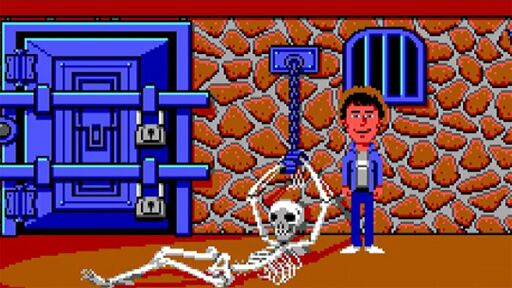
‘Maniac Mansion’, depicted in the thumbnail, specifically has pathways for characters to die or the player to be stuck without a recourse — which later adventures avoided, allowing successful completion from any point in the game.
I recently tried playing through it for the first time (on an Android tablet with ScummVM), and pretty sure I hit such a dead end.

Well, yeah.
Game companies also sold strategy guides at the time. They’re designed to be obtuse. I’m pretty sure the full walkthrough for Leisure Suit Larry 1 is only 2 paragraphs or something.
The actual steps to the end are short, there’s just always a puzzle where you have to use a rubber chicken with a bar of soap to make a helicopter or some shit. I love adventure games though, I’m just a walkthrough baby.
There were even quite a few games from the 80s and 90s that required you to use the manual in order to play with translations, instructions, sometimes even hidden codes to move forward.
 MinnesotaGoddam
there would almost always be a moment where you’d use the manual to answer a password and that was their copy protection. that kind of copy protection continued into the 90s
 Drasglaf
Up to the late 90s at least, Metal Gear Solid had a moment where, in order to progress, you had to enter a codec frequency that was in the back of the CD case.
We had a Mickey game that came with a dark maroon piece of paper with a bunch of Mickey poses on it, each one had a number or letter code (it would show a pose and you had to give it the code for the pose to start the game). The black ink on dark maroon paper was intended to prevent photocopying.
We also had this F1 racing game that had a bunch of F1 history in its manual and would ask F1 history trivia to get into the game.
Because that was the beginning of the adventure game era where there was no concept of game design and ensuring that the games made logical sense, hence the birth of “moon logic”, thanks Roberta. These games were also made to be obtuse because games were very expensive back then and making obscure logic was an incentive to make things more “worth” it, often intending to make the game last months of play time to solve their “logic” puzzles and you had to be in tune with the game designer to get them.
Not to mention that due to intention or lack of game design, these games were notorious for allowing you to put yourself into a unwinnable state with no way to correct it, things like Space Quest with the alien kiss of death that won’t trigger until the very end of the game or that Kings Quest game where you had one shot to throw a boot at a cat or you’d be dead man walking.
Not being able to finish these games wasn’t even unusual back then without the help of friends or BBS. Heck I had games adventure games I bought from that era that I never finished until the got re-released on Steam.
I remember playing Castlevania 2 back in the days. I never even came close to beating it. I only ever got as far as i did through sheer willpower and spending a shit ton of hours just brute forcing the game.
A few years ago, i tried again. I read every conversation in the game and pretty much tried everything before reading a walkthrough. I was stuck at the same part that i was as a child. The solution: take a specific orb, go to a specific wall and crouch for a few seconds. Maybe you can find this out while playing the game, but holy shit these “puzzles” were random.
 I Cast Fist
Ah, the classic AVGN problem with Castlevania 2
I had the same problem as a kid. My cousins had beaten it and given me some tips, but I could never figure it out. I also tried again a few years ago on an emulator but didn’t have the patience to make it very far! Fun game though.
Roberta liked fairy tales and the first KQ game was just as many of them crammed into one place as possible. Did she not think that the Rumpelstiltskin puzzle was not crazy? There was one hint in the game of ‘sometimes it is best to think backwards’ but who the fuck would get it?
Also Rumpelstiltskin’s name had to be spelled with the alphabet backwards! That made no damn sense!
excuse me his name was nikstlitslepmur and heaven help you if you mispeel it
IFNKOVHGROGHPRM! It was IFNKOVHGROGHPRM in the original AGI version!
i spent too much time trying to figure that out. I thought it was ROT13 or something but that was meaner.
 KairuByte
The Legend of Zelda was a game I absolutely loved as a kid. I could never get much past a certain point but never really knew why. I’d look everywhere, do everything I knew I could do, but always got stuck.
Years later I looked up a walkthrough out of curiosity. Turns out you can burn down bushes in the overworld with the candle. I don’t recall this ever being mentioned or even hinted at as a thing you could do. I was unable to progress because one of the dungeons was locked behind one of those bushes.
Maniac Mansion was designed to be replayed, which is why the cast of characters you picked could be different each playthrough. It also meant a lot more red herrings.
Lucasarts was much cleaner. We finished DOTT as kids without hints.
I vaguely remember that the point of LucasArts’ adventure games was that they were tired of the bullshit moon logic of Sierra games. I guess it’s the equivalent of someone who was so pissed off with Kaizo Mario that they made Dark Souls or something
LucasArts has plenty of moon logic in their games, sometimes even mocking it. It just did not stick your save game to a point of no return where you have to restart over.
Maniac Mansion 2 (DOTT) was way easier (and even came with Maniac Mansion 1 as an in-game easter egg)
Yep. That’s how I played Maniac Mansion!
These 80s games were made to sell actual walk-throughs. You had to buy a book or magazine for many of them.
They were not difficult, they were stupid.
Nah! We were just tougher back then!
Also, with no internet, nothing was around to distract you for 24 hours, or days, to try to solve one puzzle.
Kids these days don’t understand the struggle!
😃
Grab ye flask
But ye can’t get ye flaske!
 Blackmist
Many had a premium rate phone line, and it was just a tape so if you were stuck near the end you’d have to listen to the end and potentially pay many times the game’s cost.
The puzzle were often moon logic or ‘oh shit! You mean THAT is what I must do?’
Sierra online had great games with great stories and characters but their puzzles were… Yeah…
I had to look up a solution in Myst because it was something I didn’t know I could do.
There were also the “feelies”, which were a secondary line defense of copy protecion method. They sometimes were a clue to those puzzles.