 Sergio
 nixCraft 🐧
😂
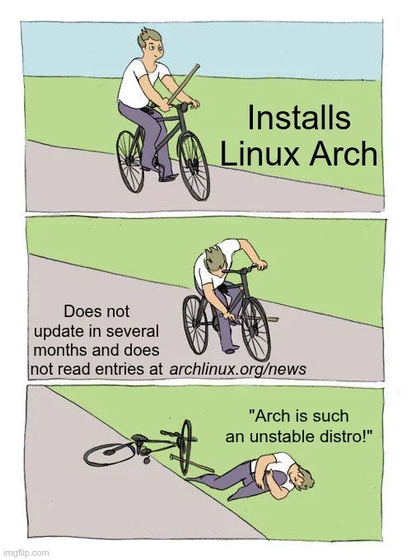
@the_codifier @nixCraft Not if you take the effort of understanding what you install, update regularly (I do it once a week), read the news page if updater complains (that tells you what will break and how to update without breaking), you do a sane maintenance of pacnew files... My current arch desktop install is as old as the computer (7 years), 0 breakage.
It can be very stable, but it's true it takes some effort.
@doragasu @the_codifier @nixCraft
... But that is pretty much the opposite of stability.
You wouldn't call a house stable, if you need to involve a civil engineer for every lightbulb change.
Arch can and will self-destruct at some point, and that's just not acceptable for anyone whose hobby isn't OS maintenance.
@doragasu @the_codifier @nixCraft
Well, that's exactly my point.
Stability means, it won't destroy itself. But an Arch install will either require substantial effort for that, or be destroyed from third parties by being outdated and insecure.
If that's your hobby, perfectly fine. But calling it stable is weapons grade wishful thinking at best.
@f09fa681 @nixCraft I didn't break my whole system, but every update would break an app or just had issues with repos not working. (I was on CachyOS though, not actual Arch)
Whereas on Mint I can't even remember the last time an update broke something.
I think in the end it depends on each person's use case, there's a fitting distro for most people out there :)
@f09fa681 @wststreet @nixCraft I remember when they were moving from rc to systemd, and at some point the whole system went “nuh-uh, you need to (manually) reconfigure everything or it’ll stop working”.
Then, after a couple years, they decided to do the same thing with updating the network framework. Expecting the user to reconfigure it all manually.
@nixCraft
Meanwhile, Slackware sends me an email from their security list when something needs to be upgraded.
Otherwise, I don't really have to interact with their website.
Slackware is so stable I had one instance running at a client's site for 10 years. Yes, I know, not the best practice, but if it ain't broke, don't fix it.
Every time, I see a post about Arch, I sigh. Why fiddle when you can have rock solid stability?
Please explain the attraction to an old man ... ?
 Oli
Oli Janik Ramírez
 doragasu
 Admiral Snackbär
 Cătă 🇷🇴🇺🇦🇲🇩🇪🇺
 Street | Train 🇷🇴
 Lenny
Lenny Artemis
 Primetime
 GvitunJ
 Rotkäppchen
 Lexi
Lexi
 Cris
Cris BoloMKXXVIII
 Michael / マイケル 사자 🦁
 محمد الضيف
 TECC
TECC 

 Cute Ferret 🐿️
 Seth Brown
 #?.info
 an actual bus
 Snuffleupadon
 �
� [HANDMAIDEN] xan
 LinkyKatsumiVT
 JerryJhird