TOPIC> Comets

2025 September 16

New Comet SWAN25B over Mexico
* Image Credit & Copyright: Daniel Korona

Explanation:
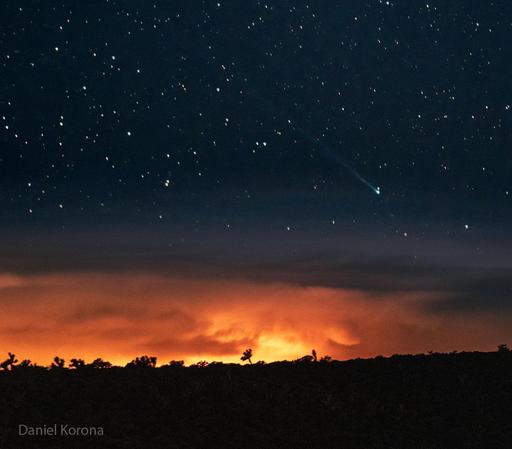
A newly discovered comet is already visible with binoculars. The comet, C/2025 R2 (SWAN) and nicknamed SWAN25B, is brightening significantly as it emerges from the Sun's direction and might soon become visible on your smartphone -- if not your eyes. Although the brightnesses of comets are notoriously hard to predict, many comets appear brighter as they approach the Earth, with SWAN25B reaching only a quarter of the Earth-Sun distance near October 19. Nighttime skygazers will also be watching for a SWAN25B-spawned meteor shower around October 5 when our Earth passes through the plane of the comet's orbit. The unexpectedly bright comet was discovered by an amateur astronomer in images of the SWAN instrument on NASA's SOHO satellite. The comet is currently best observed in southern skies but is slowly moving north. The featured image was captured at sunset three days ago just above the western horizon in Zacatecas, Mexico.

https://earthsky.org/space/new-comet-swan25b-2025/
https://soho.nascom.nasa.gov/data/summary/swan/
https://soho.nascom.nasa.gov/about/about.html

https://apod.nasa.gov/apod/ap250916.html

#space #comets #astrophotography #photography #science #astronomy #nature #NASA #ESA #education
2025 September 18

Comet C/2025 R2 (SWAN)
* Image Credit & Copyright: Team Ciel Austral
https://www.cielaustral.com/

Explanation:
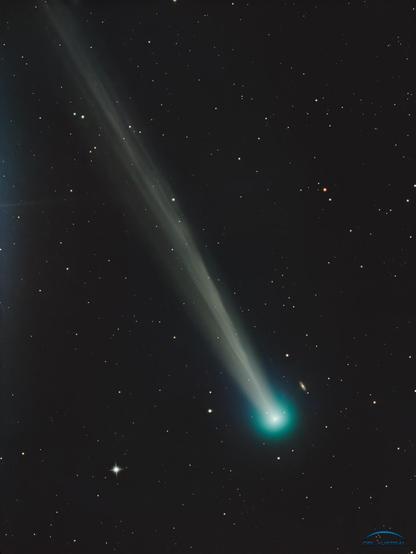
A new visitor from the outer Solar System, comet C/2025 R2 (SWAN) also known as SWAN25B was only discovered late last week, on September 11. That's just day before the comet reached perihelion, its closest approach to the Sun. First spotted by Vladimir Bezugly in images from the SWAN instrument on the sun-staring SOHO spacecraft, the comet was surprisingly bright but understandably difficult to see against the Sun's glare. Still close to the Sun on the sky, the greenish coma and tail of C/2025 R2 (SWAN) are captured in this telescopic snapshot from September 17. Spica, alpha star of the constellation Virgo, shines just beyond the upper left edge of the frame while the comet is about 6.5 light-minutes from planet Earth. Near the western horizon after sunset and slightly easier to see in binoculars from the southern hemisphere, this comet SWAN will pass near Zubenelgenubi, alpha star of Libra, on October 2. C/2025 R2 (SWAN) is scheduled to make its closest approach to our fair planet around October 20.
https://app.astrobin.com/i/i5qsgj
https://earthsky.org/space/new-comet-swan25b-2025/
https://cobs.si/obs_list?id=2659
https://en.wikipedia.org/wiki/C/2025_R2_(SWAN)#Observational_history

https://spaceplace.nasa.gov/comets/en/
https://science.nasa.gov/mission/soho/

https://apod.nasa.gov/apod/ap250918.html

#space #comets #astrophotography #photography #science #astronomy #nature #NASA #ESA #education
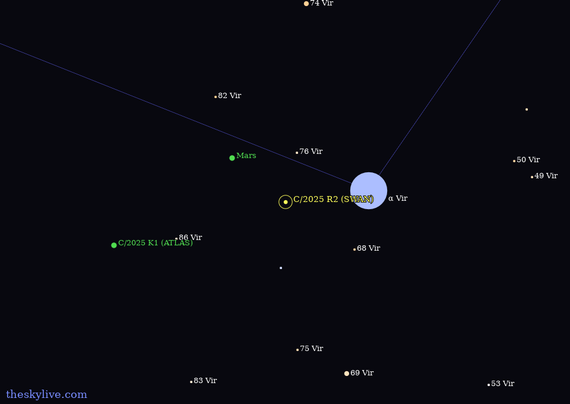
Comet C/2025 R2 (SWAN) Orbit | 3D Solar System Viewer | TheSkyLive

Visualization of the orbit of Comet C/2025 R2 (SWAN) in an interactive 3D Solar System viewer and simulator.

Comet C/2025 R2 (SWAN)

Below the horizon. Rise: 9:47 | Tran: 14:46 | Set: 19:44
Alt: -29.26° Az: 70.51° Direction: East-North-East

Comet C/2025 R2 (SWAN) is in the constellation of Virgo, at a distance of 117,117,474.3 kilometers from Earth. The current Right Ascension is 13h 35m 39s and the Declination is -11° 36’ 24” (apparent coordinates). The latest observed magnitude of comet C/2025 R2 (SWAN) is 7.3 (data provided by COBS).

* URL'S associated with the images:
1. to 2. https://theskylive.com/planetarium?obj=c2025r2
3. 5. 6. https://theskylive.com/c2025r2-tracker
4. https://theskylive.com/3dsolarsystem?obj=c2025r2

On this website you can follow the current data of the comet live:
https://theskylive.com/c2025r2-info

CREDIT
TheSkyLive.com
----

From Wikipedia, the free encyclopedia:

C/2025 R2 (SWAN)

C/2025 R2 (SWAN), formerly known as SWAN25B, is a non-periodic comet discovered on 11 September 2025 by Vladimir Bezugly through SWAN imagery. As of 17 September 2025, the comet has an apparent magnitude of +6.9 with a solar elongation of 30 degrees and is observable near the star Spica in 50 mm (2.0 in) binoculars. It is better seen from the Southern hemisphere.

Observational history

The comet was first spotted in images from the SWAN instrument onboard the Solar and Heliospheric Observatory (SOHO) by amateur astronomer Vladimir Bezugly on 11 September 2025. The presence of the comet was confirmed by other amateur astronomers, having an estimated magnitude of 7.4 and featuring a tail about 2 degrees long. The comet upon discovery was located in the constellation of Virgo and it was better seen from the southern hemisphere as it was higher in the sky after sunset.
[...]

Please read more in next post.

Text Credits:
Contributors to Wikimedia projects

#space #comets #astrophotography #photography #science #astronomy #nature #NASA #ESA #education

From Wikipedia, the free encyclopedia

[...]

C/2025 R2 was not discovered earlier in part because of the Holetschek effect as the comet was less than 30 degrees from the Sun between August 7 - September 13. Between August and September the comet had rapidly brightened from magnitude 11 to magnitude 8. The comet is not likely in an outburst, however it is currently unknown how quickly it will dim or if it will completely disintegrate.

C/2025 R2 is officially the 20th comet discovered through SOHO's SWAN instrument according to its discoverer, Vladimir Bezugly.

C/2025 R2 (SWAN) came to perihelion one day after discovery on 12 September 2025 at a distance of 0.5 AU (75 million km) from the Sun. Earth will cross the comet's orbit around 5 October 2025 and it may produce a meteor shower. It will make its closest approach to Earth at a distance of 0.26 AU (39 million km; 24 million mi) on 19 October 2025. It will cross the celestial equator on 3 November 2025.

As the comet was discovered near perihelion, the closest approach to the Sun is reasonably well known. But the aphelion (farthest distance from the Sun) is currently constrained by the low spatial resolution of about 1° per pixel STEREO-A observations in August, and without the STEREO-A observations, there is only a short 4-day observation arc for the orbit determination. Aphelion is anywhere from 60+ AU from the Sun with an orbital period of hundreds to thousands of years. The Minor Planet Center (using observations through September 15th) estimates an orbital period of 1400 years with aphelion around 250 AU, and JPL (using observations through September 14th) estimates an orbital period of 20000 years with aphelion beyond 1000 AU. ..

Text Credits:
Contributors to Wikimedia projects

Image Credit:
Filipp Romanov

https://en.wikipedia.org/wiki/C/2025_R2_(SWAN)

#space #comets #astrophotography #photography #science #astronomy #nature #NASA #ESA #education

2025 September 26

A SWAN, an ATLAS, and Mars
* Image Credit & Copyright: Adam Block
https://www.adamblockphotos.com/

Explanation:
A new visitor to the inner Solar System, comet C/2025 R2 (SWAN) sports a long ion tail extending diagonally across this almost 7 degree wide telescopic field of view recorded on September 21. A fainter fellow comet also making its inner Solar System debut, C/2025 K1 (ATLAS), can be spotted above and left of SWAN's greenish coma, just visible against the background sea of stars in the constellation Virgo. Both new comets were only discovered in 2025 and are joined in this celestial frame by ruddy planet Mars (bottom), a more familiar wanderer in planet Earth's night skies. The comets may appear to be in a race, nearly neck and neck in their voyage through the inner Solar System and around the Sun. But this comet SWAN has already reached its perihelion or closest approach to the Sun on September 12 and is now outbound along its orbit. This comet ATLAS is still inbound though, and will make its perihelion passage on October 8.
https://app.astrobin.com/i/vf43w6
https://www.skyatnightmagazine.com/news/c-2025-k1-atlas
https://theskylive.com/c2025k1-info

https://apod.nasa.gov/apod/ap250926.html

#space #comets #astrophotography #photography #science #astronomy #nature #NASA #ESA #education

2025 September 29

Two Camera Comets in One Sky
* Image Credit & Copyright: Luc Perrot (TWAN)
https://www.lucperrot.fr/bio

Explanation:
It may look like these comets are racing, but they are not. Comets C/2025 K1 ATLAS (left) and C/2025 R2 SWAN (right) appeared near each other by chance last week in the featured image taken from France's Reunion Island in the southern Indian Ocean. Fainter Comet ATLAS is approaching our Sun and will reach its closest approach in early October when it is also expected to be its brightest -- although still only likely visible with long exposures on a camera. The brighter comet, nicknamed SWAN25B, is now headed away from our Sun, although its closest approach to Earth is expected in mid-October, when optimistic estimates have it becoming bright enough to see with the unaided eye. Each comet has a greenish coma of expelled gas and an ion tail pointing away from the Sun.

https://apod.nasa.gov/apod/ap250918.html
https://apod.nasa.gov/apod/ap250916.html

https://en.wikipedia.org/wiki/C/2025_K1_(ATLAS)
https://en.wikipedia.org/wiki/C/2025_R2_(SWAN)
https://en.wikipedia.org/wiki/Coma_(comet)

https://apod.nasa.gov/apod/ap250929.html

#space #comets #astrophotography #photography #science #astronomy #nature #NASA #ESA #education
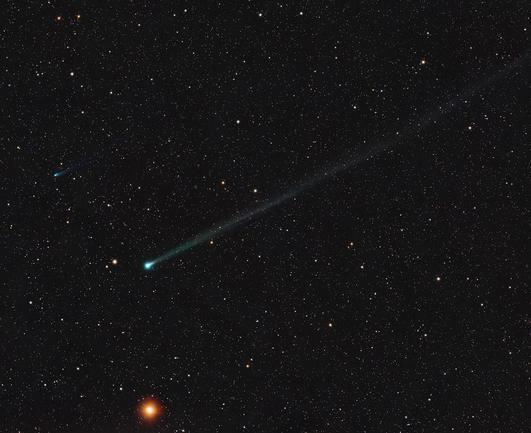
2025 September 30

Comet Lemmon Brightens
* Image Credit & Copyright: Victor Sabet & Julien De Winter
https://app.astrobin.com/i/lsnen5

Explanation:
Comet Lemmon is brightening and moving into morning northern skies. Besides Comet SWAN25B and Comet ATLAS, Comet C/2025 A6 (Lemmon) is now the third comet currently visible with binoculars and on long camera exposures. Comet Lemmon was discovered early this year and is still headed into the inner Solar System. The comet will round the Sun on November 8, but first it will pass its nearest to the Earth -- at about half the Earth-Sun distance -- on October 21. Although the brightnesses of comets are notoriously hard to predict, optimistic estimates have Comet Lemmon then becoming visible to the unaided eye. The comet should be best seen in predawn skies until mid-October, when it also becomes visible in evening skies. The featured image showing the comet's split and rapidly changing ion tail was taken in Texas, USA late last week.
https://en.wikipedia.org/wiki/C/2025_A6_(Lemmon)
https://earthsky.org/space/5-bright-comets-approaching-earth-charts-2025-2026/
https://theskylive.com/c2025a6-info
https://science.nasa.gov/solar-system/comets/facts/
https://en.wikipedia.org/wiki/Comet_tail
https://en.wikipedia.org/wiki/Astronomical_unit

https://apod.nasa.gov/apod/ap250930.html

#space #comets #astrophotography #photography #science #astronomy #nature #NASA #ESA #education

2025 October 6

The Changing Ion Tail of Comet Lemmon
* Images Credit & Copyright: Victor Sabet & Julien De Winter
https://www.instagram.com/dwj85

Explanation:
How does a comet tail change? It depends on the comet. The ion tail of Comet C/2025 A6 (Lemmon) has been changing markedly, as detailed in the featured image sequenced over six days between September 25 and October 3 (left to right) from Texas, USA. On some days, the comet's ion tail was relatively more complex than other days. Reasons for tail changes include the rate of ejection of material from the comet's nucleus, the strength and complexity of the passing solar wind, and the rotation rate of the comet. Sometimes, over the course of a week, apparent differences even result from a change of perspective from the Earth. In general, a comet's ion tail will point away from the Sun, as gas expelled is pushed out by the Sun's wind. Comet Lemmon is still inbound and brightening, passing nearest the Earth on October 21 and nearest the Sun on November 8.
https://theskylive.com/c2025a6-info
http://www2.ess.ucla.edu/~jewitt/tail.html
https://spaceplace.nasa.gov/comets/en/

https://apod.nasa.gov/apod/ap251006.html

#space #comets #astrophotography #photography #science #astronomy #nature #NASA #ESA #education
2025 October 11

Manicouagan Impact Crater from Space
* Image Credit: NASA, International Space Station Expedition 59

Explanation: 
Orbiting 400 kilometers above Quebec, Canada, planet Earth, the International Space Station Expedition 59 crew captured this snapshot of the broad St. Lawrence River and curiously circular Lake Manicouagan on April 11, 2019. Right of center, the ring-shaped lake is a modern reservoir within the eroded remnant of an ancient 100 kilometer diameter impact crater. The ancient crater is very conspicuous from orbit, a visible reminder that Earth is vulnerable to rocks from space. Over 200 million years old, the Manicouagan crater was likely caused by the impact of a rocky body about 5 kilometers in diameter. Currently, there is no known asteroid with a significant probability of impacting Earth in the next century. Each month, NASA’s Planetary Defense Coordination Office releases an update featuring the most recent figures on near-Earth object close approaches, and other facts about comets and asteroids that could pose a potential impact hazard with Earth.

#space #comets #astrophotography #photography #science #astronomy #nature #NASA #ESA #education #apod
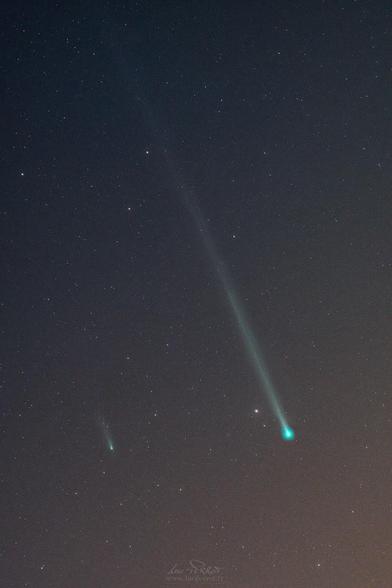
2025 October 20

Finding Comet Lemmon
* Image Credit & Copyright: Petr Horalek / Institute of Physics in Opava
https://www.petrhoralek.com/#about-1
https://www.slu.cz/phys/en/

Explanation:
Tonight, if you can see the stars of the Big Dipper, then you can find comet Lemmon in your evening sky. After sunset, look for the faint but extended comet above your northwestern horizon -- but below the handle of the famous celestial kitchen utensil of the north. It might be easier to see this visitor to the inner Solar System through your camera phone, which is better at picking up faint objects. Either way, look for a fuzzy green 'star' with a tail, though probably not so long a tail as in this impressive snapshot taken over Seč Lake in the Czech Republic two nights ago. Recent photographs of C/2025 A6 (Lemmon) often show a detailed and changing ion tail which extends farther than the eye can follow. This Sun-orbiting comet is now near its closest approach to Earth and will pass its closest to the Sun in early November.

https://theskylive.com/c2025a6-info
https://www.petrhoralek.com/?p=25820
https://www.wired.com/story/how-to-see-comet-lemmon-this-october/

https://apod.nasa.gov/apod/ap251020.html

#space #comets #astrophotography #photography #science #astronomy #nature #NASA #ESA #education

2025 October 13

Lemmon Tree
* Image Credit & Copyright: Uroš Fink
https://www.instagram.com/urosfink/

Explanation:
The tree is not in danger. That's because the comet pictured just above it, Comet C/2025 A6 (Lemmon), is far in the distance, well away from the Earth. Comet Lemmon now continues to brighten as it arcs through the inner Solar System, even though it has passed its nearest to the Sun -- because it is now approaching the Earth. The comet will likely appear brightest when it is at its closest to the Earth next week, then closing to about half the Earth-Sun distance. Comet Lemmon may then be visible to the unaided eye, but it is more likely to be imaged by a camera phone -- if you know where to look. Comet Lemmon, previously best visible in the morning, is now also visible in the evening sky for northern observers: look above the western horizon just after sunset. The featured image, centered on an unsuspecting European beech tree, was taken in Slovenia about ten days ago.

https://apod.nasa.gov/apod/ap251013.html

#space #comets #astrophotography #photography #science #astronomy #nature #NASA #ESA #education

2025 October 22

Comet Lemmon over the High Tatras
* Image Credit & Copyright: Tomáš Slovinský & Constantine Themelis
https://www.instagram.com/slovinsky.art/
https://www.instagram.com/constantinethemelis/

Explanation:
Comet Lemmon putting on a show for cameras around the globe. Passing nearest to the Earth this week, the photogenic comet C/2025 A6 (Lemmon) is now extending two long tails : a blue ion tail and a white dust tail. The ion tail is pushed away from the Sun by the ever-present by ever-changing solar wind, and shows structure also created by how much gas is ejected at any one moment. It glows because it is ionized by high energy sunlight. The dust tail is pushed away from the comet by sunlight and shines by reflecting sunlight. The featured image is an enhanced composite of 50 exposures all taken two days ago from Mlynica, Slovakia. The mountains in the foreground are the High Tatras that partly separate Slovakia from Poland. Although Comet Lemmon is best visible in long camera exposures, the shedding ice ball has become faintly visible in northern skies even to unaided eyes through dark skies toward the west after sunset.

https://spaceplace.nasa.gov/comets/en/anatomy-of-a-comet.en.jpg
https://astronomy.swin.edu.au/cosmos/c/cometary+tails
http://www.star.ucl.ac.uk/~apod/apod/ap251019.html

https://apod.nasa.gov/apod/ap251022.html

#space #comets #astrophotography #photography #science #astronomy #nature #NASA #ESA #education #apod

2025 October 23

SWAN, Swan, Eagle
* Image Credit & Copyright: Adam Block
https://www.adamblockphotos.com/

Explanation:
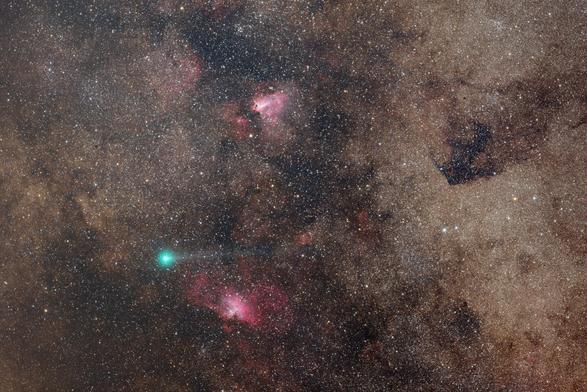
Comet C/2025 R2 (SWAN) sports a greenish coma and fainter tail, seen against congeries of stars and dusty interstellar clouds in this 7 degree wide telescopic field of view from October 17. On that date, the new visitor to the inner Solar System obligingly posed with two other celestial birds seen toward the center of our Milky Way. Messier 16, near the bottom of the frame, and Messier 17 are also known to deep skywatchers as the Eagle and the Swan nebulae. While the comet coma's greenish glow recorded in the image is due to diatomic carbon gas fluorescing in sunlight, reddish hues seen in the nebulae, star forming regions some 5,000 light-years distant, are characteristic of ionized hydrogen gas. Comet SWAN is outbound now but still a good comet for binoculars and small telescopes that can look close to the southern horizon in the northern hemisphere's early evening skies. C/2025 R2 (SWAN) was closest to our fair planet on October 20, a mere 2.2 light-minutes away.
https://app.astrobin.com/i/rkicdu
https://en.wikipedia.org/wiki/Sidereus_Nuncius#Stars
https://earthsky.org/astronomy-essentials/visible-planets-tonight-mars-jupiter-venus-saturn-mercury/

https://apod.nasa.gov/apod/ap251023.html

#space #comets #astrophotography #photography #science #astronomy #nature #NASA #ESA #education #apod

2025 October 27

Two Tails of Comet Lemmon
* Image Credit: Massimo Penna

Explanation:
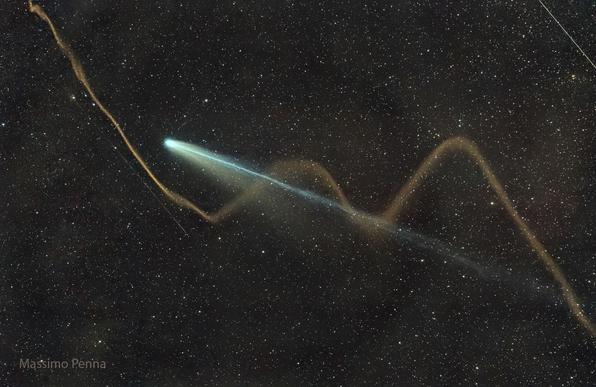
How many bright tails does Comet Lemmon have? Two. In the featured image it appears to have three, but why? The reason is that the zigzagging brown filament is a persistent meteor train that by luck appeared in front of the distant comet C/2025 A6 (Lemmon). A meteor train is the hot gas and fine dust that remains in the Earth's atmosphere and disperses in the seconds after a bright meteor flashes by. The two bright tails are the blue ion tail stretching across the image, and the white dust tail nearer the green coma on the upper left. All real comet tails originate from the nucleus of the comet inside the coma. The image was captured a few days ago from Manciano, Italy. This week, from mid-northern locations, Comet Lemmon will remain faintly visible in the northwest sky after sunset.
https://apod.nasa.gov/apod/fap/ap251027.html
https://www.virtualtelescope.eu/2025/10/26/comet-c-2025-a6-lemmon-and-a-meteor-red-afterglow-an-epic-image-24-oct-2025/
https://en.wikipedia.org/wiki/Coma_(comet)
https://en.wikipedia.org/wiki/Comet_tail
https://www.space.com/stargazing/see-comet-lemmon-cross-paths-with-a-cosmic-serpent-this-weekend

https://apod.nasa.gov/apod/ap251027.html

#space #comets #astrophotography #photography #science #astronomy #nature #NASA #ESA #education #apod
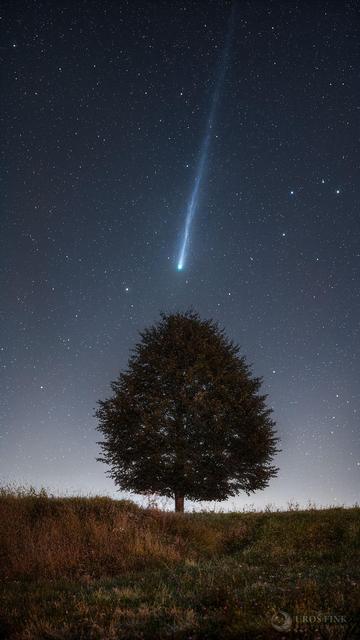
2025 November 4

Comet Lemmon Beyond Lomnický Peak
* Image Credit & Copyright: Robert Barsa
http://astrofotografia.sk/

Explanation:
Comet Lemmon has been putting on a show for cameras around the globe. Passing nearest to Earth in late October, the photogenic comet C/2025 A6 (Lemmon) sprouted two long and picturesque tails: a blue ion tail and a white dust tail. The ion tail is pushed away from the coma by the ever-present but ever-changing solar wind, at one point extending over 20 times the diameter of the full Moon -- as captured in this long-duration exposure. The shorter and wider dust tail is pushed away from the coma and shines by reflecting sunlight. The featured picture, captured two weeks ago, framed the comet behind Lomnický Peak of the High Tatra Mountains, home to the Slovakian Lomnický Stit Observatory. Comet Lemmon is now fading as it heads away from planet Earth. The huge shedding snowball will round the Sun later this week.
https://www.instagram.com/p/DQUSyhYAp2q/
https://en.wikipedia.org/wiki/C/2025_A6_(Lemmon)
https://astronomy.swin.edu.au/cosmos/C/cometary+dust+tail
https://astro4edu.org/resources/glossary/term/61/
https://spaceplace.nasa.gov/comets/en/anatomy-of-a-comet.en.jpg
https://science.nasa.gov/sun/what-is-the-solar-wind/
https://theskylive.com/c2025a6-info
https://web.astro.sk/en/research/observatories/lomnicky-stit-observatory/
https://www.youtube.com/watch?v=Sh9uHKMYWM8

https://apod.nasa.gov/apod/ap251104.html

#space #comets #astrophotography #photography #science #astronomy #nature #NASA #ESA #education #apod

2025 November 17

Comet Lemmon's Wandering Tail
* Image Credit: Ignacio Fernández
https://www.instagram.com/igneis.nightscapes/

Explanation:
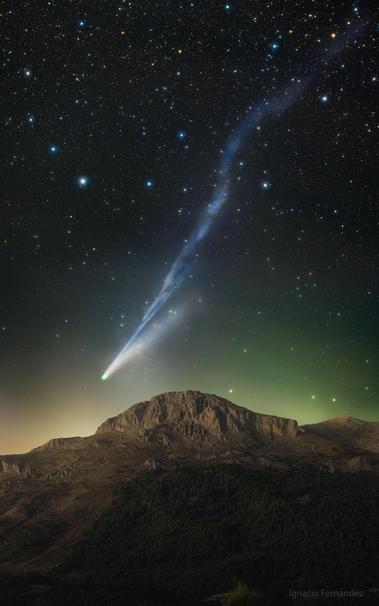
What has happened to Comet Lemmon's tail? The answer is blowing in the wind — the wind from the Sun in this case. This continuous outflow of charged particles from the Sun has been quite variable of late, as the Sun emits bursts of energy, CMEs, that push out and deflect charged particles emitted by the comet itself. The result is a blue hued ion tail for Comet C/2025 A6 (Lemmon) that is not only impressively intricate but takes some unusual turns. This long-duration composite image taken from Alfacar, Spain last month captured this inner Solar System ionic tumult. Comet Lemmon is now fading as it heads out away from the Earth and Sun and back into the outer Solar System.
https://en.wikipedia.org/wiki/C/2025_A6_(Lemmon)
https://apod.nasa.gov/apod/ap220125.html
https://theskylive.com/c2025a6-info
https://science.nasa.gov/sun/what-is-the-solar-wind/
https://apod.nasa.gov/apod/ap240818.html
https://science.nasa.gov/science-research/heliophysics/nasa-noaa-sun-reaches-maximum-phase-in-11-year-solar-cycle/
https://www.jpl.nasa.gov/nmp/st5/SCIENCE/cme.html
https://science.nasa.gov/earth/facts/

https://apod.nasa.gov/apod/fap/ap251117.html

#space #comets #astrophotography #photography #science #astronomy #nature #NASA #ESA #education #apod

2025 November 25

Comet Lemmon and the Milky Way
* Image Credit & Copyright: Lin Zixuan (Tsinghua U.)
https://www.tsinghua.edu.cn/en/

Explanation:
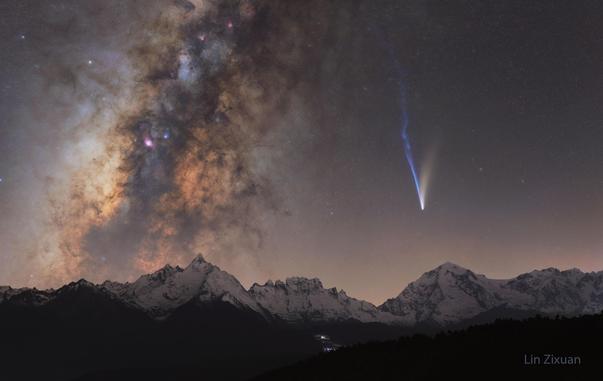
What did Comet Lemmon look like when it was at its best? One example is pictured here, featuring three celestial spectacles all at different distances. The closest spectacle is the snowcapped Meili Mountains, part of the Himalayas in China. The middle marvel is Comet Lemmon near its picturesque best early this month, showing not only a white dust tail trailing off to the right but its blue solar wind-distorted ion tail trailing off to the left. Far in the distance on the left is the magnificent central plane of our Milky Way Galaxy, featuring dark dust, red nebula, and including billions of Sun-like stars. Comet C/2025 A6 (Lemmon) is already fading as it heads back into the outer Solar System, while the Himalayan mountains will gradually erode over the next billion years. The Milky Way Galaxy, though, will live on -- forming new mountains and comets -- for many billions of years into the future.
https://www.youtube.com/watch?v=YylNkfmGNAQ
https://en.wikipedia.org/wiki/Himalayas
https://apod.nasa.gov/apod/ap251117.html
https://astronomy.swin.edu.au/cosmos/C/cometary+dust+tail
https://apod.nasa.gov/apod/ap240326.html
https://science.nasa.gov/resource/the-milky-way-galaxy/
https://apod.nasa.gov/apod/ap051004.html
https://apod.nasa.gov/apod/ap240214.html
https://science.nasa.gov/sun/
https://en.wikipedia.org/wiki/C/2025_A6_(Lemmon)
https://www.pbs.org/wgbh/nova/everest/earth/birth.html
https://apod.nasa.gov/apod/ap241105.html
https://apod.nasa.gov/apod/ap210303.html

https://apod.nasa.gov/apod/ap251125.html

#space #comets #astrophotography #photography #science #astronomy #nature #NASA #ESA #education #apod
2026 February 17

Tails of Comet Wierzchoś
* Image Credit & Copyright: José J. Chambó
https://cometografia.es/acerca-de/jose-chambo/mi-perfil-my-profile/
* Text: Cecilia Chirenti (NASA GSFC, UMCP, CRESST II)
https://science.gsfc.nasa.gov/sci/bio/cecilia.bertonimarthahadlerchirenti
https://www.nasa.gov/
https://www.nasa.gov/goddard/
https://www.astro.umd.edu/people/cecilia-chirenti
https://cresst2.umd.edu/

Explanation:
Some comets are regular guests of our solar neighborhood, others come by only once, never to return. We won’t have another chance to see Comet C/2024 E1 (Wierzchoś), which is currently making its way through the inner Solar System. The hyperbolic orbit of this comet indicates that it will likely become an interstellar traveler. Comet Wierzchoś is today near its closest approach to the Earth, passing roughly the same distance from the Earth as is the Sun. The featured 30-minute exposure was taken last week in Chile and shows a 5-degree long ion tail as well as three shorter dust tails. The green hue of the coma comes from the breakdown of dicarbon molecules by sunlight, but that process does not last long enough to also tinge the tails. On the far right lies a spiral galaxy far in the distance: NGC 300.
https://science.nasa.gov/solar-system/comets/
https://apod.nasa.gov/apod/ap240808.html
https://en.wikipedia.org/wiki/C/2024_E1_(Wierzcho%C5%9B)
https://science.nasa.gov/solar-system/
https://en.wikipedia.org/wiki/Hyperbolic_trajectory
https://cosmoquest.org/x/365daysofastronomy/2026/01/18/jan-18th-ultra-distant-comet-c-2024-e1-wierzchos/
https://astro.vanbuitenen.nl/comet/2024E1
https://en.wikipedia.org/wiki/Astronomical_unit
https://apod.nasa.gov/apod/ap220206.html
https://science.nasa.gov/sun/
https://spaceplace.nasa.gov/comets/en/anatomy-of-a-comet.en.jpg
https://apod.nasa.gov/apod/ap250126.html
https://www.science.org/content/article/why-do-some-comets-glow-green
https://www.esa.int/ESA_Multimedia/Images/2023/11/Structure_of_a_comet
https://en.wikipedia.org/wiki/Diatomic_carbon
https://pbs.twimg.com/media/BUCOEePIcAAht9h.jpg
https://www.pnas.org/doi/full/10.1073/pnas.2113315118
https://science.nasa.gov/universe/galaxies/types/
https://apod.nasa.gov/apod/ap241202.html

https://apod.nasa.gov/apod/ap260217.html

#space #comets #astrophotography #photography #science #astronomy #nature #NASA #ESA #education #apod
2026 April 9

Death of Comet C/2026 A1 (MAPS)
* Video Credit: Brian Day, SOHO, SDO, JHelioviewer
https://science.nasa.gov/people/brian-day/
https://soho.nascom.nasa.gov/
https://sdo.gsfc.nasa.gov/
https://www.jhelioviewer.org/
* Text: Cecilia Chirenti (NASA GSFC, UMCP, CRESST II)
https://science.gsfc.nasa.gov/sci/bio/cecilia.chirenti
https://www.nasa.gov/
https://www.nasa.gov/goddard/
https://www.astro.umd.edu/people/cecilia-chirenti
https://cresst2.umd.edu/

Explanation:
As the crew of Artemis II travelled towards the Moon this week, Comet C/2026 A1 (MAPS) was expected to have its closest approach to the Sun on Monday. At this point, comet and Sun would be closer than half the distance separating the Earth and Moon. The comet did not survive; the featured video was made with 40 hours of data and shows the comet plunging toward the Sun, like a moth to a flame. Observing the comet so close to our bright star requires a coronagraph, an instrument that blocks the Sun and is used for studies of its corona. This composite video combines, starting from the outside, views from: the wider angle coronagraph (blue) and the narrower angle coronagraph (red), both on NASA's Solar and Heliospheric Observatory, and NASA's Solar Dynamics Observatory (black). We can see the comet approaching the sun, stretching, disappearing behind the coronagraph's occulting disk and reappearing as a cloud of debris that dissipates.
https://www.nasa.gov/feature/our-artemis-crew/
https://www.nasa.gov/mission/artemis-ii/
https://science.nasa.gov/moon/
https://en.wikipedia.org/wiki/C/2026_A1_(MAPS)
https://en.wikipedia.org/wiki/Kreutz_sungrazer
https://www.rmg.co.uk/stories/space-astronomy/how-far-away-moon
https://images.pexels.com/photos/1469196/pexels-photo-1469196.jpeg
https://apod.nasa.gov/apod/ap151102.html
https://www.space.com/what-is-a-coronagraph.html
https://nso.edu/for-public/sun-science/corona/
https://www.swpc.noaa.gov/products/lasco-coronagraph
https://soho.nascom.nasa.gov/
https://sdo.gsfc.nasa.gov/
https://apod.nasa.gov/apod/ap090322.html

https://apod.nasa.gov/apod/ap260409.html

#space #comets #astrophotography #photography #science #astronomy #nature #NASA #ESA #education #apod

@grobi WOW this is very cool.