@JeffGrigg @christianschwaegerl @jamie @fsinn I think this is missing the point and the law (at least, US copyright law).
I buy a book. I then own that book. I can cut that book into individual pages. I can scan all those pages into my computer. I can have an image-to-text algorithm convert the text in the images into an ebook. I can do this to a billion books. I can run whatever algorithms I want on the text of those books. I can store the resulting text of my algorithms on my computer, in any format.
This is all legal, for both me and for any company. Copyright does not prevent use of a work after it has been sold, "use" meaning just about anything--short of distributing the work.
Because what copyright protects against is the reproduction and distribution of copyrighted works. For AI companies, that "distribution" doesn't happen until somebody puts a prompt into the AI, and receives back a result. That result is the distribution. To sue an AI company for copyright infringement, you would have to have a result that infringes on your copyright, and you would have to prove that the AI company was more than just a tool that the prompter used to infringe your copyright.
For the Disney example, if somebody prompted, "Darth Vader in a lightsaber duel with Mickey Mouse," it would be an uphill battle to prove the AI company is responsible for that instead of just the prompter. The argument that the AI company would make is that the prompter clearly used the AI as a tool to make infringing work, but just like you can't sue Adobe if someone used Photoshop to make the same image, you can't sue the AI company because someone used it as a tool to infringe copyright.
Now, I don't find that a wholly persuasive argument because of the, frankly, complicity in the creation that AI has that Photoshop doesn't, but that's definitely the argument they would make, and judges have seemed receptive to that and similar (and even worse) arguments.
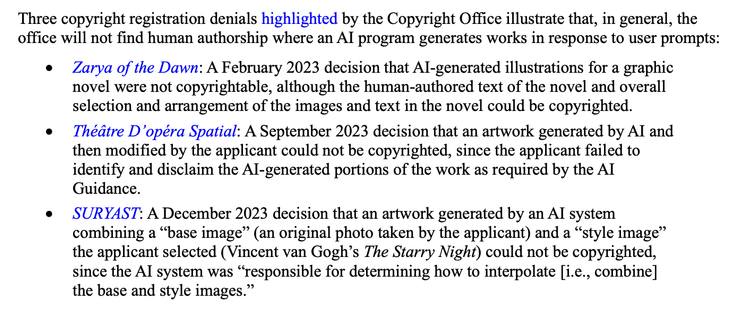
As far as I'm concerned, the original point of this thread proves that the AI company should be mostly-to-wholly responsible, even if the prompter was deliberately asking for infringing works. After all, AI-generated work is not copyrightable because it is not human created, it is computer created.
If it's not human created, how can the human be responsible for the infringement?
If it is computer created, then isn't the computer's owner responsible for the infringement?
After all, if I ask a digital artist to create me "Darth Vader in a lightsaber duel with Mickey Mouse," and they do, the digital artist is on the hook for that infringement. They reproduced the work, and they distributed it. There is a "prompter" and a "creator" in both scenarios; it seems illogical that if the "creator" is a human, they're responsible, but if the "creator" is a computer, they aren't responsible.
This is, per @pluralistic, "It's not a crime, I did it with an app!" Why we let apps get away with crimes we'd never tolerate from people, I don't know. But that's where we are.
 arturoe
 Jamie Gaskins
 Francisca Sinn
 Max L.
 Christian Schwägerl
 your auntifa liza 🇵🇷 🦛 🦦
 d@nny disc@ mc²
 Azuaron
 Jeff Grigg
 Ur Ya'ar
 Cory Doctorow
