We've got ISSUES. Literally.
We scraped >100k special issues & over 1 million articles to bring you a PISS-poor paper. We quantify just how many excess papers are published by guest editors abusing special issues to boost their CVs. How bad is it & what can we do?
arxiv.org/abs/2601.07563
A 🧵 1/n
In the strain on scientific publishing, we showed that total publications have grown out of control. A huge part of that was guest edited special issues by groups like
#MDPI and
#Frontiers.
This ongoing practice is the largest delegation of editorial power academia has ever seen.
2/n
The strain on scientific publi...
The strain on scientific publishing
Abstract. Scientists are increasingly overwhelmed by the volume of articles being published. The total number of articles indexed in Scopus and Web of Science has grown exponentially in recent years; in 2022 the article total was ∼47% higher than in 2016, which has outpaced the limited growth—if any—in the number of practicing scientists. Thus, publication workload per scientist has increased dramatically. We define this problem as “the strain on scientific publishing.” To analyze this strain, we present five data-driven metrics showing publisher growth, processing times, and citation behaviors. We draw these data from web scrapes, and from publishers through their websites or upon request. Specific groups have disproportionately grown in their articles published per year, contributing to this strain. Some publishers enabled this growth by hosting “special issues” with reduced turnaround times. Given pressures on researchers to “publish or perish” to compete for funding, this strain was likely amplified by these offers to publish more articles. We also observed widespread year-over-year inflation of journal impact factors coinciding with this strain, which risks confusing quality signals. Such exponential growth cannot be sustained. The metrics we define here should enable this evolving conversation to reach actionable solutions to address the strain on scientific publishing.
Systematic self- and ring-citation is established scientific misconduct. Why don't we treat editors publishing in their own special issues the same?
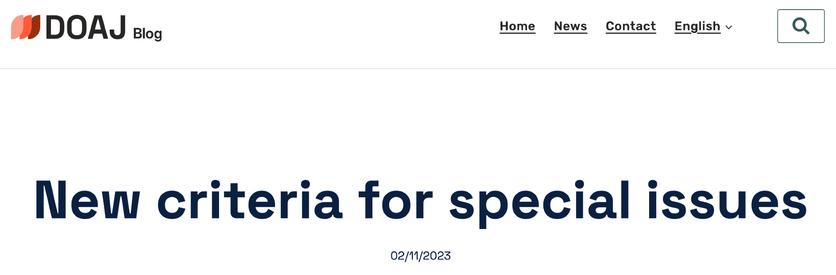
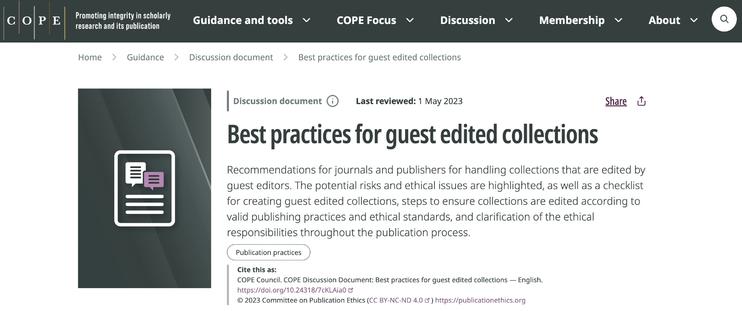
Groups like COPE and DOAJ have now issued guidelines to limit this, but a lack of data has prevented enforcement.
You know what that means...
3/n
With data from >100k special issues, we set out to tackle this problem.
Guest editors publishing in their own issues is a form of "endogeny". In this study, we define special issues with extreme endogeny as Published In Support of Self (PISS).
So, how much of this literature is PISS?
4/n
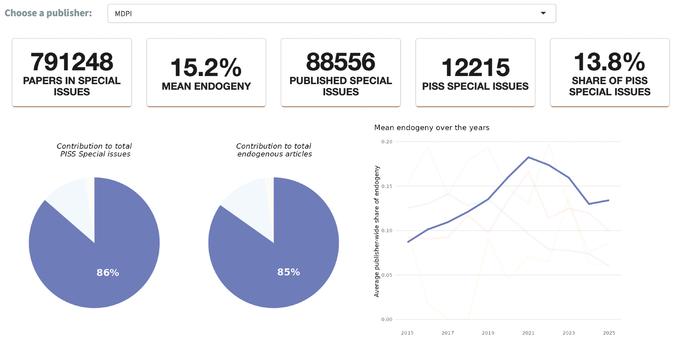
First, let's talk journals. Of 904 journals, ~60% hosted at least some PISS. Mean endogeny across all issues has hovered between 12-16% since 2017, peaking in 2021 alongside the explosive growth of special issues we showed in the Strain paper.
But that's just the mean. 🙃
5/n
In fact we actually saw pretty similar rates of PISS across all publishers tested:
#MDPI,
#Frontiers,
#BMC,
#Discover, but also the non-profit RSoc. Give authors a chance to guest edit and they'll PISS.
Relative rate: 1 in 7 editors PISS 😬
Still, the real problem is about ABSOLUTE quantity...
6/n
It's not just the extremes. Sure, we found >1300 special issues with >75% of the articles authored by guest editors themselves. But the bulk of PISS, endogeny beyond any existing threshold, comes from systematic mild abuse.
The real danger is how we've normalised mild abuse, not the extremes.
7/n
Most PISS comes from journals where only 20-30% of issues are PISS. But when you publish 100s-1000s of special issues per year... oof.
Analysing just 904 journals, we find ~16-43k excess endogenous articles in PISS issues.
PISS in just these 904 journals rivals
#ResearchIntegrity and fraud.
8/n
And let's be clear: that's a fair comparison. Indexers treat excess endogeny as misconduct. That's why they're putting hard limits on it.
The processing fees we spend on PISS could be funding hundreds to thousands of multi-year research grants.
This problem sounds niche. It's really not.
9/n
PISS also affects the sum value of the literature: 1 person PISSing in the pool of scientific literature? Largely negligible.
Tens of 1000s PISSing in the pool? The water takes on a different hue...
Luckily, PISS is easy to solve: just enforce EXISTING policies by checking the author list!
10/n
a dog is swimming in a blue po...Far from enforcing their policies, publishers *hide* PISS.
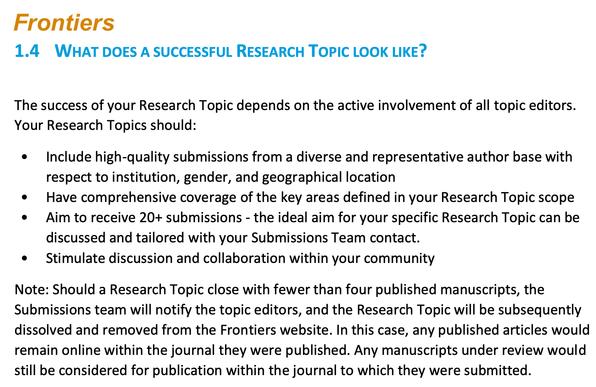
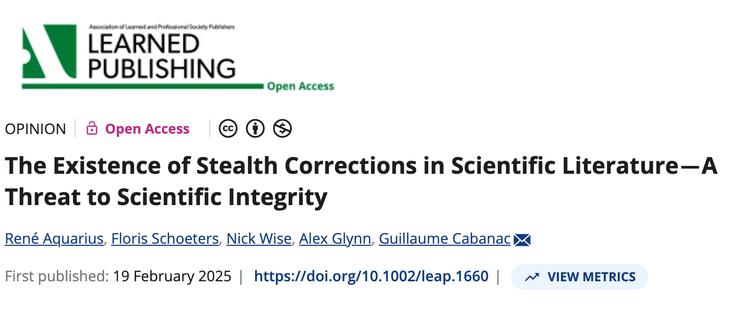
We learned most publisher policies ACTIVELY hide PISS by altering article metadata post-hoc.
At a *minimum*
#Frontiers,
#Elsevier,
#MDPI all do it publicly! Yikes. 🤯
Thanks to
@[email protected] et al. for noting this (see pics).
11/n
And why wouldn't they support PISS? Guest editors may not handle their own articles. But a special issue of ~10 articles can equate to ~$25k in revenue. If an associate editor rejects a paper & the guest editor leaves, the journal loses that money.
Guest-editing creates a COI plain & simple.
12/n
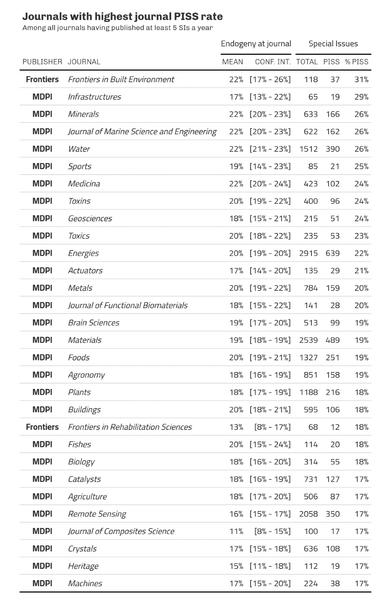
Philosophical Transactions: pr...Most journals practice special issues fairly responsibly. But it's the worst offenders that contribute most of the PISS. ~90% of PISS in our data come from just 150/904 journals.
And it's exactly who you think it is.
#MDPI #Frontiers
13/n
PISS is easy to spot & easy to police with special issue tags & editor/author metadata. Journals could include these in xml reported to OpenAlex or CrossREF. Indexers can require them to do so.
Efforts like ours and
#ScienceSleuths &
#FoSci shouldn't have to be the vehicle for essential data.
14/n
PNASTo help with this effort, the brilliant
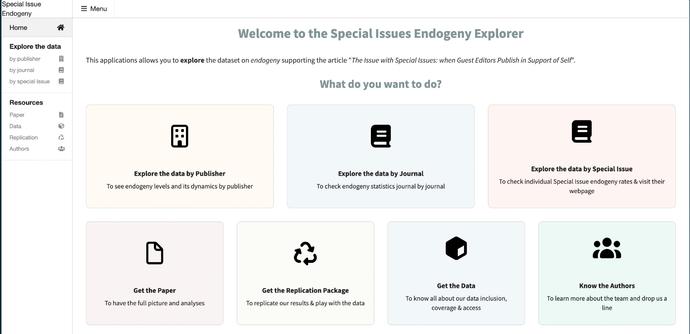
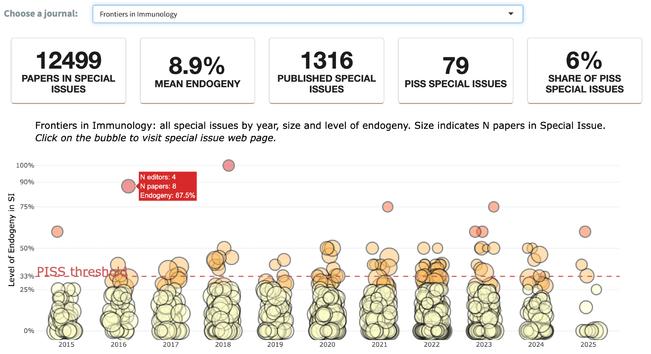
@[email protected] has made an app to explore our data. Sort by publisher or journal. You can even click the bubbles in the plots & it links to the special issue in question 👏
bit.ly/PISSpaper
We also have reams of appendix tables. Have at 'em!
15/n
We really can't stress this enough: PISS is a huge drain on scientific publishing in time, trust, & money. Publishers like to say these papers would be published anyways & special issues just collate them. If that were true, just publish them the normal way without soliciting widespread COI!
16/n
The Drain of Scientific Publis...
The Drain of Scientific Publishing
The domination of scientific publishing in the Global North by major commercial publishers is harmful to science. We need the most powerful members of the research community, funders, governments and Universities, to lead the drive to re-communalise publishing to serve science not the market.
So there ya have it. We hope our data are useful to indexers, and to the public to help corral this widespread academic misconduct.
The cost of inaction is immense. Without it, we will continue to piss hundreds of millions of research funds down the drain.
arxiv.org/abs/2601.07563
17/17
 Mark A. Hanson