Check out these unbelievably beautiful macro photographs of Slime Moulds by Barry Webb at https://www.barrywebbimages.co.uk/Images/Macro/Slime-Moulds-Myxomycetes

The photograph below of glistening, Comatricha nigra slime moulds won the People's Choice award in the macro category of the British Photography Awards 2025.

Also check out the macro images of fungi at https://www.barrywebbimages.co.uk/Images/Macro/Fungi

Barry's Instagram site: https://www.instagram.com/barrywebbimages/

More about slime moulds at https://en.wikipedia.org/wiki/Slime_mold
#Photography
1/n
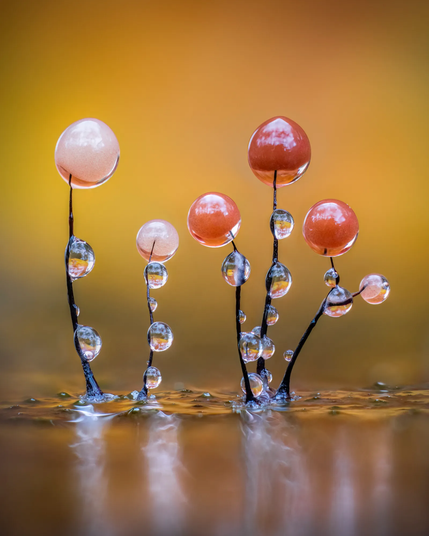
In this article, English photographer Barry Webb explains that due to the size of the subject, "one picture would not do them justice, you can get virtually nothing in focus".

He describes how he uses a technique called focus bracketing, where dozens of photos are taken.

"You take multiple pictures, sometimes over 100 and it takes tiny little slithers of focus, and then you put all those into software, and that creates your final image."

https://www.bbc.com/news/articles/c9d9409p76qo
2/n

Also, check out this gallery of images and winners of the 2025 British Photography Awards.

"There are 400 images taken all over the world, showcasing the best of British photographic talent."

https://www.britishphotographyawards.org/2025-shortlist/gallery
#Photography
3/n

British Photography Awards

The British Photography Awards is a charity oriented photography prize open to all UK residents and British photographers the world over

Check out this article for insights into focus stacking techniques from Barry Webb and two other specialists.

Barry uses a mirror-less Olympus OM-1 camera, which is based on the Micro Four Thirds (MFT) system standard. It supports focus bracketing - taking images at multiple focus settings.

https://amateurphotographer.com/technique/macro_photography/focus-stacking-how-to-achieve-pin-sharp-macro-shots/
#Photography
4/n

Focus stacking: achieve pin sharp macro shots of delicate subjects

Three experts show you how to use focus stacking in macro photography and provide top tips, their favourite software and must-have kit

Amateur Photographer

@AkaSci
The later Canon 7 series cameras* will do it in camera.
Occasionally useful.

* I use them for runners and triathletes, they are also optimised for wildlife, and are, like most equipment these recent several quinquennia very good cameras.

@Photo55
Do you mean that the later Canon 7 series cameras can be programmed to take multiple images at slightly different focus settings and then stack/stitch them together into a beautiful composite image?
@AkaSci
I think Canon would say that beauty isn't their department, but yes, focus stacking and combining they do. I think it only arrived in the R7 - I have the earlier ones as well.
@Photo55 @AkaSci Fujifilm (at least x-series, but maybe others) can do focus bracketing, but assembling the final image requires software tools.

@jack @AkaSci
The R7 saves the intermediate images, as well as making a composite*. One might choose to do one's own composing, or patch the camera composite with a section from one or two individual images.

The first macro stack I made - long ago - used a micrometer slide holding the camera, and I blended layers in the Gimp.

Along the way I learned a little about focus breathing on the one hand and magnification by distance on the other.

Animals are more difficult.

* Internal software

@jack I think focus bracketing is slightly different, because it is inconvenient to bounce back and forth, and large numbers of brackets are less usual.
The stack thing is a definite progression from the nearest to the furthest, and the R7 offers up to 999 locations which is excessive, 70 is a more commonly used number by one of our club members who catches bugs.

@Photo55 Fujifilm describes it as focus bracketing, but maybe the terminology varies between manufactures.

On my Fujifilm, I can specify the focus start point, focus end point, number of photos to take (also up to 999), and a few other factors, and when I press the shutter release the camera will automatically take each of the successive photos (adding a delay between each, if desired).

But no on-camera processing is done with the resulting series of photos. You have to off-load and process.

@jack
Earlier Canons will do - IIRC - the camera's guess at focus, then a bit beyond, then a bit closer or similar, but I don't think they went up to large numbers or combined them. Never used it.

So the facilities sort of leapfrog with makes and models.

@AkaSci

Incredible! Who needs to conjure alien worlds when we have these life forms right here on earth! What fantastic photography! Thanks for posting.

@AkaSci @briankrebs Those are stupendous images.
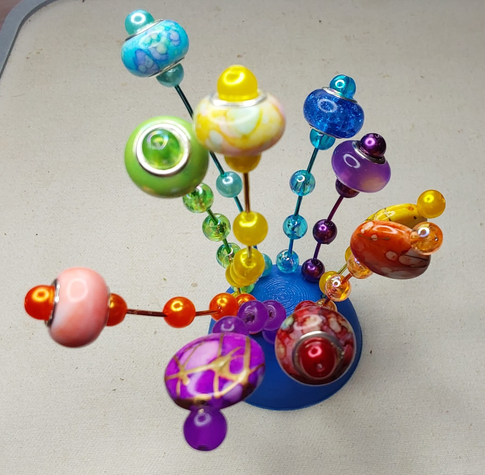
@AkaSci Great photo - one that made me recall a beading creation I conceived a few months ago ...

@AkaSci Some of those look like they're part of some fantasy land on another planet! Just beautiful!

There's a gorgeous yellow slime mold at the nearby wooded park I spotted a couple days ago. I desperately want to photograph it, but I have to wait for my new macro lens to arrive, and I need to get over this Flu. I hope it hasn't disappeared in that time 😕

@AkaSci Spotted these earlier today. Absolutely stunning! I'm lucky enough to own a 4K screen and these look... absolument phénoménal!