I was recently reminded of this.

A couple decades ago, I wrote a short paper that described how the basic approaches of cryptography and computer security lead to an efficient and practical privilege escalation attack against master-keyed mechanical locks, which I published in IEEE Security and Privacy (a nerdy computing technical journal).

https://www.mattblaze.org/papers/mk.pdf

TL;dr: Master-keyed locks have fundamental, exploitable weaknesses.

But I wasn't ready for what happened next.

1/
Unexpectedly, my paper got some press attention. @jswatz_tx found it and wrote a short piece in the NY Times.

And then locksmiths freaked out. I mean completely lost it. They were very upset, not so much that a very common lock design had a basic security flaw, but that an "outsider" found it and had the poor moral character to make it public.

I started getting weird death threats. They doxed me ("let's see what kind of lock the bastard has on HIS house")

2/

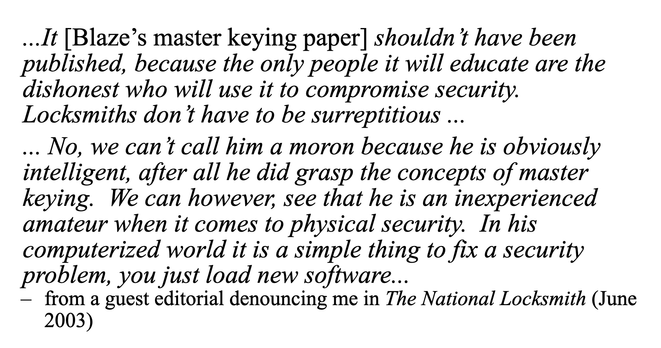
A trade publication called The National Locksmith ran monthly guest editorials in which prominent members of that profession were invited to denounce me. My favorite quote, from a locksmith named Billy Edwards, who had written a book on master keying, and who took my paper rather personally.

3/

I should point out that master keying was about a century old at the time, and while the mechanical details weren't secret, locksmiths tended to regard the inner workings of locks as "restricted knowledge", rather like a medieval trade guild. I didn't understand this.

What took me by surprise was how different the physical security wold's attitude was compared with that of my community, where the ethics of discussion of vulnerabilities has long been essentially settled in favor of openness.

4/

Essentially, their argument was that this would be a huge pain and expense to fix, and so we are all better off just keeping it on the down low. And that kind of worked, for about a hundred years, until more open communities - like computer security research - started looking seriously at locks (as both metaphors and as interesting mechanisms in their own right).

I see their point, even if I personally reject it. But in the age of the Internet, you just can't keep this kind of stuff secret.

5/

Anyway, my intent in looking at locks and publishing my paper wasn't to disrupt the lock industry. I believed, as I still do, that mechanical locks and physical security have quite a bit to teach computing, but also that the abstract techniques of cryptography and computer security can illuminate weaknesses that are hard to see when looking at systems in strictly mechanical terms.

My attack is intuitive and obvious to cryptographers, but rather subtle without our field's tools.

6/

I never did reach a truce with the locksmiths. A couple years later, I met Billy Edwards, the author of that editorial denouncing me, at a trade show, and when he learned who I was he refused to shake my hand and asked me to leave him alone.

I wish he had seen things differently, but I can respect that he was coming from a place of genuine concern, even if I think his approach was wrong.

To this day, I worry that I'm pretty screwed if I get locked out of my house.

7/7

NB: While I never intended to piss off locksmiths with my master keying paper, I did write a followup a couple years later about safes and safecracking, partly out of spite.

https://www.mattblaze.org/papers/safelocks.pdf

TL;dr: We can learn a lot from safes and safe locks, and the frameworks of cryptography and computer security are applicable there, too. The fact that our learning about this subject makes people in that industry upset is just a bonus.

I wrote that paper after I had moved from AT&T Labs to U. Penn. The Penn locksmith went totally apoplectic, and wrote regular angry letters to the dean and to the head of campus security warning about what an irresponsible, dangerous menace I am. But for whatever reason, his efforts were unsuccessful in getting me fired; the administration just forwarded me his letters, which I taped to the door of my office.

It occurs to me that people outside the security field might find it odd that we openly publish stuff like this. Why help people who might use the knowledge to do bad things?

There are a number of reasons. The first is that only through open discussion are we able to identify and fix problems. Another, which is what motivated my work, is educational: you can't learn to defend systems unless you understand how they are attacked.

So while openly publishing offensive security techniques might indeed help criminals, that harm is outweighed by significant benefits. Every properly trained computer science student should understand how to exploit vulnerabilities. Because the attackers DEFINITELY understand it.

The bottom line here is that while being the subject of attack by a deranged internet mob is never fun, sometimes it's the cost of doing business for doing interesting work.

And for those who yell at me for posting black and white photos or not putting content warnings on discussions of current events or not using enough hashtags or whatever, don't bother. I've stared down angry locksmiths and come out the other side.

I've gotten a few replies asking me if I regret publishing this or would do anything differently.

No. I'm proud of this work. I think it has value. I would do nothing differently. I am, evidently, remorseless and incorrigible.

@mattblaze you know, it's probably your work and similar that led to a more open world of locksmithing where you have people like The Lockpicking Lawyer doing full teardowns of fancy locks on their site, where locksport continues to be a popular (if somewhat niche) pastime, and where - one hopes - physical locks continue to evolve more securely.

So anyhow, thank you for publishing that paper. The people who got pissed off were just coming from an older way of thinking about things.

@me I'm not sure what the reason is (though I like to believe I was part of it), but I definitely agree that we're in a much better place today -with open discussion of physical security and an active community probing it and publishing about it - than we were 25 years ago.

@mattblaze
Thanks for sharing this story - lots to learn here, and translatable to many guilded communities. But, I find myself wondering if, even if more openly discussing security after your work, the locksmith community ever remedied the master keyed lock flaw? Or was it really too expensive to make it practically unfixable?

@me

@me @mattblaze There are so many locksmiths and lock manufacturers that hate folks like LPL, McNally, & locksports in general because they often reveal how much of it is an extremely false sense of security - the number of designs that are trivial to bypass or get in to is way too high, and many lock manufacturers just haven't bothered to make their stuff more secure.

A lot of thieves who bother with lockpicking and bypassing already knew a lot of the stuff locksports are sharing with the broader public. They already knew that you can comb open certain lock designs, smack certain padlocks to force the spring latch to release, bump-key a deadbolt to get in without obvious damage...

IDK it just seems like locksmiths and lock makers rely heavily on security-by-obscurity and all that does is leave the honest folks in the dark about how secure a lock truly isz meanwhile the dishonest figured out which locks can be easily gotten in to long ago & figure that out well before anyone publicly shares that knowledge.

@senil

designs that are trivial to bypass or get in to is way too high, and many lock manufacturers just haven't bothered to make their stuff more secure

I believe this is another important aspect of, and reason for, bringing responsible disclosure, or any disclosure at all, to the realm of physical security.

How do locksmiths expect the general security baseline to improve, if not by putting economical pressure on manufacturers? Build shitty locks, people eventually can realize they're flawed, so they can choose to not buy 'em anymore.

And don't anyone dare arguing "well, everyone should pay a licensed professional to choose each and every lock that is moderately important" — that's some secret guild level choke-hold of the commoners, by literal gatekeeping. :)

Endangering practically everyone long-term, while impotently and ineffectively imploring manufacturers to build better locks, isn't a gloriously effective prospect.

Thank you for that paper, @mattblaze !

@mattblaze this was such a fun read - thank you
@mattblaze excellent article, thank you for posting it

@mattblaze

The issue is not "how can I protect my 42 Rolex from thieves?" but "Why must a thief pick my 42 Rolex?", bringing to ask "Who taught to this person that to have 42 Rolex is good?", i.e. "Who invented the competition based on the possession of things?".

@mattblaze :-) I’ll look up the papers, thanks! … I wonder if a perspective here is that the entire idea of ā€œprivileged knowledgeā€ is, basically, tremendously morally dubious. You note several problematic outcomes of it.

I think there is a distinction to ā€œsecretsā€. We understand a secret is only secret when it is kept secret. We don’t expect others to respect the secrecy, that duty is on us.

With privileged knowledge there is some sense of requiring others to align with our own ideas. … I just can’t see that leading to healthy incentives, and it seems pretty guaranteed to create unfortunate power imbalances?

Maybe someone’s already written about this clearly, because I don’t think I’m managing to!

@benjohn @mattblaze The problem with "privileged knowledge" aka "security by obscurity" is that you have no way to verify that nobody else knows. Every idea can and will be thought again. So security by obscurity does not provide reliable security at all.

@ax11 @mattblaze I agree with this, but I’m suggesting maybe we can make a stronger statement, beyond just the realm of security, that ā€œprivileged informationā€ is problematic.

Thinking of historic examples, we’ve got the power of the church amplified by the bible being in Latin, and also being very expensive to copy. I think there are lots of examples of knowledge hoarding in libraries, prior to this being more open. There are also lots of cases of manufacturing knowledge being kept private to block competition.

In these cases, it’s been rational for some group to maintain privileged information, but it seems hard to claim this has benefitted people at large.

@benjohn @mattblaze I fully agree. Unfortunately, microblogging platforms are not really made to explain your argument in deep.
@ax11 @mattblaze a follow on thought - the intent (often subverted) of patent law was to encourage information disclosure instead of hoarding. The ā€œpaymentā€ for disclosure being exclusivity for some period. So even our regulatory system considers privileged process information to be problematic.
@benjohn @mattblaze ...hence the "non-discriminating" condition in certain license.
@benjohn @mattblaze I think you managed pretty well.

@mattblaze The locksmiths need to stay in more, and enjoy a few fun YouTube videos from the LockPickingLawyer, who has not only picked every lock in sight on camera, and insulted nearly all of them, he has, or used to have, a side hustle selling the kit he uses.

This cat will not get back into the bag.

https://www.youtube.com/@lockpickinglawyer/videos

LockPickingLawyer

This channel aims to educate consumers about weaknesses and defects in security devices so they can make better security decisions. It should go without saying, but I’ll say it anyway: do not use any of the information presented in my videos for illegal purposes. My mailing information is below. Do NOT send anything you want back unless I’ve agreed in advance to do so. LockPickingLawyer P.O. Box 215 Damascus, MD 20872 USA Please note that I do not recommend locks, nor do I provide assistance in opening them. For advice getting started in locksport, I recommend the ā€œUniversityā€ at LockLab.com. For all other inquiries, email me (channel name at gmail). One final note - I usually receive over one hundred emails each day, and though I spend a couple hours a day answering emails, I can’t answer them all. Apologies in advance if your email is one that slips through the cracks. https://www.twitter.com/lockpickinglwyr https://www.instagram.com/lockpickinglawyer

YouTube
@steter @mattblaze He still does, Covert Instruments. Recently got the Covert Companion Pro, which is basically an entire field kit in the form of a leatherman tool :)

@mattblaze If nothing else, your future is assured as a viral sensation.

Locksmiths HATE THIS GUY... find out how to break locks with that ONE SIMPLE TRICK!

@mattblaze
Now I'd like to read one of those papers? I found this interesting and of course, being right is not always rewarded, with the hostilities it draws.
@mattblaze evidently, you're okay with going in a Blaze of glory

@mattblaze I realized the problems with master keying back in the mid-80s in college, so I figure it had to be common knowledge then or thieves would be too stupid to breathe. That includes the practical vulnerabilities of just swiping a copy of the master or making a bump key.

I wonder how many things are relatively secure only because even the bad guys dismiss the attack as "Nobody would be brain-dead enough to leave _that_ in there...".

@mattblaze And they never once changed the keying on your office lock. Or did they? (The right way to do it, of course, is to rekey is that your key works but the master keys don't, thereby locking the maintenance people out. Then wait for something to go wrong—or "help" that along…)
@SteveBellovin @mattblaze you sir have an admirable evil streak 🫔
@quinn @mattblaze It’s part of being a good security person. The way I put it is that I get to think evil thoughts and feel virtuous about it.
@mattblaze After reading all of this and remembering business 101: You revealed a market upgrade opportunity for innovation and relevance to the first locksmiths to adapt and offer the products and service. Again, business 101 most common degree in America at one point. Anyway, those upset by your publication of *the truth* of a day zero exploit a hundred years in are lazy entitled parts of our entire problem and may be disregarded if not actively countered with principled resource expenditure.

@mattblaze So ... they [the locksmiths] had a hundred years to try to solve the problem, but didn't?

That kind of deflates the "this is serious because it takes longer to fix physical vulnerabilities" argument ...

@tychotithonus @mattblaze Induction, applied to procrastination.
@tychotithonus @mattblaze Well. Physical security is hard. You may find that practical & secure master key system is impossible, for example.

@pavel

Indeed. Almost as if solving the problem that way was untenable, and they knew it, and were relying on obscurity instead of solving the problem a harder way.

This is a cybersecurity metaphor.

@mattblaze Now I'm wondering why you were recently reminded of this.

Like, are there reports of a wave of burglaries that happened suspiciously around the same time a bunch of infosec academics lost their NSF grants?

@lahosken @mattblaze or did you misplace your keys? šŸ¤”

@mattblaze

We should really start a multidisciplinary peer reviewed open access Journal of Spite.

@mattblaze this is an outstanding story.

@mattblaze Do your locksmith friends know about this guy?

https://en.wikipedia.org/wiki/LockPickingLawyer

I’ve watched some of his videos and it is surprising how easy it is to pick locks.

LockPickingLawyer - Wikipedia

@Robgbysea That is a little bit like watching a recording of Nureyev in his prime and concluding it's easy to dance ballet.

@mattblaze

@graydon @Robgbysea @mattblaze yeah, the comments by locksmiths about how good he is, amazing.

@7leaguebootdisk @graydon @Robgbysea @mattblaze

"surprising how easy it is *for the LPL* to pick locks"

Was inspired by those into lock sports to buy a set of picks to try this myself. Substantially more difficult than depicted in videos on YouTube and orders of magnitude more difficult than depicted in 1980s TV detective dramas.

@graydon @Robgbysea @mattblaze _Some_ of the stuff he does is easy, so even if he always manages to open a lock, you can usually tell a lot about the quality of it.

If a lock can be opened with a simple shim or by raking it, stay away. If a video includes phrases like "the tool that Bosnian Bill and I made", it tends to be a decent lock.

@Uglesett @graydon @Robgbysea @mattblaze
Given that there is a secretive locksmith community who is actively hostile against anyone revealing the specific weaknesses of particular locks, I now realise the LPL has good reason to never allow his face to be shown on camera
https://youtu.be/b6jI9W1wERI
Can THERMITE Actually Break a Lock? (w/ Lock Picking Lawyer)

YouTube
@Uglesett @graydon @Robgbysea @mattblaze Or if the video is titled "A Padlock I'd use"
@Uglesett @graydon @Robgbysea @mattblaze And security is ultimately an economics problem. If the lock on my bike is good enough the thief takes yours instead I win. If the lock is stronger than the rest of the security on something then it serves no purpose being better because I'll just take the other path, be it a sledgehammer or removing jewels from Parisian museums by going in somewhere else.
@Robgbysea @mattblaze Just LPL's title is enough for any lock company's legal department think twice before sending him a Cease and Desist letter and asking Youtube to take down content of a lock LPL has deemed unfit. He's very careful about what he says about bad locks couching them as opinions which are completely legal and not libelous.
@Robgbysea @mattblaze The great thing about LPL's videos is that I can tell when some actor is pretending to pick a lock vs. actually picking it on TV and movies. They usually get the turner wrench wrong.

@mvilain @Robgbysea @mattblaze
If they bother to even use a turner wrench
https://youtu.be/1d-ISQfmCmM

When script writers for TV drama just needed to move the plot along, any contrivance would work regardless of accuracy. A credit card shim or a swift kick would be just as effective.

MacGyver Season 4 Episode 11

YouTube

@Robgbysea
You know, there might be more than one reason why the LockPickingLawyer prefers to stay anonymous. šŸ˜‚

@mattblaze

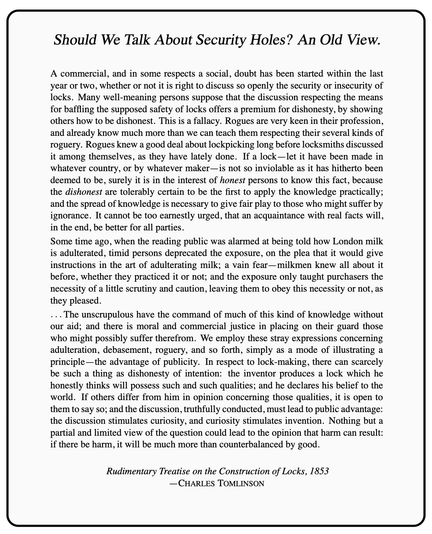
@mattblaze What's really funny to me is this 1853 book that Ches and I quoted in the first edition of "Firewalls", about whether it's proper to discuss vulnerabilities in locks.
@SteveBellovin @mattblaze Well argued, and I enjoyed reading the Victorian era language it is written in.

@SteveBellovin @mattblaze

"It cannot be too earnestly argued, that an acquaintance with real facts will, in the end, be better for all parties."

"An acquaintance with real facts" — Ah, so I see they had the same problems then as we do now.

@mattblaze Thanks for sharing your story. I see a lot of similarities to an issue I face in some of my work.

I am curious: If you had known about the coming backlash, is there anything you would have done differently?

@mattblaze As a ā€œcomputer personā€ in this equation, it strikes me as obvious that, if some exploit exists, no matter how hard you try to keep it secret, bad actors are already out there who posses the knowledge.

Trying to keep it under wraps only serves to allow those actors to exploit the issue, without the rest of us being any wiser.

I suppose that’s exactly what you thought as well.