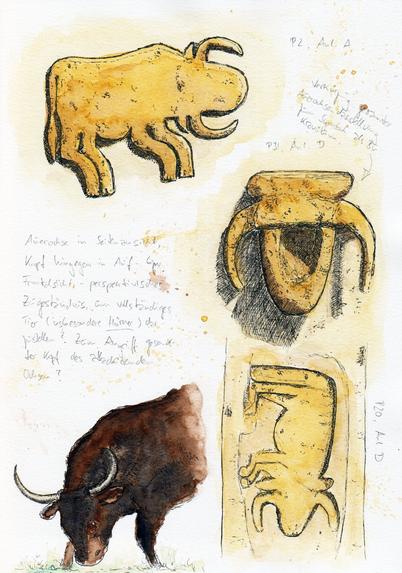
Absolutely appreciating Irving #Finkel and his out-of-the-box thinking, so naturally followed up curiously here since this is so closely tied to my own work and research (in fact, the piece shown by Jason here was one of the first I've drawn after I started working at #GöbekliTepe) ...

RE: https://bsky.app/profile/did:plc:7pipiyze4po5d3opgg5fgnl6/post/3mah4gk53mc2q
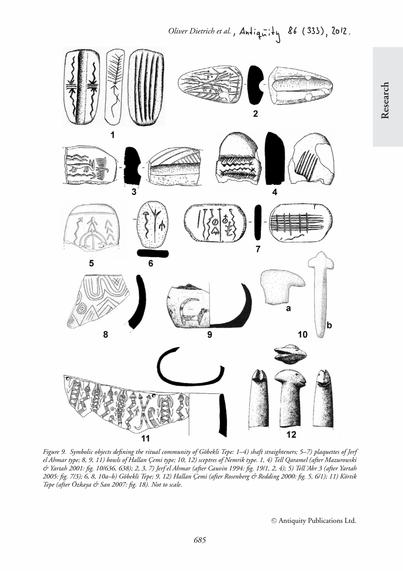
Finkel may or may not be right about these particular types of object really being used as stamps (it's been discussed before, but I personally remain sceptical) - yet I absolutely would agree that they represent a communication medium of sorts.
These so-called stone #plaquettes (the type originally named at (and after) the site of #JerfElAhmar in modern day Syria) are a very fascinating find group in particular since they seem to serve no other purpose than indeed carrying these symbols (see e.g. 5-7 in the figure here).
These depictions are well fitting into PPN #iconography known from a variety of typical find groups - apparently shared over a wider region and forming a common set of symbols within what seems a large-scale communication respectively exchange network. www.dainst.blog/the-tepe-tel...
And sometimes there are even #symbolic substitutes for larger, more complex depictions. Like, for example, the #bucranium ("ox head") instead of an aurochs in its entirety, arrow-like zigzag lines instead of snakes, or large birds reduced to a few lines.
These depictions and their "abbreviations" seem to follow some kind of convention, or even standardisation. This could imho indeed speak in favour of a #communication system for storing and transmitting specific content and #knowledge.
Would I go so far as to call it #writing? Well, no. Personally I don't think this crossed the threshold towards a structured approach using consistent symbols & specific script to represent spoken language. But a #communication system? Yeah, totally on board with that.
And as often in such cases this is, of course, already a long and ongoing discussions among scholars. 😉 Here's e.g. Sarah Kielt Costello's take, published in Cambridge Arch. Journal 21 … about 14 years ago: www.researchgate.net/publication/...