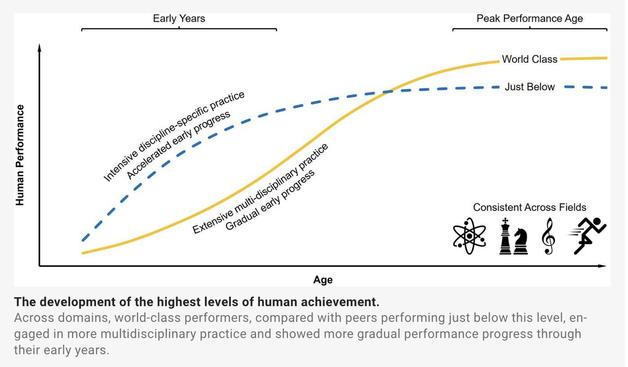
This perspective on human performance is super interesting!

Many of our stories about "genius," "superstars," and high performers are grounded in assuming that the patterns of early learning will extrapolate to the rest of life - e.g., child prodigies, gifted students, and those with early steep curves on the achievement trajectory. But what happens when you expand the window of observation?

This review challenges some of our long-standing myths about high performance. They suggest:

"The pattern of predictors that distinguishes among the highest levels of adult performance is different from the pattern of predictors of early performance. Higher early performance in a domain is associated with larger amounts of discipline-specific practice, smaller amounts of multidisciplinary practice, and faster early discipline-specific performance progress."

https://www.science.org/doi/10.1126/science.adt7790

I suspect there are downsides to early hyper-specialization that may not show up in human problem-solving until later; and this is the kind of pattern that really rocks the boat on many of our assumptions about what the best predictors for sustainable high performance really are.
More pointedly, should we be closing the door on the possibility of peak performance by the age of 8-9 across so many domains? Probably not!

Justice for multidisciplinary practice!

"By contrast, across high levels of adult performance, world-class performance in a domain is associated with smaller amounts of discipline-specific practice, larger amounts of early multidisciplinary practice, and more gradual early discipline-specific performance progress."

Parallels to my own developer science work:

- I have emphasizes that short-term payoffs can distract software teams from recognizing the long-term damage of cycles like learning debt, or engaging in contest cultures. Broadening the window of observation is crucial for seeing not just the "line go up" immediate response, but the "line crash down" that happens when your psychological environment is damaging

- human peak performance is probably a lot more diverse than we think, particularly for complex knowledge work. Generalizing from small and narrow measures mostly tested in early childhood/early learning (like cognitive tests) introduces a host of assumptions, and obscures our view of gradual, life-level learning!

- aptitude is not achievement! It's important to know that we can see lower levels of achievement associated with certain strategies at a certain point in time, but those same strategies will yield HIGHER achievement over time! There are many complex effects here, like protective effects from certain strategies that only come to light under challenge, or thresholds after which the longer-term strategies pay off more.

This is all part of the beautiful, incredibly complex science of achievement!

This kind of pattern also challenges long-standing myths about coder talent and what we think predicts what.

Should you always prioritize demonstration of early hyper-specialization when you're hiring programmers? If we overweight that at scale (which cultural beliefs about genius and ability are good at making us do!), we may be cutting ourselves off from the multidisciplinary problem-solving that our organizations will need to face complex challenges.

Another general meta thought: it's important to be careful when we look at work like this, because ultimately, peak performance is VERY hard to measure, predict, or generalize about. The populations are obviously very unique, and looking backwards can mean we pick up on selection biases. Nevertheless I really enjoy provocations that push back against some of the relationships we assume without realizing it!

One of the authors chatting about the selection effect issues I and others have wondered about and clarifying goals of the claims:

https://bsky.app/profile/brookemacnamara.bsky.social/post/3mahqgzo2hk2l

Brooke N. Macnamara (@brookemacnamara.bsky.social)

This is the focus of the paper—the pattern is quite different for the broader population than the associations observed within the highest levels.

Bluesky Social

@grimalkina

Exactly WTF is peak performance?

No developer/manager can be at peak daily
No task/solution can be written at peak always

So comes the classic books like ,The mythical Man-Month’ then ,Peopleware’ …

@teixi well, it's possible to be interested in people who achieve at the highest levels of performance in a domain without expecting it of everyone
@teixi but I agree that it's important to be careful about slippery assumptions about those patterns and trying to explain the whole world with them! Ultimately my advice is usually it's most strategic to focus on the solutions that measurably improve things for everybody and protect against instability rather than fixating on performance

@grimalkina

It is really important to focus on overall team performance/productivity/market goals

But then this is what separates an effective –to avoid peak— team/project managers to rise

Because aside dealing from distractions:

1 teams ideas towards innovate solutions vs simply basic tasks implementation delivers
2 customers/market demands towards last issue/trends vs delivering product solutions
3 top management availability to provide proper resources in time vs distractions

@grimalkina reminds me of how many times I’ve had to take down people who say “if you’re not doing programming as your hobby then you won’t be any good at it / aren’t the sort of person we should hire”. This is not a predictor of engineering success, but this attitude is a predictor of the tendency towards toxic behavior.

@grimalkina

Hey, I may name overweight, but that has nothing to do with me being hyper or being a bad programmer.

- bad early morning social media reading skills

@grimalkina Hyper-specialization requires a societal substrate to support it. To early and the web is too fragile, the specialist needs the support of the generalist to fill the gaps.

Over time, if the society grows large enough, the gaps between the nodes in the mesh narrow as normal randomization within standard distribution spreads. This allows more specialization within the same structure without requiring changes to the constraints of the overall system.

The specialist can be equally well supported in either case, though that support must be there or they will collapse. Project the singular case upon an entire society where the ratio of specialist to generalist is skewed and my feeling is that would ultimately lead to collapse

Take what you would from that as metaphor for specialized or exceptional workers in a typical corporate environment.

@grimalkina The question would be whether hyper-specialization limits peak performance, or simply takes a person to their peak and then is not productive. People with a higher peak may need less hyper-specialized practice to reach it, and therefore have energy left to broaden their interests and reap the benefits of cross-disciplinary practice.

Hard question to test...

@grimalkina this seems right. Specialization has sharply diminishing returns, and only a tiny tail of problems benefit from it. The amount of specialization a person with a strong generalist background can acquire on-demand on short notice is overwhelmingly likely to be sufficient almost all the time. Hyperspecialization is hard, and also a massive investment in a single trick, so when that trick doesn't work it can distort outcomes as we try to make the expensive tool solve the cheap problem.
@grimalkina That's not to say nobody should do it. There are real advantages to having a system that can support hyper specialists among the rest. But it's not, I think, what we ought to optimize for.

@grimalkina having digested this a bit, our question is

is interdisciplinary research and practice so fruitful because of something fundamental, or because that's the thing we've denied ourselves by shaping society to avoid it, so it's where the low-hanging fruit is?

@grimalkina not really a question with immediate practical implications, but
@grimalkina (the individual lens on "performance" is an important one but it's also important to remember that the project of exploring all potential knowledge is a shared one, and can't be fully understood without also looking at civilization as a whole)
@grimalkina (not to belabor the point)
@grimalkina FWIW this appears to align with the thinking of an old friend of mine Duff Gibson ... he has written quite a bit about the importance of multi-sport experiences for children in the context of later high performance. I don't think he's on Mastodon. Thought you might find this interesting https://www.darkhorseathletic.ca/general-6
The Tao of Sport book | Dark Horse Athletic

Dark Horse Athletic
@snowdolphin very fun thank you! I talk about sports psychology a lot with my trainer and she will enjoy too