
This perspective on human performance is super interesting!

Many of our stories about "genius," "superstars," and high performers are grounded in assuming that the patterns of early learning will extrapolate to the rest of life - e.g., child prodigies, gifted students, and those with early steep curves on the achievement trajectory. But what happens when you expand the window of observation?
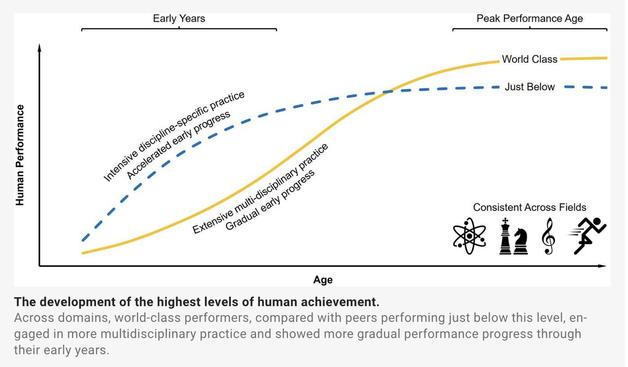

This review challenges some of our long-standing myths about high performance. They suggest:

"The pattern of predictors that distinguishes among the highest levels of adult performance is different from the pattern of predictors of early performance. Higher early performance in a domain is associated with larger amounts of discipline-specific practice, smaller amounts of multidisciplinary practice, and faster early discipline-specific performance progress."

https://www.science.org/doi/10.1126/science.adt7790

I suspect there are downsides to early hyper-specialization that may not show up in human problem-solving until later; and this is the kind of pattern that really rocks the boat on many of our assumptions about what the best predictors for sustainable high performance really are.

@grimalkina having digested this a bit, our question is

is interdisciplinary research and practice so fruitful because of something fundamental, or because that's the thing we've denied ourselves by shaping society to avoid it, so it's where the low-hanging fruit is?

@grimalkina not really a question with immediate practical implications, but
@grimalkina (the individual lens on "performance" is an important one but it's also important to remember that the project of exploring all potential knowledge is a shared one, and can't be fully understood without also looking at civilization as a whole)
@grimalkina (not to belabor the point)