 Momentum Institut
Am Arbeitsmarkt herrscht Krise. Zusätzlich wurde die Option zum geringfügigen #Zuverdienst zu Arbeitslosengeld und Notstandshilfe eingeschränkt. Was dem Arbeitsmarkt in der Rezession wirklich hilft, zeigt das #PaperderWoche von Tom Bauermann. @miriam_frauenlob fasst zusammen. 1/
In seinem neuen Paper „How to fight unemployment during a recession – insights from an agent-based model” analysiert Tom Bauermann mit einem agentenbasierten Modell drei verschiedene Szenarien und deren Auswirkung auf #Arbeitslosigkeit während einer #Rezession. 2/
Die drei verschiedenen Szenarien sind dabei einerseits die Reduktion des Arbeitslosengelds, ein Konjunkturpaket mit Transferzahlungen und #Kurzarbeit. Durch das agentenbasierte Modell lassen sich sowohl kurz-, als auch langfristige Effekte dieser drei Maßnahmen simulieren. 3/
Der Vorteil des agentenbasierten Modells liegt darin, dass individuelles Verhalten, aggregierte Nachfrageeffekte und die Heterogenität von Firmen gleichzeitig dargestellt werden. Das Modell analysiert ein konkretes Szenario, in dem die Arbeitslosigkeit durch #Firmenpleiten entsteht. 4/
Im ersten Szenario wird eine Situation modelliert, in der die Regierung das Arbeitslosengeld für #Langzeitarbeitslose kürzt und von den Arbeitslosen intensivierte #Arbeitssuche verlangt. Dabei versucht Bauermann die realen Arbeitsmarktreformen Deutschlands in den frühen 2000ern zu simulieren. 5/

Die Ergebnisse des Modells zeigen, dass die Arbeitslosigkeit in diesem Szenario kurzfristig minimal zurückgeht, sich langfristig aber auf einem höheren Niveau stabilisiert. Die geringeren Einkommen von Arbeitslosen senken den #Konsum und damit die Nachfrage. 6/
Im zweiten Szenario werden Transferzahlungen an Haushalte modelliert. In diesem Szenario kommt es durch die gestiegene Nachfrage zu einer schnelleren Rückkehr zur durchschnittlichen Arbeitslosigkeit – der Schock wird rascher überwunden. 7/
Im dritten Szenario wird #Kurzarbeit modelliert. Im Fall der Kurzarbeit können Firmen, die anspruchsberechtigt sind, ihre Arbeiter:innen im Umfang von 75 Prozent beschäftigen, während ein Großteil des Einkommens stabilisiert wird und der Staat einen Teil des Verdienstverlustes kompensiert. 8/
Kurzarbeit führt zu weniger #Entlassungen. Kurzfristig sinkt die Arbeitslosigkeit stark – und der Effekt ist wirksamer als Transfers. Diese Maßnahme wirkt als effiziente Möglichkeit der Nachfragestabilisierung. Nicht nur die Nachfrage der Haushalte wird gesichert, auch die Liquidität von Firmen. 9/
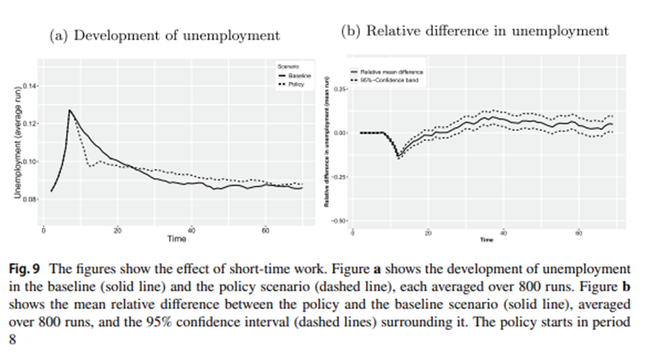
Ein weiterer Effekt, den das agentenbasierte Modell herausarbeitet, ist der asymmetrische Effekt von Kurzarbeit. So verteilt sich die #Nachfrage im Fall der Kurzarbeit auf mehrere Firmen, da weniger Firmen abrupt aus dem Markt ausscheiden. Das hat positive #Verteilungseffekte. 10/
Insgesamt zeigt das Paper: Wenn Arbeitslosigkeit durch Firmenpleiten verursacht wird, sind nachfragestabilisierende Maßnahmen wirksam, wenn es darum geht die Arbeitslosigkeit wieder zu senken. 11/
Maßnahmen, die Menschen schnell in schlechtbezahlte Jobs drängen, wirken zwar in der kurzen Frist, erhöhen langfristig jedoch die Arbeitslosigkeit, da es zu #Nachfragemangel kommt. 12/
Das ganze Paper findet ihr hier: https://link.springer.com/article/10.1007/s11403-025-00459-x
13/13
13/13

How to fight unemployment during a recession? - Journal of Economic Interaction and Coordination
The low and (partly) negative economic growth rates in Germany since the outbreak of the energy crises and growing danger of deindustrialization sparked debates about measures to avoid growing numbers of unemployed, for example by changing the generosity of unemployment benefits (UB) or extending short-time work. This paper aims to contribute to the theoretical literature of policy responses to recessions by analyzing three prominent instruments: (a) a permanent reduction of unemployment benefits that is accompanied by increasing search efforts, (b) a fiscal stimulus package and (c) short-time work. To analyze these measures, researchers typically use DSGE models or search and matching models. In contrast, I develop an agent-based macroeconomic model (ABM). Thus, I can analyze the interplay between macro- and microeconomic effects of policies, as well as how interactions among agents shape economic outcomes. I find three main results: First, (a) has almost no effect on unemployment in the short run and negative effects in the long run. This is contrary to the canonical search and matching models, even though the simulations reveal the same "desired" effects, e.g., shorter unemployment spells in the short run. Second, in comparison with (a), policies (b) and (c) can dampen unemployment in the short run and bring employment back to the normal rate more rapidly. Third, in contrast to representative agent models, I can show that short-time work supports the economic recovery through demand stabilization and a distributive effect among heterogeneous firms. In particular, the distributive effect has not been shown in other papers so far.