Imagine that your language had a pangram—a sentence that uses every letter of the alphabet—without duplicates. Imagine that this pangram was also a poem, and that it's widely known.

For the sake of illustration, pretend that the English pangram

veldt jynx grimps waqf zho buck

is this poem [there are five red spelling wiggles in that line on my browser].

Imagine that this poem is so well known that even in far-flung cultural contexts, "v" signifies firstness, "e" signifies secondness, "l" signifies thirdness, and so on.

You start to find that the letters v, e, l, d, t, j, y get used to mark ordered lists. The names of the notes of the musical scale are given these letters, in this order. Your railway's tickets are labelled V, E, L, for first-, second-, and third-class.

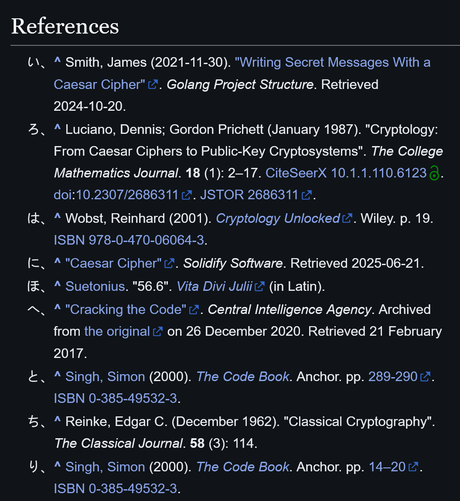
This is a post about iroha. https://en.wikipedia.org/wiki/Iroha

Iroha - Wikipedia

Here is the entire iroha poem:

いろはにほへと
ちりぬるを
わかよたれそ
つねならむ
うゐのおくやま
けふこえて
あさきゆめみし
ゑひもせす

Japanese has moved on a bit since this was written a thousand years ago. Some characters like ゑ are now obsolete. Another character ん has since entered common use.

Professor Ryuichi Abe translates iroha to English thus:

Although its scent still lingers on
the form of a flower has scattered away
For whom will the glory
of this world remain unchanged?
Arriving today at the yonder side
of the deep mountains of evanescent existence
We shall never allow ourselves to drift away
intoxicated, in the world of shallow dreams.

I think this is a bit more poetic than the one about the zho buck.

There's really nothing like this in Alphabetic languages. Iroha is used a bit like Roman numerals are in the West. As Japanese doesn't have an innate order to its syllabary the way Latin does, "iroha" became the de facto ordering, a bit like "A-B-C" does in English, and there are some parallel semantics.

I'm curious if other syllabaries have trodden this path. Cherokee? Canadian Aboriginal languages using the syllabic script? Linear B?

Nerd alert: CSS supports iroha ordering for numbered lists. Stick

style="list-style-type: hiragana-iroha;"

onto any <ol> in HTML, and you'll be able to read the whole poem.

@futzle This is amazing!
@futzle brb changing every style sheet I have access to…

@futzle

I was overjoyed when they added this.

And, yes, the full iroha poem is my habitual penmanship exercise. It should be noted that it is a form of Buddhist scripture.

@futzle I was taught that there is an ordering to the kana, and I've seen that ordering used to organise stock in shops in Japan. The one I'm familiar with is あ (a), い (i), う (u), え (e), お (o), か (ka), き (ki), く (ku), け (ke), こ (ko) etc.

@sbszine Yes, this is the modern ordering, called the Gojuon. It's how dictionaries sort entries.

https://en.wikipedia.org/wiki/Goj%C5%ABon

Gojūon - Wikipedia

@futzle Latin doesn't have innate ordering either, does it? It's just a very long-standing convention.
@skaphle I suppose so, if the alphabet also read as a poem when you wrote it out?
@skaphle @futzle Big Bird would like to have a word with you. A most remarkable word..,

@skaphle @futzle

The ordering we have is a mutation of the one used by the Phoenecians who imitated the Egyptian acrophonic use of hieroglyphics without correctly understanding it, and accidentally created the alphabet.

Meanwhile, the Japanese syllabary also has a formal tabular order (derived ultimately from Sanskrit grammarians, who were working with a script derived ultimately from the Phoenecian proto-alphabet) of vowel columns and consonant rows.

@futzle For an evolution like this to occur in English I suspect it would be necessary to use whole words as the ordinals. #lang_en
@futzle ... Unless we had a syllabary. #lang_en
@ellenor2000 I agree, syllabaries are the ripest ground for this kind of thing.
@futzle that's amazing, thanks for writing about it!