I've got a new #KiCad plugin out in the KiCad plugin manager:

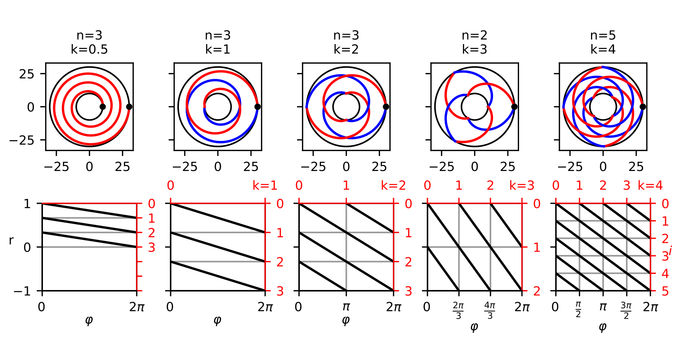
KiCoil generates "twisted" planar inductors. You can make it do one- or two-layer spiral inductors, toroid inductors, and many intermediate, hybrid variants in between spiral and toroid inductors.

These hybrid types have wider traces than a single-layer spiral, and have better high-frequency behavior (parasitic capacitance and self-resonant frequency) compared to two-layer spiral inductors. And they look really pretty!
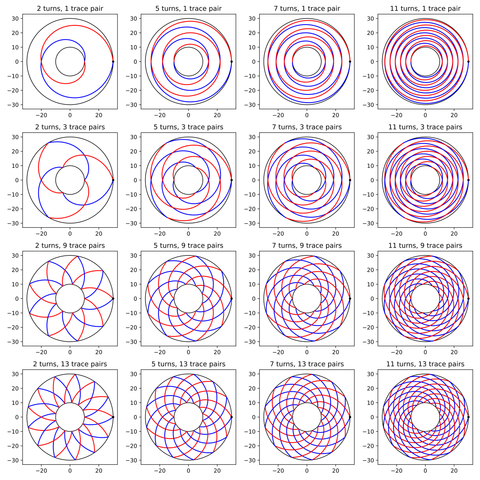
#electronics

@jaseg out of curiosity, what's a typical inductance that you can sensibly achieve with these?
@gsuberland Depends on board area, I'd say about 50 µH in 25 mm diameter and maybe 400 µH in 50 mm diameter. The main limiting factor for large inductances is DC resistance due to the narrow trace width you need to stack many windings.
@jaseg @gsuberland huh, but thats already feasible sizes for SMPSes, neat

@funkylab @gsuberland I think the main limitation using these for something like an SMPS would be that they are coreless and large, and as such they would be a total EMI nightmare if you fed them straight from a FET switching with nice, crisp edges. You could maybe mitigate that and increase inductance with one fo these ferrite shielding sheets you can get for cheap for wireless charger coils.

Besides that, when pushing power, in PCB planar inductors the DC resistance quickly gets annoying.

@funkylab @gsuberland btw, the GUI calculates a rough approximation of inductance. The approximation holds for near-spiral layouts, the closer you get to a toroid the higher the real inductance gets compared to the calculated one.
@jaseg @funkylab @gsuberland Have you done any characterization against real PCBs? If so, can you share some results and pretty pictures?
If I have empty PCB space on a future project, I would put some of these on there just for the looks.
@tom_verbeure @funkylab @gsuberland I have, a detailed analysis is going to be in my PhD thesis which will be public in a few months, but I can find the results table and post a screenshot here.
@jaseg @funkylab @gsuberland Awesome! Thanks for sharing these!