I've got a new #KiCad plugin out in the KiCad plugin manager:

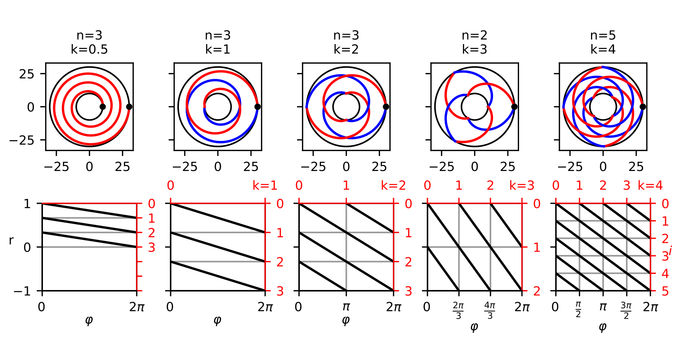
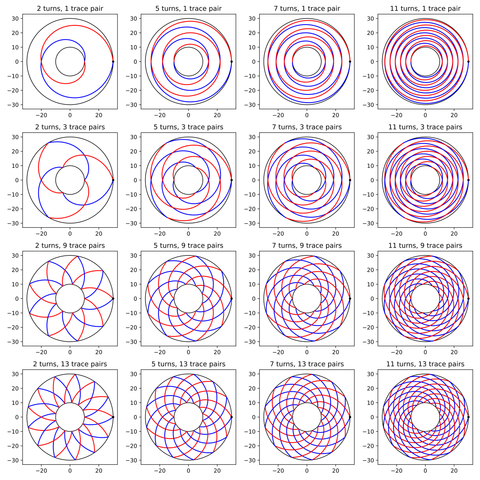
KiCoil generates "twisted" planar inductors. You can make it do one- or two-layer spiral inductors, toroid inductors, and many intermediate, hybrid variants in between spiral and toroid inductors.

These hybrid types have wider traces than a single-layer spiral, and have better high-frequency behavior (parasitic capacitance and self-resonant frequency) compared to two-layer spiral inductors. And they look really pretty!
#electronics

@jaseg out of curiosity, what's a typical inductance that you can sensibly achieve with these?
@gsuberland Depends on board area, I'd say about 50 µH in 25 mm diameter and maybe 400 µH in 50 mm diameter. The main limiting factor for large inductances is DC resistance due to the narrow trace width you need to stack many windings.
@jaseg @gsuberland huh, but thats already feasible sizes for SMPSes, neat

@funkylab @gsuberland I think the main limitation using these for something like an SMPS would be that they are coreless and large, and as such they would be a total EMI nightmare if you fed them straight from a FET switching with nice, crisp edges. You could maybe mitigate that and increase inductance with one fo these ferrite shielding sheets you can get for cheap for wireless charger coils.

Besides that, when pushing power, in PCB planar inductors the DC resistance quickly gets annoying.

@jaseg @gsuberland I can see that (but think it's an unlikely use case that you'd want a ferrite sheet applied to the surface, but not use a discrete inductor).
@funkylab @gsuberland Yeah, totally. Maybe if you need a ton of inductors of different values you could save some BOM space like this?
@jaseg @gsuberland I do have a few questions on what the actual magnetic field looks like for these, but I might just want to sit dowmln with your inductors first and think. But: first row of your 16 examples, the density's highest in the center, field lines there normal to pcb. Last row I find really hard to visualize.
@funkylab @gsuberland Yeah, due to being busy with other stuff I never managed to do some proper simulations. I spent a bunch of time trying to get these to simulate in elmer, but ultimately the geometric complexity just led to lots of crashes and numeric instability. I *think* the more "twisted" (bottom right) ones have a similar field to a standard spiral/solenoid, but the field lines spiral sideways instead of going exactly parallel to the main axis.

@funkylab @gsuberland This would make sense given that they are intermediates between a solenoid and a toroidal inductor.

I have some preliminary code to simulate these with magneticalc, but IIRC that just didn't work for me:

https://github.com/shredEngineer/MagnetiCalc

GitHub - shredEngineer/MagnetiCalc: MagnetiCalc calculates the magnetic field of arbitrary coils.

MagnetiCalc calculates the magnetic field of arbitrary coils. - shredEngineer/MagnetiCalc

GitHub