In my neighborhood, I often see parcel delivery trucks from 5 different transport companies wasting energy to drive to the same homes on the same day.

This is unregulated capitalism.

Then comes trash day, and 1 company arrives with 1 garbage truck and empties all the trash cans in 1 go.

This is regulated capitalism.

The municipality decided only 1 company could win the garbage truck service job. They offer up the job every couple of years, 1 company wins, and we all save CO2 emissions.

@randahl CUPW the postal union of Canada Post argued it could/should do last mile delivery - getting the package to the final customer. So companies don't race to the bottom in competing for home delivery
https://www.deliveringcommunitypower.ca/our_plan
Our Plan

All around the world, postal services are successfully reinventing themselves to better meet the needs of their citizens in the 21st century. What if we told you that postal workers have a plan to fight climate change and deliver vital new services to every corner of the country? Elder check-ins, low-fee postal banking, high-speed internet, and climate-friendly delivery with a fleet of electric vehicles. Welcome to the postal service of the future.

Delivering Community Power

@pinhman @randahl

What a brilliant idea, get rid of ten delivery trucks going down every street everyday and give everyone access to community mail boxes for secure delivery of parcels rather than just tossing them on the doorstep.

@randahl Scandavian NordPost offers pickup lockers at its service points.
Last Mile to service point would work for many

Alas CanadaPost has privatized in-person postal services to ShoppersDrugMart, owned by grocery giant Loblaws

https://www.postnord.se/en/private/receiving/collect/

Collecting parcels and letters | Private

Important details for recipients collecting parcels and letters sent via PostNord, ensuring a smooth and convenient pickup process.

@pinhman my local "post office" is at Jean Coutu, which is not the same oligarch.

Must be an Ontario thing.

@hub In SK & BC its ShoppersDrug Mart,

In Saskatoon in the old downtown central post office building that no longer does anything postal,
the old staff bassment cafeteria has been turned into a wonderful live music performance space. Run by Saskatoon's Jazz Society

https://thebassment.ca/

The Bassment

The Saskatoon Jazz Society

The Bassment

@pinhman they closed the main Vancouver post office (the one where you could get service in French — didn't ask they just recognised the French accent) and when I had a PO Box it was at a dépanneur in Yaletown

tl;dr not exclusive to Weston.

@randahl

In Germany its called (or euphemized) #SocialMarketEconomy, and worked fairly well flourishing the german post-war economy, and giving the working class a decent income and pensions for decades.

Well, until the Social Democrats (moderate center/left-wing) decided to promote more and more neo-liberalism (full scale capitalism) and fxxk'd up the country as well as their own party.

https://en.wikipedia.org/wiki/Social_market_economy

https://en.wikipedia.org/wiki/Social_Democratic_Party_of_Germany
Social market economy - Wikipedia

@randahl
Ah, this reminded me of how they do fiber installations around here. First one provider comes and digs up the side of the road to lay their fiber, then a few months later another one and maybe six months later again someone is digging a trench.

On my street there are only 2 fibers so far, but I've heard of even four different providers in some areas. Ofc it's nice prices going down because of competition but ffs why can't they co-operate in digging.

@shadowdancer @randahl in Poland a lot of fiber infrastructure was built with EU money with the requirement, that all providers can use it - so there is one infrastructure, but you still can select providers... suddenly, you don't have one or two who were able to build to choose from, but many more
@tuvok
Right, to that regard we have a mixed bag here in 🇫🇮. Most fiber operators are established telcos who each build their own infra, but there's also one operator who provides the physical fiber only, and then you can choose your internet connection from a selection of operators who all have access to the fiber. I don't think EU money is involved here, though I'm not sure.
@randahl
@randahl
And for all that "competition", it's currently more expensive to post a letter domestically in Denmark, than all the way from New Zealand on the opposite side of the planet. 😬
@randahl - In my town, Vancouver, even garbage collection is unregulated, resulting in a dozen large trucks driving through the neighbourhood every day making one or two pickups. Super-inefficient, climate unfriendly, and annoyingly noisy. Capitalism at its worst.
@mike_vlasman must be really bad for traffic too. In my city, just the one garbage truck is a bit in the way in the morning, so I would imagine multiple trucks would be quite annoying.
@randahl Oh, you mean like the USPS mail truck does?
@randahl
Wow! You mean I'd have to wait all day for that 1 parcel delivery truck that brings my parcel(s)? A big, slow truck that can't park on sidewalks or in narrow streets? A truck that can't speed like a race car? Would that be progress? 😁

@randahl This is a central argument in libertarianism. The state _should_ control access to limited resources and leave the rest be.

But what resources are _limited_? Suitable places to build bridges over rivers? Electromagnetic spectrum? Water/sewage? Internet fiber? Crop fields?

As a teenager I refered to myself as "right-wing anarchist" (that would be economic right, this is way before the current fascist right) which I long afterwards realized was known as (right) libertarianism. With age I've come to consider more and more things to be "limited" - and I consider the "nordic social democracy" to be a pretty good implementation of this.

@troed it is really difficult to define, and I think no matter where you draw the line, or is a trade-off.

In Denmark, most hospital capacity is run by the public regions, which means there is only one single hospital company. From an economic perspective, one would think that would completely ruin competition and quality, but our hospitals are far cheaper than the hospitals in the US, with a high quality too.

And there are zero harmful incentives to get customers to buy unneeded treatment.

@randahl I can think of a better solution: instead of paying for both costs AND owner profit, have the state own the fleet and pay to just cover the costs.

@wolf in some cases that may be helpful, but in others not.

I think it requires thorough analysis in each sector to figure out whether profit plays a constructive role.

I for one am really happy that surgeons in Denmark are NOT motivated by hospital profit to get you to accept more surgery than you need.

At the same time, I like that the restaurant is very service minded and innovative because they want me to return. I definitely do NOT want one public company to run all the restaurants.

@randahl @wolf Good example. Cafes in Copenhagen are one dedicated owner, 3 full-time professionals and service handled by bored absent-minded students.
Danish mail used to be a proud department, like rail. Then they were starved and screwed over, and then private services seem sensible.
A generation of politicians who could not be trusted with the responsibility for infrastructure.
@randahl I'm not sure I'd classify restaurants as a service though, in the same manner as mail, hospital, or transportation.
@randahl
What if, and I'm being hypothetical here, what if we... <looks left, then right> what if left capitalism right out of it?
We could have a government run office, where you could post things, a kind of.. post office, and they would be a government service so they wouldn't... <lowers voice to a whisper> ...they wouldn't even need to make a profit...

@randahl

Just don't give the contract to the cheapest bidder.

They just leave my package in the driveway when it's raining, nicely soaked, visible to everyone, for anyone to grab, just because the drivers are treated badly and are under so much pressure that they don't have time to walk to the front door.

Regulate subcontractorism in favour of the working people too.

@randahl It's not "unregulated", it's planned capitalism, since your neighborhoods spread across huge areas, you can't have e.g. shops around the house and only "strip malls"...
And no automated postal boxes, like in Europe.
And of course dependency on vehicles and oil. As "true" capitalism loves.

@randahl
This still bothers you? 🤣

I mean fair, but your plan needs to account for the sender as well as the delivery.

If you have 5 delivery services locally then perhaps you should setup a local service where it can deliver for all the others, that way you’d only have 6 delivery services.

@taatm @randahl
Imagine you live on a one lane, one way street, one that's a little narrow, but has parking on one side... So you have 4 courier companies doing 1 or 2 trips a day.

... obviously every dickhead trying to drive through decides to blast their fucking car horn outside your goddamn window every single time a courier van stops for even a second... So now the couriers are all in a rush and can't wait the 15 seconds it takes for me to walk to the front door, so they ring the bell and run back to the truck, and by the time I get to the door I just have either a "lmao you have to come to our shop on the other side of town now" card or worse "we'll try again", so now there's even more couriers and even more people blasting their horns because they decided their absolutely life critical time crunch journey absolutely had to come past my loungeroom window and sure, they could have got the bus/tram/metro but a car is faster so i gotta honk because the car is faster faster car honk honk courier bad THERE IS NOTHING ON THIS STREET BESIDES MORE OF THIS STREET WHY DO YOU THINK THIS IS A SHORTCUT

@EndlessMason @randahl
I’m very much in support of this initiative to lower the delivery vans.

I’m just being the arsehole for shits and giggles.

@randahl The differences between municipal and private entities ...
@randahl Even more energy would be wasted if those people receiving deliveries had, instead, driven to a store to buy the goods, then driven home again.

@anne_twain @randahl

Only if they went to 5 different stores...so it depends.

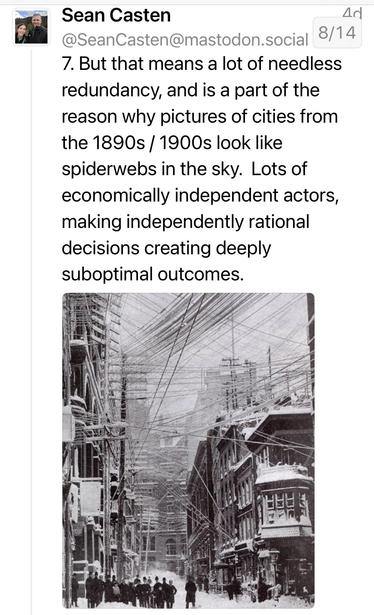
@randahl Apparently this is what it looked like in the past when there were different electricity suppliers in the cities:

@randahl @GRA3432

The Austrian postal service offers a scheme where your deliveries by everyone else get sent to them and they are the only service making the final mile delivery to your doorstep. Which sounded like an interesting idea in principle, but then they defeat the whole purpose by limiting the scheme to some ridiculously low number of parcels per month (think single digits), so in practice you would gain exactly nothing, as you still have to deal with all the companies and on top with some parcels that are diverted.

@randahl I recently said the same thing — while we were in the midst of a postal strike… which was co-incident with a factory manufacturing electric delivery vehicles suspending manufacturing…

Regulate and unionize all delivery drivers, then mandate EV’s to keep the plant running… raise the standard of living for delivery drivers, minimize emissions from 5x old diesel trucks all criss-crossing the same neighbourhood and idling, support electrification, and keep manufacturing jobs going.

Nope, we’ve got to make everything worse, for everyone, everywhere.

@randahl to properly regulate capitalism struck checks on corruption and any money in politics punished by execution.
Nationalise everything.
Universal basic income of £500 a week, all companies nationalised or they’d just stop paying people to work.
Then a max of 10x the minimum wage for those of exceptional worth.
Free housing, free food and mass graves for the people dropping dead at this suggestion.