 Steve Lieber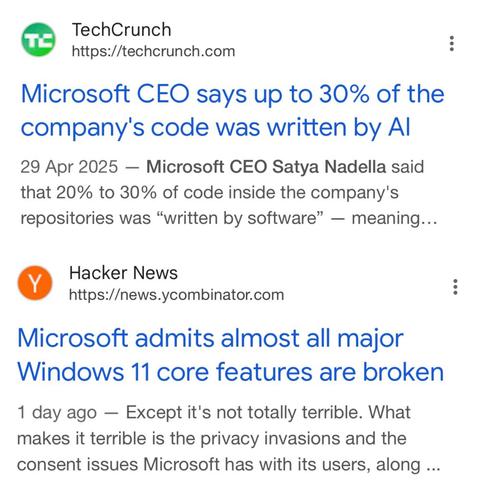
 r-hold
@stevelieber wasn't there a single human involved in that 30%?
What does that even mean?
No one wrote a promt?
Nobody checked the code?
There was no correction or altering the code after generation?
@stevelieber wasn't there a single human involved in that 30%?
What does that even mean?
No one wrote a promt?
Nobody checked the code?
There was no correction or altering the code after generation?
@rhold @stevelieber ai "boom" isn't even real you tools, it's practically a fraud bubble to the tune of 610+ billion banking on bros like you 😂😂😂
@rhold @stevelieber I don't see any of those assumptions. Nor really a direct correlation between the use of the AI and the rate of rot in the Windows codebase.
However, the implication is that AI can generate subtle bugs faster than human engineers can track them down and correct them.
Even with purely human generated code, the majority of human reviewers do not do a deep dive looking to fully understand code. The best you get is a two minute read through of changes that took two days to make, and a "LGTM 👍".
Perhaps we're doing this wrong; keep humans for writing code, and use AI for doing the boring difficult bit - looking for bugs. Combine that with language constructs that indicate intent, and I think you'll have a winning combination.
 Alexey Skobkin
 snakespeare
 Jonathan Downie
 OtterCynical
 Abram Kedge🏴🇨🇦
 CrashLogger